Mercedes didn’t win the British Grand Prix by being the fastest car in clean air. It won it by reading the ending correctly — and, crucially, by being willing to look a bit daft if it went wrong.
George Russell’s call to stay out when most of the front runners dived for fresh tyres under the late Safety Car was the kind of decision that tends to get judged brutally in hindsight. At Silverstone, it aged beautifully because the race never really restarted.
The decisive moment came when Max Verstappen spun into Stowe, losing the rear of his Red Bull and parking the whole thing in the gravel. With four laps left, it had all the ingredients of a late shootout: the field stacked up, tyre life suddenly decisive, and strategists scrambling to calculate whether track position was worth more than grip.
Ferrari blinked first. Charles Leclerc pitted from the lead, and Lewis Hamilton followed suit from second. Leclerc still emerged in P1, but Hamilton didn’t — he filtered back out behind Russell, who’d rolled the dice on staying put and keeping the road.
It was the sort of on-the-fly split that teams dream of having available: one car plays defence with position, the other attacks with tyre advantage. Except in this case the “attack” never arrived, because the Safety Car stayed out to the flag, leaving Hamilton bottled up and Russell sitting pretty.
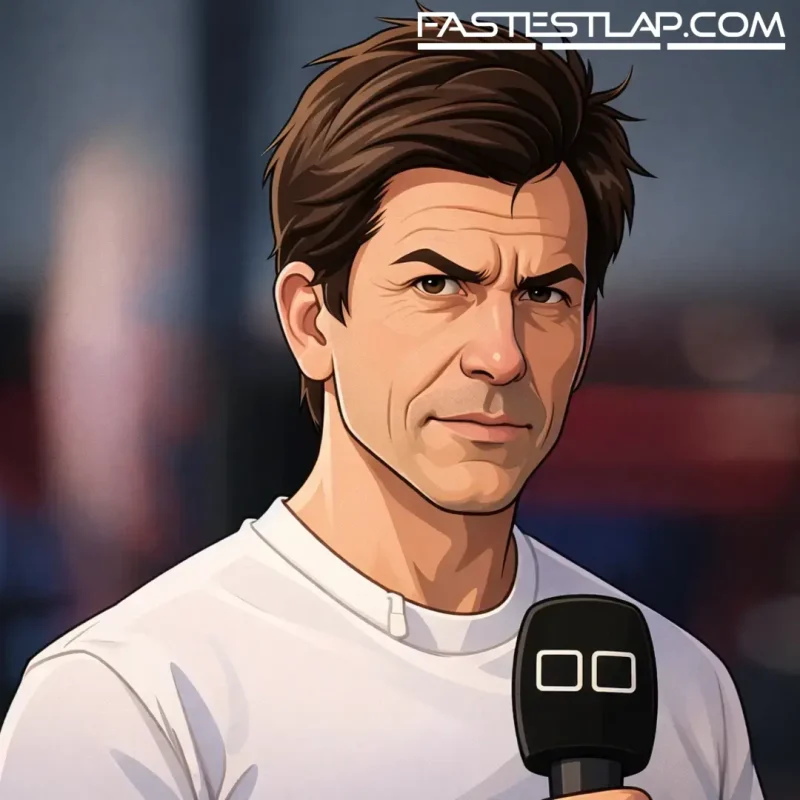
Toto Wolff, never one to miss a line that cuts through the tension, couldn’t resist pointing out there was another occasion a Safety Car finish might have suited him more.
“I would have preferred for this to happen in ‘21, that was more important,” Wolff said afterwards. But the point he kept returning to wasn’t nostalgia — it was process. Mercedes made its call. Race Control made theirs. And for Wolff, the sport has to live with that even when the optics are ugly.
“Sometimes it doesn’t give for the most exciting final, certainly from a spectacle standpoint,” he said. “Everybody would have loved to see Lewis on a soft against us, and maybe fighting with Leclerc, but this is a sport.
“Show follows sport and not the other way around, so it’s good that FIA made that call.”
That’s the sharp edge of modern F1: teams are paid to be ruthless about outcomes, while everyone else is left arguing about entertainment. Russell’s “gutsy” stay-out looks inspired because the race ended behind Bernd Mayländer’s Mercedes. If the Safety Car had peeled in and the pack had been released with one lap to go, he’d likely have been a sitting duck against newer tyres — potentially dropping the win and wearing the blame for weeks.
What made the end at Silverstone even messier was the messaging. Fans in the grandstands — and plenty watching at home — briefly thought they’d been promised a restart when the “Safety Car in this lap” message appeared. It didn’t happen.
The FIA later attributed that to a “software error”, stressing that the rules were followed. Under the Safety Car procedure, once the unlapping process is executed, one additional lap must be completed — and, with Silverstone’s lap length, that can swallow the remaining race distance quickly when you’re late enough in the window.
“The ‘Safety Car In This Lap’ message was displayed erroneously due to a software error,” the FIA said.
Even in a paddock that’s learnt to live with constant communication noise — radio snippets, timing graphics, automated alerts — that sort of slip matters because it changes expectations. It turns “this might end under Safety Car” into “we’re definitely going racing again,” and the difference is the difference between disappointment and outrage.
Martin Brundle, on commentary duties, was unimpressed and went further than a simple complaint about software. He questioned whether the underlying rule still does what it was intended to do, particularly on long circuits where the unlapping shuffle can take an age.
“Whatever the regulations say, it’s not right,” Brundle argued, pointing out venues like Spa where the delay can feel interminable. In his view, the system that was designed to prevent backmarkers interfering with a late sprint can end up killing the sprint altogether.
That tension won’t go away. The FIA can point to the rulebook — and, in this case, an administrative glitch alongside it — but the political pressure tends to follow the spectacle, not the legality. When a grand prix ends in formation, there’s always a chorus calling for tweaks, and it’ll only get louder when a championship fight is on the line.
For Mercedes, though, the takeaway is more practical than philosophical. Russell’s win was built on a willingness to back himself and a pit wall comfortable making an unpopular call in real time. Hamilton’s race, meanwhile, became collateral in a split-strategy scenario that was perfectly defensible on paper and maddening in outcome.
Silverstone didn’t deliver the last-lap knife fight plenty wanted. But it did deliver something else F1 never stops producing: a reminder that, in the biggest moments, the rulebook, the software and a single strategic gamble can decide who gets to spray the champagne.