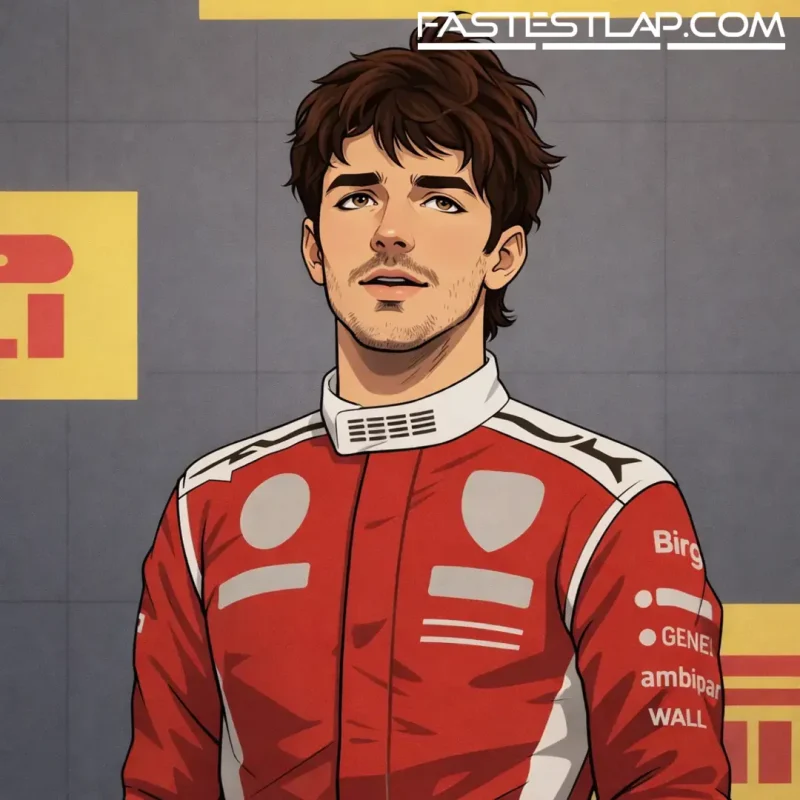
Ferrari didn’t just win at Silverstone — it changed the temperature around Charles Leclerc.
A first victory since the 2024 United States Grand Prix should’ve been a straightforward “finally” moment, but Leclerc’s post-race mood hinted at something more pointed. He talked about “narratives being created” and “a lot of negativity” in the build-up, the sort of background noise that tends to follow a top driver when the points column doesn’t match the expectation.
And the timing matters. Leclerc arrived in Britain having been outscored by Lewis Hamilton across the previous five races, with the standings reflecting it: fourth overall, 39 points behind his team-mate and only 11 clear of Lando Norris. In other words, still very much in the fight — but with the internal pressure at Ferrari no longer theoretical.
Silverstone, though, offered Leclerc the kind of weekend that resets things quickly in this sport.
The race turned on the phase Ferrari has quietly been making a habit of winning: the launch. Leclerc and Hamilton both got away sharply and surged past pole-sitter Kimi Antonelli, immediately flipping the complexion of the Grand Prix. For Hamilton, the early climb didn’t translate into control of the race — he dropped to third on lap 11 — but Leclerc settled into the sort of first stint that makes strategists sleep better at night.
Antonelli briefly regained track position on lap 25, but Leclerc responded when it mattered, retaking the lead on lap 36. From there, the door never reopened. Issues on Antonelli’s W17 meant any late-race squeeze simply didn’t come, and Leclerc managed the closing stages without the frantic, defensive edge that can make a win feel like survival.
What will resonate inside Ferrari isn’t just the final margin, but how Leclerc described the drive. There was a calmness to it — a driver who knew what he had, and how to keep it.
“After that, I just tried to manage my tyres, focus on the feeling I had with the car from qualifying,” he explained. “I knew what to do inside the car, I knew what to change in terms of tools that I have on my steering wheel.”
That’s the key line. Not the lap numbers, not the “we got lucky” acknowledgement he added later. He’s talking about operating from instinct again — that sense of being ahead of the car rather than hanging on to it.
And it’s hard not to read the start as symbolic. Ferrari’s launches have been strong, but Leclerc’s wasn’t even close to clean in the sprint, where he fell from P4 to P7 by the end of the opening lap. It clearly stung enough to become a Sunday priority.
“We had a very strong start, which wasn’t a given because yesterday the start was very poor,” Leclerc said. “So that was a point of focus.”
In a season where fine margins are shaping entire narratives — including the one Leclerc says he’s been fighting off — these details become ammunition. The sprint start was a problem. The Grand Prix start was a statement. Same car, same track, different execution. That’s a driver-and-team response, not just a car being quick.
Leclerc didn’t pretend Silverstone has solved everything. He called it “only a first step” and admitted he needs to show it “on multiple track layouts.” But he also made an important point about why this one matters: confidence. Silverstone rewards commitment, and commitment doesn’t come if you don’t trust the front end, the rear stability, the balance in quick changes of direction. If the feeling isn’t there, it shows — brutally.
“On such a track where confidence is key, I wouldn’t have been able to do that without the feeling,” he said. “So that’s really good.”
Ferrari will take the win, of course. But it’s the internal consequence that’s more intriguing. With Hamilton leading Leclerc by 39 points, the team dynamic had started to look one-directional on paper. A race like this doesn’t flip the standings, but it does something teams feel immediately: it restores leverage. It gives Leclerc a platform to push back — not with words, but with a Sunday that forces everyone to recalibrate.
He did concede Antonelli’s late trouble helped seal it. “It was going to be tricky with Kimi at the end, so we’ve been a little bit lucky on that,” Leclerc said. “But we also need that sometimes.”
Maybe. But luck doesn’t explain a driver leading twice, reacting when he needed to, and sounding, at the end of it all, like someone who’s had enough of being discussed as a problem to be solved.
At Silverstone, Leclerc didn’t just end a drought. He reminded the paddock — and perhaps a few corners of the internet — that the quickest way to kill a narrative is to win a Grand Prix.