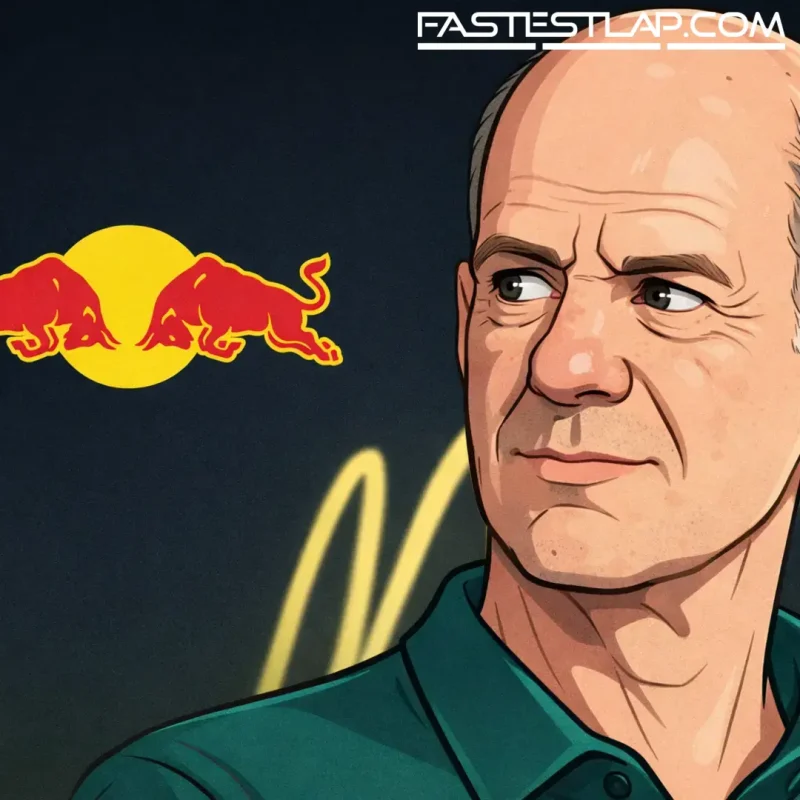
Adrian Newey has never been one for paddock small talk. When he turns up, he’s usually there to look at something — properly look at it — and Silverstone last weekend offered a familiar sight: the Aston Martin team principal lingering on the grid with his eyes fixed on other people’s machinery.
This time, the object of his attention was unmistakably close to home. Photographers caught Newey studying Red Bull’s RB22, specifically the car raced by Isack Hadjar, as it was manoeuvred into position before the British Grand Prix. Not long earlier, he’d also been seen giving Charles Leclerc’s Ferrari SF-26 the same quiet, forensic once-over — the sort that’s less “curious glance” and more “filing detail away for later”.
None of this is unusual behaviour for Newey. It’s the habit of a designer who’s made a career out of noticing what others miss, and who still seems more comfortable reading surfaces, joints and packaging choices than offering soundbites. Even with a new badge on his pass, the instinct hasn’t changed: walk the grid, look closely, and learn.
What does land a little sharper is the context. Newey’s relationship with Red Bull is recent history, not some sepia-toned memory. He swapped Milton Keynes for Silverstone in 2024 and completed his move in March 2025 after nearly two decades at Red Bull, a period that spanned title runs with Sebastian Vettel and Max Verstappen and turned his design philosophy into a competitive north star. Seeing him lean in towards the RB22 now, as Aston Martin’s boss, is exactly the kind of paddock image that carries subtext without anyone needing to say a word.
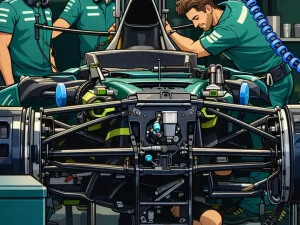
It also underlines how hands-on his 2026 has been. Silverstone was Newey’s third paddock visit of the season after appearances in Australia and Monaco — a selective schedule, but one that keeps him close enough to the sharp end of development trends. The grid remains the best open-air showroom Formula 1 offers: cars exposed, bodywork off in places, mechanics working, solutions visible for anyone patient enough to spot them.
Ferrari’s SF-26, meanwhile, gave Newey another timely reference point. Leclerc went on to win the British Grand Prix, his first victory since the 2024 United States Grand Prix, and it’s hard to imagine a more useful benchmark for a rival technical leader than the car that’s just converted form into a trophy. Newey’s glance at the Ferrari didn’t look like admiration; it looked like professional curiosity — where have they put the mass, what have they prioritised, what’s the “tell” that explains the lap time?
For Aston Martin, the weekend itself offered far less to admire. Lance Stroll and Fernando Alonso qualified on the last row for the fourth event in a row, which is the sort of pattern that stops being “unlucky run” and starts becoming a genuine competitive crisis. Race day didn’t calm things down either: Stroll collected three five-second penalties after a flurry of track limits infringements — three strikes in nine laps, then further breaches to leave him with six in total. Under the rules, the punishment escalates quickly once you’ve used up your allowance, and Stroll found that line the hard way.
It all fed into the sense that Aston Martin’s season is currently being measured less in points than in how quickly the team can turn its underlying concept into something workable. That’s where the next phase of this story gets interesting, because Silverstone wasn’t just a weekend of damage limitation — it was effectively a holding pattern before a significant technical swing.
Aston Martin is set to bring a major upgrade package to the Hungarian Grand Prix later this month, and Newey has already framed it in unusually direct terms. The headline is weight: the AMR26 is set to receive a lighter chassis and gearbox architecture as part of a push to reduce mass, with knock-on changes including revisions to the rear suspension, the nose and aerodynamic surfaces. Newey has described it as a “large step” in performance — language that, coming from him, tends not to be thrown around casually.
There’s a broader implication here that goes beyond any one component. In 2026, with teams still feeling their way through different interpretations and compromises, weight is performance you carry into every corner, every braking zone, every traction phase. If Aston Martin believes it can claw back a meaningful chunk through architecture and packaging rather than just bolt-on aero, it’s a sign the team thinks the core car has been holding it back more than its surface-level setup.
That also explains why Newey’s grid stroll mattered. When you’re about to introduce a new chassis and gearbox philosophy — and when you’re chasing solutions at the sharp end — there’s value in re-calibrating your eye against what’s working elsewhere. Red Bull’s details are relevant because of Newey’s history and because he’ll know exactly which choices are “legacy” and which are new direction. Ferrari’s are relevant because Leclerc just proved, on that day, that their total package could win.
Silverstone, then, served up a neat snapshot of Aston Martin’s current reality: a heavyweight of the technical game literally weighing up the opposition, while his own cars languished at the back and his drivers wrestled with the fine print of track limits. The next time Newey’s seen on a grid, the questions might be less about what he’s looking at — and more about whether the thing he’s built has finally given him something worth defending.