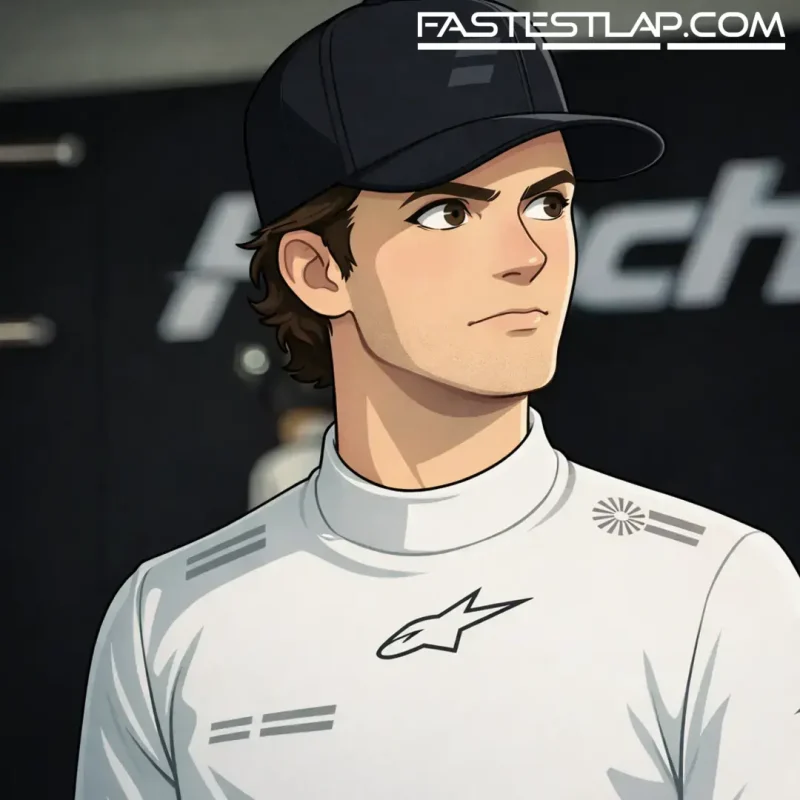
Colton Herta isn’t hiding behind the usual rookie-season excuses. Halfway through his first Formula 2 campaign, the American has delivered his own blunt verdict: it hasn’t been good enough — and that matters when you’re trying to talk your way into a future Formula 1 seat with a works project that’s still shaping its driver plan.
“I wouldn’t grade my season so far very highly at all,” Herta admitted in Hungary, where he’s set to pull double duty: another Friday run in Cadillac’s MAC-26 for FP1, then back into the F2 paddock for the final round before the summer break. “It’s been disappointing from that side of things. But I just need to continue to improve and make the small steps.”
The problem for Herta is that 2026 was meant to be a statement year. He walked away from an established IndyCar career to put Super Licence points and European single-seater credibility on the board. Instead, he arrives at Budapest 17th in the F2 standings on 20 points — 10 behind Hitech team-mate Ritomo Miyata — and carrying a five-race scoreless run that has dulled the shine from flashes like fifth in the Barcelona sprint.
Cadillac, for its part, hasn’t locked anything in. Herta says there’s been no conversation yet about his role next season, or whether the team will add more FP1 appearances to bolster his Super Licence tally. “No, we haven’t talked about next year yet,” he said. “My next FP1 will be in Budapest, so I can say that. But the two following, I think, are still being decided on, depending on multiple factors from the team.”
That’s a telling line: “multiple factors” is paddock-speak for performance, logistics, and internal priorities all tugging in different directions. Herta knows he’s effectively auditioning in two theatres at once — one in an F2 car that’s been an awkward fit, the other in an F1 car that, ironically, feels more familiar.
Ask Herta where the F2 machine rewards what he brings from the United States, and he doesn’t bother dressing it up. “Rewards-wise, probably nowhere,” he said, before explaining why the transition has been so jarring. “The Indy car is very different… the way that you drive and how aggressive you can be with your inputs and multiple inputs, is very different to… specifically the F2 car.
“I would say the F2 car kind of stands alone in its driving style and what it needs, especially compared to the F1.”
In Herta’s view, the F2 car punishes forcefulness. He likened it to a GT car — a machine you can’t bully without paying for it on lap time. That’s more than just colourful analogy; it’s a window into why his weekends have too often started on the back foot. He’s been clear that qualifying is the weak point, and in F2 that tends to set your entire narrative before the first lap of the first race.
“Obviously, as a racing driver, I want to compete for wins, poles, and podiums,” he said. “We’ve been close, but for the most part, qualifying has been the Achilles’ heel… If we can sort that out, our race pace has been much better than our qualifying pace.”
There’s a technical layer to it, too, and Herta points straight at the tyres — not as a catch-all scapegoat, but as a variable that amplifies small mistakes. The Pirelli compounds in F2 demand a kind of precision and restraint that doesn’t come naturally when you’ve built habits around a different style of car.
“It’s not extremely clear every time. It’s not like one shoe fits all at the moment,” he said. “Each track is a little bit different… the tyres are a lot more sensitive… any bad thing that you do to them, you kind of get hurt by it really quickly.
“It’s a very, very different tyre, and to learn it just takes time. That’s part of it, but not the whole equation on what I need to work on.”
What will perk up Cadillac’s decision-makers is the other half of Herta’s assessment: he believes Formula 1 machinery plays closer to his instincts than Formula 2 does. That’s a bold claim, but it isn’t hard to see why he’s leaning into it. FP1 outings are limited, the team’s long-term planning is still fluid, and Herta needs to make those sessions count not just as mileage, but as evidence that his ceiling is higher than his F2 position suggests.
“The good thing is I think in Formula 1 there is a lot more similarities,” he said, contrasting the way an F1 car — like an IndyCar — allows a driver to be more assertive with inputs and attitude.
Still, he’s not pretending IndyCar experience is useless in the junior formula. If anything, it has made him dangerous in the messy parts of a race weekend. “I think where it can help is maybe race experience,” he said. “We seem to be very strong compared to most on the starts and first laps. But we also qualify near the back, so that helps… Hard to move rearwards from there.”
That laugh lands because it’s true — and because it underlines the reality of his season. The raw ingredients are there: racecraft, adaptability, and enough self-awareness to know what’s holding him back. But this is the phase where excuses get expensive.
Budapest, then, isn’t just another stop before the summer shutdown. It’s a chance for Herta to reset the storyline: to show progress in the one-lap work that’s defined his F2 struggles, and to make an impression in Cadillac’s Friday programme while the team weighs what “next year” looks like — for him and for everyone else in a driver market that never waits politely.