
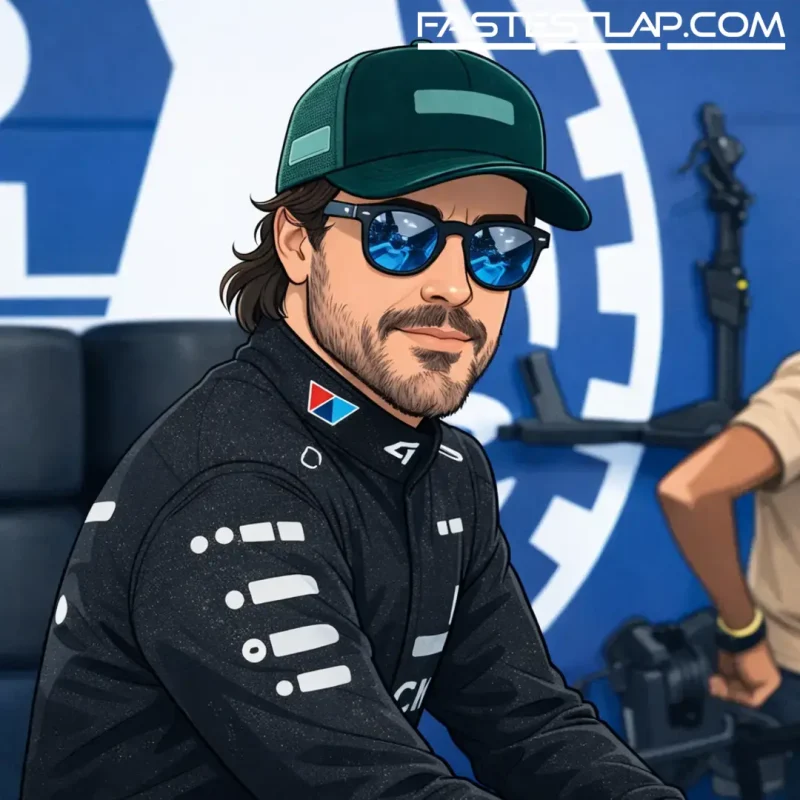
Fernando Alonso was barely out of the pitlane on Sunday when Silverstone served up a familiar kind of frustration: the Aston Martin simply switched itself off halfway through the formation lap.
From the outside it looked like one of those modern F1 failures that are almost too clean to be dramatic — no smoke, no bang, just a car that becomes a very expensive piece of static. Alonso, starting a lowly P21 anyway, tried the obvious fix: cycle it, restart it, get it going. He did, and the car then ran without further incident for the rest of the race. But the damage was done. Because the stoppage happened on the way to the grid, Alonso was forced into a pitlane start.
When he emerged, the day was never going to be about points. He eventually came home 18th, helped along by retirements behind him, and spent most of the afternoon doing what backmarkers do when the race is out of reach: running laps, collecting information, and trying to turn a grim weekend into something the factory can use.
And that, more than the final classification, is what made Aston Martin’s post-race mood so sour. Alonso didn’t have an answer for the shut-down when he faced the media.
“I have no answer from the formation [lap], the car shut off by itself,” he said. “So then I tried to restart the engine, and everything was fine from that moment.
“[I was just] gathering data for the team, hopefully they see something on the data that can help the development of the car, and we drive as fast we can.”
The more worrying detail for Aston Martin was that the mystery didn’t clear once the helmets were off and the laptops opened. Chief Trackside Officer Mike Krack admitted the team still couldn’t explain why it happened, even after the initial debrief.
“The honest answer is, we don’t know,” Krack said. “The car shut down, and we need to look completely in the data, where is it from?
“Because there could be a lot of possibilities from the ECU, the chassis side, the energy side. We were just in the debrief. We wait for the data, and then we can say something.”
In 2026, that list of “possibilities” is precisely the point. Cars don’t just fail mechanically anymore; they can be undone by an electronic decision, an energy-management edge case, a sensor reading that crosses a threshold at exactly the wrong moment. The fact Alonso could restart and then run trouble-free only sharpens the suspicion that this wasn’t a simple hardware failure — but that’s exactly the kind of conclusion teams resist until the data is properly trawled, because “intermittent” is the nastiest word in engineering.
For Alonso, it was also another example of how little margin there is for a team that’s not currently living at the sharp end. Starting P21 is already damage limitation. Starting from the pitlane after a formation-lap shutdown is the kind of needless complication that strips any remaining value from the opening stint and turns the race into a long test session.
And if that all felt very 2026, Alonso made sure to underline another theme of the season when he reflected on the racing itself. His gripe wasn’t with Silverstone, but with how overtaking is increasingly shaped by energy states rather than risk and improvisation.
“It depends what the fans and the sport wants today,” Alonso said. “You saw it in the sprint, people overtaking in the middle of the straight with more battery, so there is not any driver input or driver talent needed to overtake a car in front of you.
“You don’t need to outbrake anyone, you don’t need to overtake on the outside, you don’t need to take any risk, and just press one button and you overtake if you have a better power unit than the car in front.”
It’s a pointed complaint, and it lands differently coming from Alonso than it might from someone who benefits from the system. He’s never been shy about calling out the sport’s direction when he thinks it’s drifting away from what drivers are supposed to do. But it also reads like a driver who, after a weekend spent at the wrong end of the grid and then tripped up by a bizarre pre-race failure, is watching others race with tools he can’t consistently access.
Aston Martin’s immediate priority is far more basic: work out why a car can shut down on a formation lap, then behave perfectly once restarted. Krack was clear that the team needs to dig into the data before drawing any conclusions, with potential causes spanning everything from ECU to chassis systems to the energy side.
That’s the uncomfortable part. When you don’t know whether the weakness is in the control electronics, integration, or energy deployment, you’re not just chasing a one-off glitch — you’re questioning the reliability of the entire chain.
Alonso got his laps. The team got its data. But at Silverstone, Aston Martin left with the sort of unanswered question that keeps engineers awake, and the sort of racing Alonso increasingly sounds tired of watching from the midfield.









