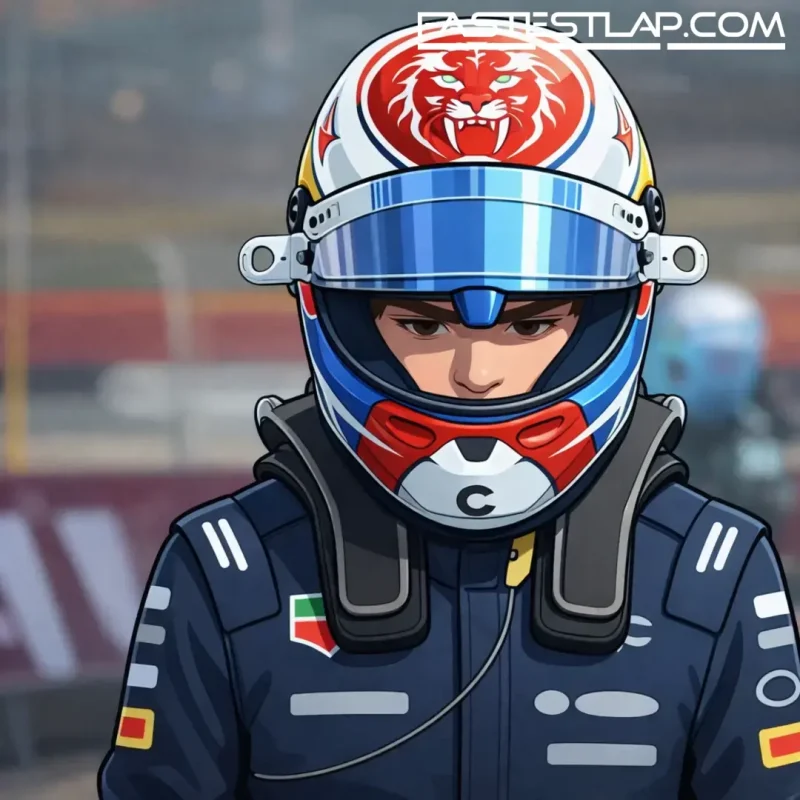
Max Verstappen didn’t need a debrief to tell him how close he’d come at Silverstone. The moment the rear stepped out through Stowe and the RB22 speared off into the gravel, the podium he’d been shaping up for was gone — and the bigger worry returned with it: this was the second high-speed failure in two races.
After climbing out, Verstappen didn’t dress it up. He said he was “fed up”, not with a scrappy weekend or a missed set-up call, but with a car that’s now twice put him in the passenger seat at the sort of corners where you don’t get much say in the outcome.
“When it happens one time, that can happen, faults happen,” Verstappen said. “Two times, it’s getting very dangerous for me because you can really hurt yourself at these high-speed corners when it happens. I was lucky in Austria, I was lucky here, but that’s why you get really fed up with it.”
Red Bull team principal Laurent Mekies didn’t try to dilute that frustration either. If anything, he amplified it — and that’s telling in itself, because teams typically want to frame these moments as unfortunate anomalies rather than a pattern.
“He’s right not to be happy,” Mekies said. “It is very unpleasant for drivers to be let down by the car in the high-speed corners in two consecutive races.
“It is also extremely unpleasant for us as a group to send our drivers to the gravel trap, so he’s right to be unhappy. I have no doubt that as a team we will put in place what is necessary for that not to happen again, even if we fail to do that today, and we take that as seriously as one can do, and therefore the minimum that Max can feel today is being unhappy.”
In Verstappen’s case, the default assumption in the paddock is always that if he loses it at a place like Stowe, you start by checking the car before you even finish the sentence about driver error. That held true again: Red Bull identified a fault with the rear wing system, which failed to fully close on the approach to the corner. That detail matters because it places the incident firmly in the category Verstappen is most allergic to — unpredictable aero behaviour arriving without warning at very high speed.
And it also drags Silverstone into the shadow of Austria, where Verstappen had a qualifying crash that, in broad terms, looked uncomfortably similar. You don’t need to spell out the consequences for driver confidence when a car’s rear stability can be undermined by a mechanism not doing what it’s told. Drivers will always accept that you can be beaten, out-strategised, or caught by a gust. Being “let down”, as Mekies put it, is different. It’s the stuff that lingers.
Mekies said Red Bull understands what happened this time, but kept the specifics behind the garage door. He did, however, hint at an important nuance: the failure mechanism at Silverstone was not the same as the one they dealt with previously. That’s simultaneously reassuring and unsettling. Reassuring because it implies Red Bull isn’t simply watching the same part fail again; unsettling because it suggests the team has had two separate problems reach the same dangerous end-point.
“I’m not going to go into the details, because I don’t think it will be right, but we understand the failure,” Mekies said. “From the early analysis today, we have suffered a different type of failure. It doesn’t make it better, but it is clear that in front of the succession of events, whether or not the failure is different doesn’t really matter.
“We are going to review the full area to make sure we leave zero chance for that to happen again.”
“Zero chance” is the kind of phrase you don’t hear often from a team principal unless they know the optics are bad — and, more importantly, unless they know the risk profile is unacceptable. At high-speed corners, reliability stops being a points conversation and becomes a duty-of-care one, and Verstappen’s comments made it clear he’s not prepared to normalise it.
It also changes the tone inside Red Bull. Mekies has been in the job for nearly a year, and this is the sort of moment where a team principal’s role becomes less about defending the brand and more about reassuring the one person whose buy-in you can’t afford to lose. Backing Verstappen publicly is the easy part; delivering a fix that restores trust is harder, especially when the team is now dealing with consecutive race weekends where the car has bitten back without the usual warning signs.
For Verstappen, the sting at Silverstone wasn’t just the gravel trap or the lost podium. It was the feeling of going into corners like Stowe knowing the car should be planted — and discovering, twice in quick succession, that “should” isn’t good enough.