Max Verstappen didn’t just lose a British Grand Prix on Sunday — he lost patience.
Red Bull left Silverstone facing an awkward, increasingly serious question about its “Macarena” rear wing concept after Verstappen suffered a second high-speed spin in two race weekends, again tied to the behaviour of the rotating element used in straight-line mode zones. Verstappen was blunt about the implications, calling it “super dangerous” after his RB22 snapped into a spin on corner entry when the wing failed to reattach properly.
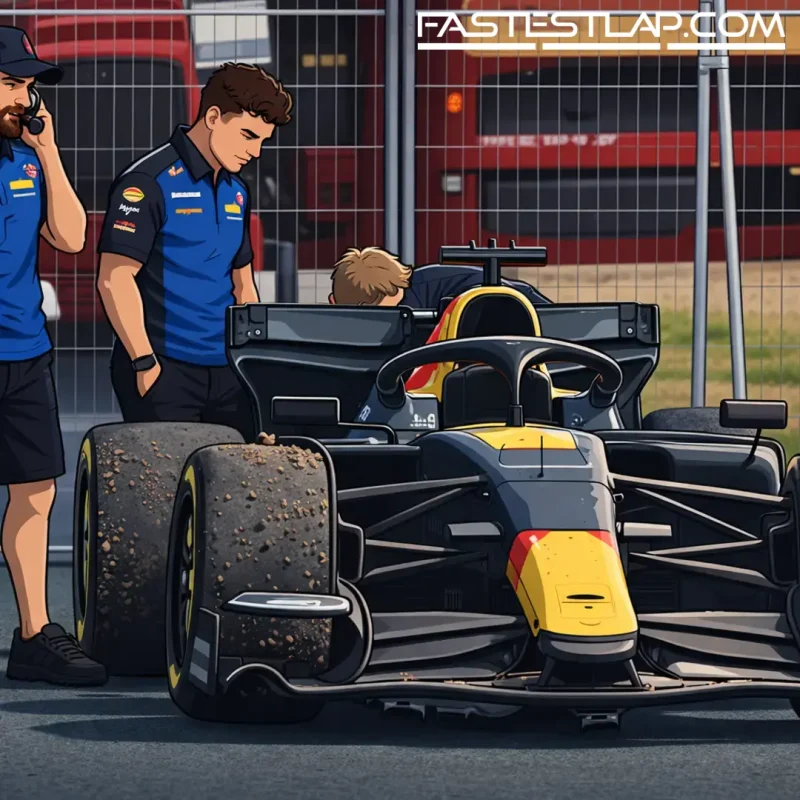
It happened as he turned into Stowe. Verstappen, suddenly robbed of rear downforce, was a passenger as the car rotated and slid into the gravel before becoming beached. The gravel did its job in trimming speed, but not enough to prevent a heavy hit; the left-hand side of the Red Bull took the impact.
The tone in the aftermath was telling. Verstappen wasn’t hunting for marginal gains or venting about bad luck — he was outlining a safety concern, and doing it with the frustration of someone who feels he’s been put in the same position twice.
“Like Austria, a different fault but the same outcome,” Verstappen said. “So, again, while turning into the corner, the rear wing is not fully attaching and you lose a lot of downforce for that.
“At that point, it’s super dangerous because you can really hurt yourself two times. I was lucky in Austria, I was lucky here, but that’s why you get really fed up with it.”
The Austrian reference matters. Just eight days earlier, Verstappen spun as he entered Turn 9 during qualifying for the Austrian Grand Prix — a separate incident, but one that’s now impossible to treat as isolated. Two high-speed moments, two weekends, and one common thread: the rear wing not doing what the driver expects at the exact moment commitment is highest.
In modern F1, that’s about as unacceptable a failure mode as you can design into a car. Drivers can live with understeer, tyre drop-off, even an occasional system glitch — but unpredictable aero state changes at corner entry are in a different category entirely. When Verstappen talks about “really hurt yourself”, it isn’t hyperbole. It’s the clearest sign yet that Red Bull’s internal threshold for risk has been met, possibly exceeded.
Team principal Laurent Mekies struck the cautious-but-firm note Red Bull needed. Publicly, he didn’t offer excuses or attempt to downplay the incident as a one-off sensor issue. Instead, he committed the team to a full analysis and made it clear nothing is off the table — including the possibility that the concept itself needs rethinking.
“The answer is that we will do whatever is necessary to be on the safe side,” Mekies said. “We have raced quite a few races with that concept. We have raced it since Miami, I think. So, it’s been a number of races.
“It’s too early in the analysis to establish whether it’s an issue with the concept or something else. But we are going to for sure leave no stone unturned when it comes to it, and we have all the options open.”
That last line — “all the options open” — is as close as you’ll get to a warning shot from a team that normally backs its technical ideas to the hilt. Red Bull has put mileage on the Macarena wing since Miami. It’s not an untested prototype thrown on for a Friday. Which is why this is now a bigger headache than simply swapping a component and moving on.
Mekies added that the team can already see from the data what triggered the crash in the first place — confirmation that the wing “didn’t close properly”. But he stressed the Silverstone problem isn’t a carbon copy of Austria, even if the consequence was identical.
“We can certainly see from the data the fact that the wing didn’t close properly,” he said, “and this is why we were able to tell you guys what happened before.
“So that’s what we can see today. The car is just back now, and we are only able to say that it’s a different type of issues compared to last week, but it doesn’t make it better.”
That’s the chilling part for Red Bull: two failures, two different causes, same end result — a car that can go from planted to pointless in the blink of an eye. If it’s a single root cause, you can box it, solve it, validate it. If it’s a broader sensitivity in how the system behaves across operating conditions — or a tolerance stack that occasionally leaves it not quite latched — then the fix gets messier fast.
And while Mekies’ language was measured, Verstappen’s wasn’t. The four-time world champion sounded like a driver who believes the team has pushed its luck, and who expects the next step to be decisive rather than investigative. When he says he’s “fed up”, that’s not just about losing results — it’s about trust in the car beneath him.
Red Bull now has to respond on two fronts. First, the immediate one: prove this won’t happen again, because “we’ll look at it” doesn’t cut much ice when the failure mode is a high-speed spin. Second, the political one inside the team: the balance between innovation and robustness. Every squad wants clever concepts; none can afford the perception that a performance idea is flirting with driver safety.
Silverstone should’ve been a weekend of damage limitation at worst. Instead, it’s turned into a scrutiny test for one of Red Bull’s more eye-catching developments — and a reminder that in 2026’s ultra-sensitive aero world, the clever stuff only counts if it’s predictable when it matters most.