Max Verstappen wasn’t in the mood to feed the circus at Silverstone, and you could hardly blame him.
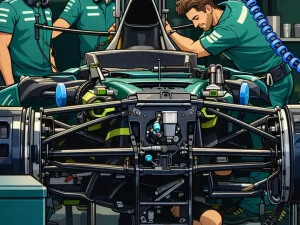
A British Grand Prix that already felt like another weekend of Red Bull operating on the edge ended with the kind of failure that leaves drivers looking over their shoulder at their own machinery. Verstappen’s race unravelled late on when his Macarena rear wing didn’t reattach properly after a straight-line mode zone, pitching him into a spin on lap 48 of 52 and sending him into retirement. His verdict was blunt: “super dangerous”.
That alone would’ve been enough to sour anyone’s Sunday. But the bigger story hanging over the paddock is that Verstappen now sits in the exact kind of championship position that, according to widespread reporting, gives him the contractual leverage to walk away.
The details doing the rounds are simple: an exit clause understood to be tied to him being outside the top two in the standings at the summer break. After Silverstone, he’s seventh, 78 points down, with a maximum of 50 left on the table before the break. If those numbers are the trigger, the trigger is live.
Asked directly about his future, Verstappen shut it down.
“I’m not going to say anything about that,” he said to assembled media. “It’s not fair to say anything about that also right now.”
That’s not a denial, and it’s not an admission either. It’s what you say when you know anything you add becomes a headline — and when you don’t fully trust the situation around you to remain stable week to week.
The irony is that the “contract clause” chatter wouldn’t have the same bite if Red Bull’s on-track direction looked coherent. Instead, Silverstone delivered another snapshot of a team and driver no longer moving in lockstep.
After qualifying, Verstappen wanted changes significant enough that he suggested starting from the pit lane. Red Bull said no. He qualified eight-tenths off pole, and when asked why the team hadn’t taken his preferred route, his answer landed with the weight of someone who’d seen this movie too many times.
“I don’t know. I mean, I wanted to start from the pitlane. They were maybe confident to fix it,” he said. “I was not.”
Those last three words are the uncomfortable bit for Red Bull. The relationship that carried them through four straight titles from 2021 to 2024 was built on ruthless execution and, crucially, a shared belief that whatever the team decided would be the right call. When the driver is openly expressing a lack of confidence in the plan before the race has even begun, the problem isn’t just pace — it’s trust.
Red Bull’s slide hasn’t come out of nowhere. The team has been trending the wrong way since early 2024, a period that was messy in public and, by all accounts, wearing in private. Verstappen’s camp — with his father Jos still a vocal presence — warned back then that the foundations were starting to crack. The subsequent results have only made that warning look less like rhetoric and more like forecasting.
McLaren took the Constructors’ title in 2024. Verstappen lost the Drivers’ championship in 2025. And in 2026, nine grands prix in, he’s managed two podium finishes. For a driver used to measuring weekends in wins, that’s not a slump — it’s a different reality.
So when Verstappen was asked whether Red Bull’s struggles were straining the relationship, he didn’t dress it up.
“It would be a very zen person to be optimistic at the moment with what happened again this weekend,” he said. “I’m sorry, but it’s just like that. I need a few days, I think, to reset and try again.”
There’s something revealing in that choice of words: “again”. Silverstone wasn’t framed as an isolated bad break, but as another entry in a growing list.
In the background, the market is moving — or at least the paddock believes it is. For years, the speculative destination for Verstappen has been Mercedes. Lately, the talk has shifted: McLaren is the name being repeated, and specifically a scenario where Verstappen would replace Oscar Piastri.
Nothing has been confirmed, and it’s worth saying clearly that rumours can run faster than reality in July. But multiple sources in the paddock have suggested McLaren and Verstappen are deep into talks, with the sense that any negotiation of this scale doesn’t reach “closing stages” unless both sides believe the timing is right.
That, ultimately, is what makes the clause talk so potent. It isn’t just a legal mechanism — it’s a pressure point. If Verstappen can activate it, Red Bull can no longer rely on the comfort blanket of “contract until 2028” to make the noise go away. Every operational misstep becomes more expensive. Every internal disagreement becomes more consequential.
And yet, the existence of an exit clause doesn’t automatically mean an exit is coming.
His manager Raymond Vermeulen reiterated to Bild last month that Verstappen is contracted to 2028, acknowledged that exit clauses exist “as they always have”, and stressed they’ve never been used. He also leaned hard into the loyalty line — but with a caveat that matters: Verstappen wants to stay, and even finish his career at Red Bull, “but, of course, with the chance to win.”
That’s the entire debate in one sentence. Verstappen isn’t shopping for a change of scenery. He’s shopping for certainty — the kind Red Bull used to provide by default.
Silverstone, with its refusal to pivot after qualifying and a rear wing failure in race conditions, did the opposite. And when a four-time champion starts sounding like he’s counting the days until he can “reset”, it’s not hard to see why the rest of the grid is listening closely.