BYD has finally taken the heat out of one of the paddock’s more breathless rumours: no, it’s not plotting a rush job into Formula 1, and it’s certainly not interested in turning up as a hollow badge on someone else’s sidepod.
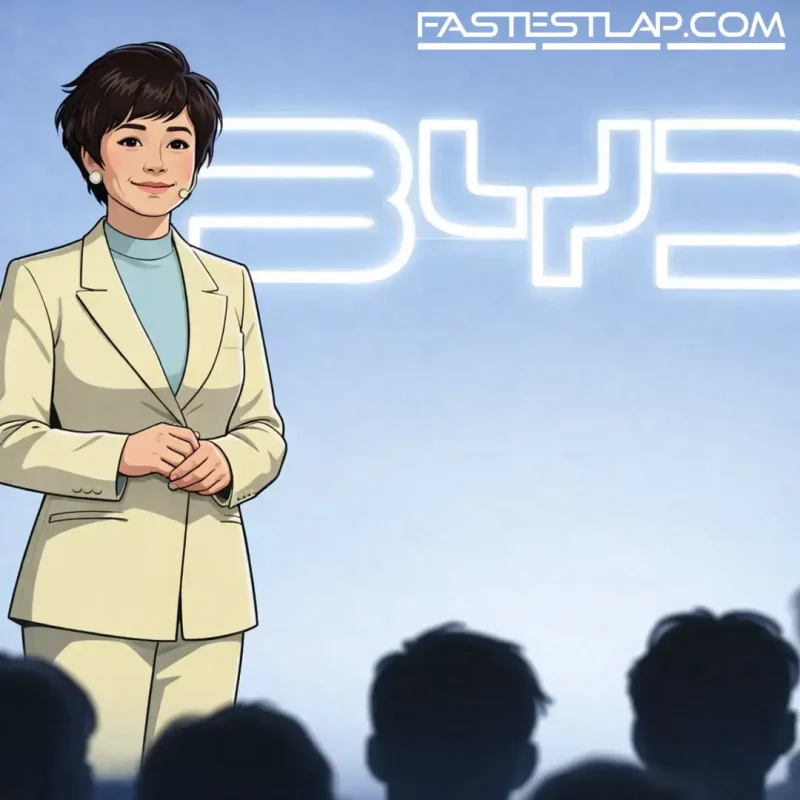
After months of noise around the Chinese EV giant “discussing” F1 involvement, vice-president Stella Li has been careful to frame what those conversations actually are — and, just as importantly, what they aren’t. The company has met with F1 CEO Stefano Domenicali and FIA president Mohammed Ben Sulayem, including in Monaco last month, but the tone from BYD is now unmistakable: if there’s a role, it has to be meaningful and technical.
“I think Formula 1, it’s all pure energy, the emotional connection to the people, and then it’s the culture,” Li said in Monaco. “For BYD, we are a technology leader. We are seeking any opportunity to see if BYD technology can help FIA, can help all other teams.
“Second ambition, as BYD, we also need to build a brand here. So this is the scope.”
That’s a far cry from the idea of BYD arriving as a 12th team any time soon — and it’s also a subtle rebuttal to the cynicism you hear in certain corners of the pitlane. Some senior figures have privately questioned how realistic a BYD entry ever was given its lack of motorsport pedigree and the sheer amount of specialist infrastructure required, no matter how impressive its ability to scale in the road-car world. Others have suggested the entire F1 flirtation was little more than a high-profile publicity exercise, with any genuine new-team capability still “years away”, even if F1 opened an expressions-of-interest process.
BYD isn’t pretending it can snap its fingers and become the next manufacturer-team success story. If anything, the latest comments read like a company doing its homework, running a ruler over the sport’s direction, and deciding the usual routes into F1 don’t fit.
The awkward timing is obvious. F1’s current power unit landscape — with increased electrification — is a much easier sell for an EV manufacturer. But the talk around the post-2026 era points to a different emphasis, with the next engine formula likely to reduce the electrical/hybrid component and move towards a V8 running on sustainable fuels.
BYD special advisor Alfredo Altavilla, speaking during a Goodwood Festival of Speed media briefing and quoted by SoyMotor.com, made it explicit that the company’s interest has a hard condition attached.
“We are not involved in the discussion of the new rules for 2030,” Altavilla said. “I think Stella has been very clear about this: we only consider Formula 1 to the extent that our technology can serve the purposes of Formula 1. We will never participate in Formula 1 just to put a sticker on the side of a car. There are better ways to invest that money.
“If we find a way to be Formula 1 technology partners, we could be interested; then we need to find a solution. But that is a prerequisite. So let’s see how those new rules are developed.”
That “technology partner” line is doing a lot of work — and it’s where this starts to feel more like a cautious exploration of technical collaboration than a flirtation with grand prix racing as a marketing platform. Li also hinted in Monaco that the meetings were largely a fact-finding mission rather than an attempt to nudge the rulebook.
“[They] did not change anything [in the rules], so that’s the reason we are just understanding what they are doing,” she said. “It’s not only that; that’s the only part, but the thing about it is, even if you want to use a combustion engine, you need the best material science, which BYD is very strong.”
That’s BYD trying to keep a foot in the door even if the sport’s next cycle leans harder into combustion. It’s also a reminder that “EV company” doesn’t automatically mean “only interested in electric motors”. Materials, batteries, manufacturing, and energy systems are all currencies in modern F1 — but BYD clearly wants to be paid in relevance, not visibility.
Pressed directly on whether there’s an F1 project bubbling away, Li leaned into humour, but didn’t really leave any wiggle room.
“That’s his dream,” she joked, before adding: “No, no, there is no project. I said there’s no project in mind. The dream is always there, but we did not have a concrete agenda.”
Read between the lines and it’s not hard to see the conclusion: the regulatory road ahead doesn’t align enough with BYD’s business strategy to justify a commitment on the scale of what Audi, Honda and General Motors have signed up for under the current framework. For all the talk of the “world’s largest EV manufacturer” joining the grid, BYD sounds more like a company that’s walked into the room, listened carefully, and decided it doesn’t love what it’s hearing — at least not yet.
And it’s not as if an obvious alternative is already in play. Despite being a more natural home on paper, it’s also understood BYD isn’t currently exploring a Formula E entry.
In the background, BYD’s wider business remains enormous. The company increased global unit sales by 7.7 per cent to 4.6 million, even as net earnings fell to CNY 32.6 billion ($4.7 billion) in its first profit decline since 2021. It’s valued at around $125 billion, behind only Tesla and Toyota, and its battery subsidiary FinDreams is cited as the world’s second-largest manufacturer of lithium-ion batteries for EVs.
So yes, BYD has the scale. What it’s refusing to do is spend big in motorsport just to say it’s there.
For a sport that’s become increasingly attractive to global corporate heavyweights, that might be the most interesting part: BYD isn’t closing the door on Formula 1 — it’s simply asking F1 what, exactly, it’s buying into next.