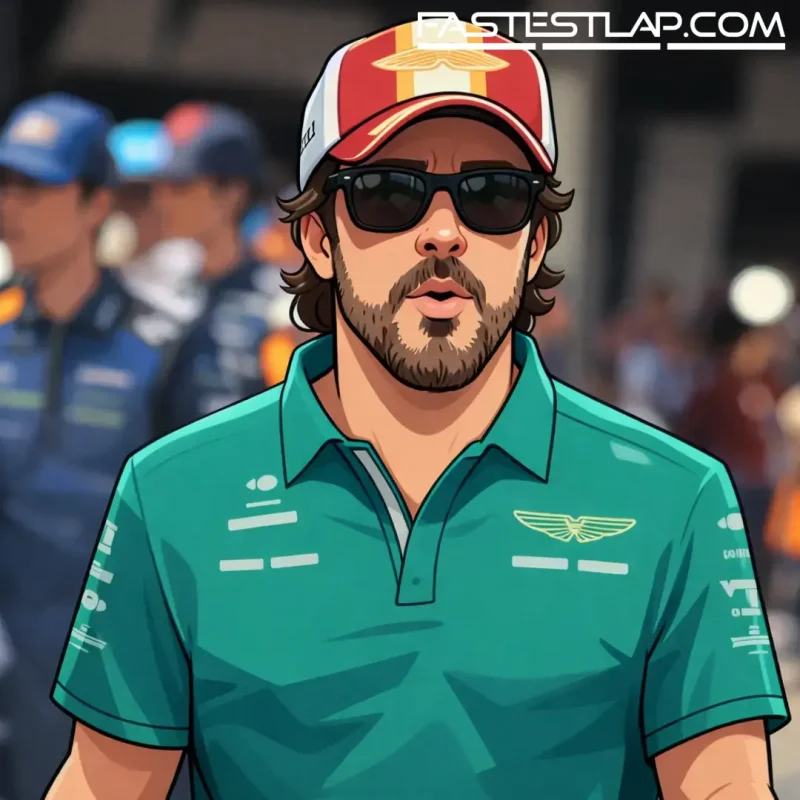
Fernando Alonso doesn’t usually need much of an invitation to pull at the loose threads in Formula 1’s regulations, and Silverstone gave him plenty to tug on.
The Aston Martin driver watched the British Grand Prix weekend unfold with a familiar sense of frustration: plenty of cars close enough to fight, plenty of movement on the straights — and, in his view, not much of it driven by craft.
“It depends what the fans and the sport want,” Alonso said in the paddock. “In the Sprint, people overtaking in the middle of the straight with more battery, so there is not any driver input or driver talent needed to overtake a car in front of you.
“You don’t need to outbrake anyone, you don’t need to overtake on the outside, you don’t need to take any risk. Just press one button and you overtake if you have a better power unit than the car in front.”
That’s the crux of the unease that’s followed 2026’s reset: the racing is being shaped by energy management to such an extent that the decisive moment can feel pre-ordained. Not “earned” in the old sense — not the late-brake feint, not the high-commitment line around the outside, not even the forced error under pressure — but a clean, clinical drive-by dictated by who’s got more deployment left and where they choose to spend it.
Silverstone’s Sprint provided the neatest illustration. Kimi Antonelli surged past Lewis Hamilton with a battery-assisted move that looked, from the outside, brutally simple. Hamilton had already burned energy earlier in the lap to keep the Mercedes behind; when Antonelli arrived with more deployment in hand, the defence effectively ended before it began.
The grand prix offered more wheel-to-wheel theatre, but even those sequences carried the same underlying rhythm. The Hamilton–George Russell exchanges, for instance, weren’t just about positioning and tyre bite; they were about timing the battery release and anticipating the inevitable counterpunch. The “back-and-forth” existed, but it was battery-led.
Alonso’s criticism goes further than nostalgia for a purer era. He’s pointing at something that matters politically as much as it does aesthetically: if overtaking becomes a button-pressing contest, it shifts the weight of performance further toward the power unit and the systems around it — and away from the driver’s capacity to improvise. F1 has always been machinery-plus-human, but there’s a difference between a car enabling a move and a car completing one for you.
The worry among some drivers this weekend wasn’t simply that energy deployment is powerful; it’s that it’s powerful in a way that can flatten the contest. If the cleanest pass is achieved mid-straight without a braking duel, you remove the most visible, most visceral part of the fight — the part that forces both drivers to commit.
There was also a moment in the weekend that underlined how chaotic the new dynamics can become when several cars arrive at the same piece of tarmac with different deployment states. Oscar Piastri, caught in a messy Lap 1 sequence, argued that the current rules are actively contributing to that kind of confusion.
Piastri’s incident came while battling the Racing Bulls pair for track position. He ended up in the middle of a three-car squeeze and had to pit for a new front wing — a costly tax for being the one who ran out of road.
“Lap 1 on these kind of circuits is just carnage,” Piastri said. “It’s almost like a multi-pass race start. I was trying to overtake Lindblad, and I seemed like I had more power than him. Lawson then passed me and seemed like he had even more power than me.
“It’s just a mess. You’re trying to judge your speed to the car in front of you, look at the car behind you, but to be honest, I’m surprised that doesn’t happen more often.”
That quote lands because it captures the new guessing game. Drivers are used to assessing closing speeds, but when a car can appear to “gain” or “lose” pace depending on deployment, the usual visual cues get scrambled — particularly in the opening lap concertina, when everyone is already threading the needle.
For Alonso, though, Silverstone’s bigger story sits in what F1 is rewarding. In his framing, the sport is drifting toward an overtaking model that asks less of the driver at the point fans most recognise as a test: the pass itself. If the move is done before the braking zone, the defending driver’s options shrink dramatically, and the attacker’s risk drops with them.
It’s not that Alonso is pretending drivers don’t still need to be good — they do, and they’re operating at the limit of complex cars — but he’s arguing that the most compelling skills are being devalued in the places where racing is supposed to feel alive.
Aston Martin, meanwhile, has its own practical concerns. Alonso is openly hoping an upcoming upgrade can move the team into the midfield conversation, but even that aspiration sits in the shadow of a bigger question: in a season where “who has the battery” can decide the shape of a fight, how much can a chassis-led step really change your Sundays?
Silverstone didn’t answer that. It did, however, sharpen the debate. And when Alonso starts asking what the sport actually wants, it’s usually because he senses F1 is at risk of drifting into a version of itself that looks fast, looks modern — and feels, in the moments that matter, strangely automatic.