
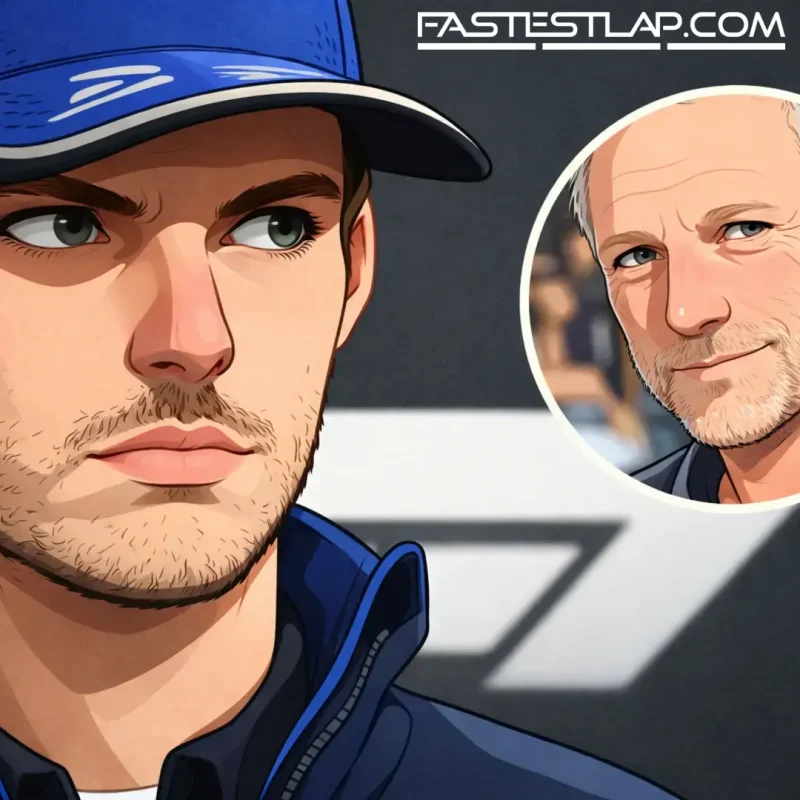
Christian Horner’s first stroll back into an F1 paddock since his Red Bull exit was always going to be a bit of a litmus test. At Silverstone, it ended up as something else entirely: a reminder of how quickly the Verstappen-era certainty has been replaced by noise, failures and very real questions about what comes next.
Horner, sacked by Red Bull in the aftermath of last year’s British Grand Prix after more than two decades running the operation, kept a low profile in public terms as he attended last weekend’s race. But his presence landed on an uncomfortable weekend for the team he once fronted. Max Verstappen, the driver Horner guided through four title-winning seasons, spun out at Stowe late on — another non-score in a season where Red Bull still hasn’t won a race.
The detail that will sting inside Milton Keynes is that the Silverstone retirement wasn’t some one-off driver error or a harmless bout of bad luck. Verstappen’s loss of control was traced to the same rear-wing problem that caused his qualifying crash in Austria at the previous round. In other words: the issue wasn’t just costly, it was recurring.
Against that backdrop, Verstappen’s reaction to Horner being back around the place was strikingly normal — almost pointedly so. Asked if he’d spoken to his former boss, Verstappen said he’s in touch with Horner “almost every week”.
“I saw him on the camera walking around, but I haven’t had time to meet anyone to be honest. It’s been busy,” he added, the kind of line that tells you everything and nothing at once.
When pressed on what they talk about, Verstappen didn’t dress it up. It’s just the cadence of long familiarity. “Like you do with your friends or people that you’ve known for a long time.”
That easy tone matters, because the wider Verstappen-Horner story has never been straightforward — at least not around the edges. Jos Verstappen’s relationship with Horner has been uneasy for years, and his early-2024 warning that the team would “explode” if Horner stayed in charge is still the quote that gets dragged out whenever Red Bull shows signs of stress.
Now Red Bull is stressed in a very different way. Not internally combustible, perhaps, but competitively hollowed out. After the British Grand Prix, Verstappen is seventh in the championship, 103 points behind leader Kimi Antonelli. Read that sentence back and it still feels like an alternate timeline: Verstappen in the midfield of the points table, Red Bull winless deep into the new era.
The politics, though, aren’t confined to the nostalgia of Horner’s return. There was a telling post-retirement moment caught on camera outside Red Bull’s hospitality unit: team principal Laurent Mekies speaking with Jos Verstappen and Verstappen’s manager Raymond Vermeulen, only for Verstappen to arrive and head straight up to his driver room. Mekies breaks off and follows.
Verstappen was asked about it and, again, didn’t take the bait. He was careful to frame it as standard procedure, not a crisis meeting.
“He came straight in my room, of course, to discuss the problems that we had in the race, to let me know what happened out there,” Verstappen said. “But that’s normal. We always do that, good or bad.”
As for Mekies’ first 12 months at the helm, Verstappen’s answer was more weary than accusatory — a driver trying to keep the blame game at arm’s length while living through the consequences.
“Everyone is trying their best. I’m not blaming one person or whatever,” he said. “It’s just painful for everyone that this is happening.”
The problem for Red Bull is that “painful” doesn’t stay an emotion for long in this sport; it becomes leverage. Verstappen’s lowly championship position means the well-documented exit clause in his contract is no longer a background detail. It’s the framing of the season.
It’s widely believed Verstappen can walk away for 2027 if he’s lower than second in the standings at the summer break. And right now, the maths makes that more than a theoretical threat.
Verstappen trails George Russell — currently second — by 78 points, with a maximum of 50 on offer across the next two races in Belgium and Hungary. Unless something extraordinary happens over the next fortnight, Verstappen isn’t climbing to second by the break. The clause, therefore, isn’t “in play”. It’s practically on the desk.
Which is why the paddock chatter has shifted from abstract “would he?” to the much more specific “where to?”. Reports this week have said Verstappen is in advanced talks with McLaren, the reigning constructors’ champion. It’s the sort of sentence that would’ve sounded like mischief not long ago; in 2026, with Red Bull’s rear wing throwing up repeat failures and Verstappen watching the championship disappear before August, it reads more like the next logical step in an uncomfortable process.
Horner’s return to Silverstone, then, wasn’t just a curiosity. It was a backdrop to an increasingly obvious truth: the Verstappen-Red Bull partnership is no longer being tested by rivals at the front, but by instability inside its own weekends — and by the calendar itself.
Two races remain before the summer break brings that contract clause into sharp focus. Spa and Budapest can still change the mood, but they can’t change the arithmetic much. And right now, the sport is watching Red Bull’s season unravel in real time, with Horner back in the frame and Verstappen sounding, for the first time in a long time, like a driver preparing options rather than protecting a dynasty.









