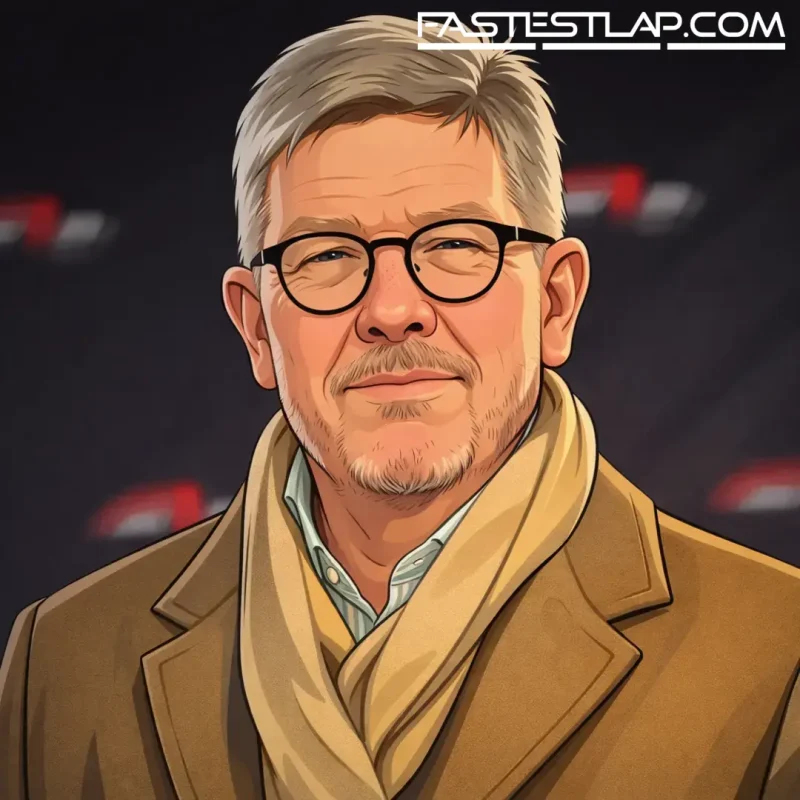
Ross Brawn doesn’t do “grand returns”. If he’s back in an F1 paddock, it’s usually on his own terms, with minimal fuss and even less need to be seen. Which is exactly why his low-key presence at Silverstone last weekend landed with a bit of quiet significance.
Brawn, now 71, was spotted on the grid ahead of the British Grand Prix Sprint, accompanied by his wife Jean. No microphone, no formal role, no obvious agenda — just the sort of understated appearance that nevertheless turns heads in a sport that never truly forgets its power-brokers.
It’s the first time Brawn has been seen trackside at a grand prix for quite a while, and it comes only weeks after his next motorsport chapter became official. In May, he joined the board of directors at Pramac Racing in MotoGP, adding another heavyweight name to the growing crossover between F1’s executive orbit and the motorcycling world — a shift that’s hardly surprising given Liberty Media’s takeover of MotoGP.
Brawn’s deal with Pramac also has him working as a strategic adviser to team principal Paolo Campinoti. The timing has been interesting. Pramac started the season rooted to the bottom of the MotoGP teams’ standings and had managed just six points by the time Brawn came onboard. In the four races since, that tally has jumped by 20. Nobody sensible is pinning that turnaround on one man parachuting into the boardroom, but Brawn has built a career on making organisations calmer, clearer, and harder to beat. Even in a different paddock, the effect tends to be felt.
His Silverstone cameo is also a reminder of how deliberately he’s kept F1 at arm’s length since stepping down from his Formula One Management role at the end of 2022. That was the end of a high-impact stint in which Brawn helped shape the sport’s modern competitive framework, and he wasn’t shy about pushing ideas with long-term consequences. He was one of the central figures behind the ground-effect regulations that underpinned the 2022–2025 era — rules designed, in part, to make the racing less aero-sensitive and the field less stratified.
Since then, his public F1 appearances have been sporadic and ceremonial rather than operational. He attended the F1 75 season-launch event in London in February 2025, and earlier this year he turned up at the 83rd Goodwood Members’ Meeting, where he was reunited with Jenson Button and the Brawn GP BGP 001 — a car that still feels like the sport’s favourite “how did they get away with it?” story, even after all these years.
Silverstone, though, is different. Goodwood is nostalgia with a timetable; a grand prix grid is the sport’s bloodstream. It’s where the conversations happen that don’t make the press release, where the real power map is visible if you know where to look — who’s standing with whom, who’s avoiding whom, and who’s suddenly back in circulation.
And Brawn wasn’t the only familiar face reappearing. His return to the paddock coincided with Christian Horner making his first grand prix appearance since his dramatic Red Bull exit in July 2025. Horner spent more than two decades running Red Bull, steering the team through its Vettel peak and then its Verstappen years. Seeing him back around the place at Silverstone carried its own subtext, especially in a season where the grid is already twitchy about what comes next — not just on track, but in the political backrooms that shape the next two or three years.
For Brawn, the intrigue is less about whether he’s “back” — he isn’t, at least not in any formal F1 capacity — and more about what his presence represents in 2026. Formula 1 is in an era where experience is a currency again. The sport’s leadership class is smaller than it pretends to be, and the same names keep resurfacing whenever there’s a regulatory inflection point, a commercial pivot, or a governance headache that needs solving without drama.
Brawn, of course, has been solving problems at the sharp end of F1 for three decades. Championship runs with Michael Schumacher at Benetton and Ferrari. The Honda-to-Brawn GP transformation that produced one of the most improbable title doubles in modern history with Button in 2009. The Mercedes transition that laid down so much of what followed in the turbo-hybrid era, even if he departed at the end of 2013 before the full avalanche arrived.
That’s the thing about Brawn: he’s not remembered for loud leadership, but for systems that work and decisions that stick. When someone like that strolls back onto an F1 grid — even as a “mere” spectator — people notice. Not because they think he’s about to be handed a pass and a desk, but because the paddock is instinctively alert to where influence might drift next.
Maybe Silverstone was simply a day out at a race he still loves, a chance to see familiar faces and breathe the air again. Maybe it was a reminder, intentional or not, that his motorsport life isn’t confined to MotoGP meeting rooms. Either way, it didn’t feel like an accident.
In Formula 1, the past never quite stays parked. And when Ross Brawn is back in the mix — even quietly — the paddock tends to listen, just in case there’s more to come.