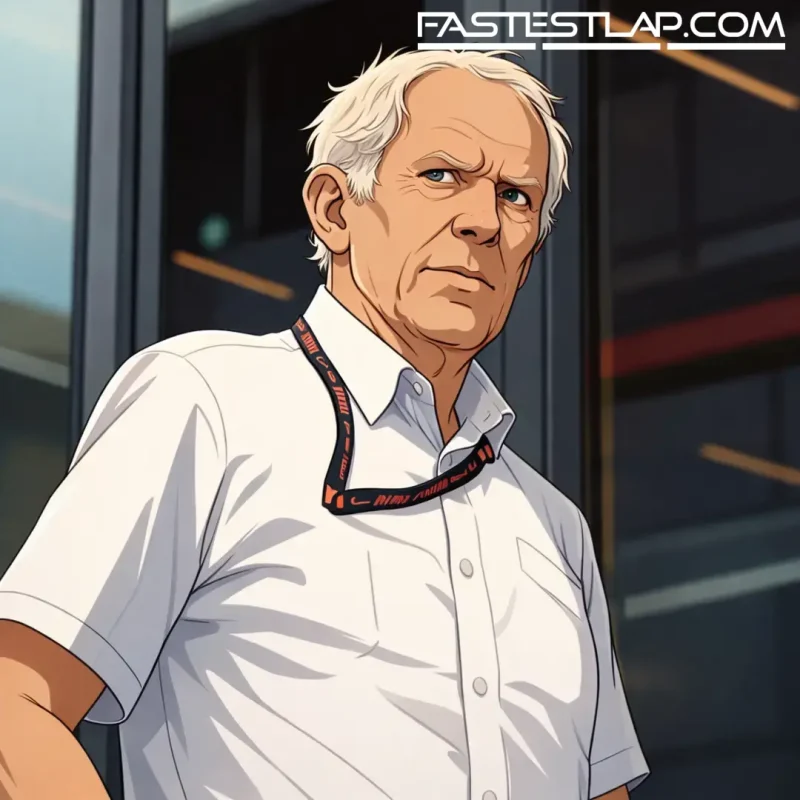
Helmut Marko isn’t giving anyone the soundbite they want, but the sight of him sitting down with Jos Verstappen and Raymond Vermeulen in the days after Silverstone did plenty of talking all by itself.
Marko, who walked away from Red Bull at the end of 2025 after two decades running its junior programme and shaping its driver pipeline, confirmed the meeting took place — and then shut the door firmly on what was said. “My visit was private, if that’s what you want to ask,” he told GPBlog, declining to expand when pushed on Max Verstappen’s thinking for 2027. “No idea. I am not in charge anymore.”
That’s the public line. In the paddock, the timing is what makes it impossible to ignore.
The Amsterdam meet-up came just days after reports that Verstappen is in advanced talks to leave Red Bull for McLaren for the 2027 season, and at a moment when the mechanics of his Red Bull contract are starting to look less like background noise and more like a live grenade.
It’s understood Verstappen can trigger an exit clause if he’s outside the top two in the standings heading into the summer break. Ahead of this weekend’s Belgian Grand Prix he’s staring at a brutal piece of arithmetic: he trails George Russell, currently second, by 78 points — with only 50 points available before the shutdown. In other words, unless something dramatic happens immediately, the contractual pathway to a departure isn’t theoretical. It’s right there.
And Red Bull’s last fortnight has only poured fuel on the idea that Verstappen’s camp will keep every option open.
At Silverstone, Verstappen’s British Grand Prix ended with a rear wing failure at high-speed Stowe — described as a “super dangerous” moment. It was his second rear wing failure in as many race weekends, following an accident in qualifying at Red Bull’s home race in Austria. For a driver who measures teams by how relentlessly they execute, back-to-back failures of that nature land as more than bad luck. They land as a warning sign.
When Verstappen was asked after the British GP about his future, he offered nothing that could be pinned down. “I’m not going to say anything about that,” he said. “It’s not fair to say anything about that also right now.” It was careful, controlled, and — in its own way — telling. Drivers who are completely settled tend to swat these questions away with ease. Drivers who are weighing leverage usually keep things exactly this grey.
The photograph of Marko with Jos Verstappen and Vermeulen was posted by De Telegraaf’s Erik van Haren, with the caption noting that what was discussed is unknown and that Verstappen’s future is under a microscope. Marko, who originally pulled the strings to get Verstappen into the Red Bull fold, is still widely believed to be a trusted figure to the Verstappen inner circle even after his split from Red Bull GmbH. That’s why this isn’t just another paddock coffee — it’s a meeting with someone who knows where the bodies are buried, and who also knows precisely how Red Bull thinks when it’s negotiating from strength or scrambling under pressure.
Asked whether improved performance from Red Bull could shift Verstappen’s thinking, Marko refused to play. “That’s also not my business. You have to ask Laurent [Mekies],” he said, deflecting to Red Bull’s current leadership.
Vermeulen, meanwhile, has already sketched out the Verstappen position in blunt terms. He said the priority is to assess how the car develops over the coming weeks and that while Verstappen wants to be loyal, it won’t be unconditional: the team needs to deliver a car capable of winning.
That’s the pivot point. The “loyalty” line is often deployed in Formula 1 as a softener — something to keep relationships intact while hard decisions are being prepared. And it’s hard to look at the current convergence of factors — the points gap to P2, the exit clause trigger window, the reliability failures, and the McLaren talks rumbling louder — and conclude this is simply noise.
If Verstappen does reach the summer break outside the top two, the legal lever becomes available. What happens next would come down to appetite and timing: whether Verstappen actually wants to pull it, whether McLaren truly has the space and willingness to land a generational driver for 2027, and whether Red Bull can present a credible enough technical and operational recovery to make the conversation uncomfortable rather than inevitable.
Marko’s refusal to comment is, on the surface, predictable. He isn’t employed by Red Bull anymore, and he’s always been selective about when he chooses to be blunt. But the private meeting — and the fact it happened at all — underlines a simple reality: Verstappen’s future is no longer a story that lives purely in rumours and hypotheticals. The contractual math is tightening, and the people around him are behaving like they know it.