Spa’s never needed help being intimidating, but the FIA has still managed to add an extra layer of intrigue ahead of this weekend’s Belgian Grand Prix by confirming five Straight Mode (SM) zones around the lap — the joint-highest tally of the 2026 season so far.
The headline detail is the one that’ll make older hands in the paddock do a double-take: Straight Mode will be available on the run from La Source down towards Eau Rouge. That’s a section of Spa where, for years, the sport has been deliberately cautious about letting drivers play with moveable aero, and for good reason. But there’s a very clear line in the FIA’s decision too: SM is not permitted through Eau Rouge/Raidillon itself.
In other words, you can trim the drag and slingshot down the hill, but you’ll be back in the car’s “natural” configuration before the compression and commitment of Eau Rouge bites. It’s a compromise that nods to performance and overtaking without reopening the old safety argument that led to free use of DRS in practice and qualifying being outlawed ahead of 2013.
Active aero has effectively replaced DRS in 2026, and the rhythm is now familiar: straight mode for the speed, then a return to maximum downforce for the corners. What’s changed from track to track is how much the FIA is willing to lean into it. Monaco had none at all last month; Spa gets five. That alone tells you how the governing body is reading the trade-offs between racing, risk and the particular demands of each layout.
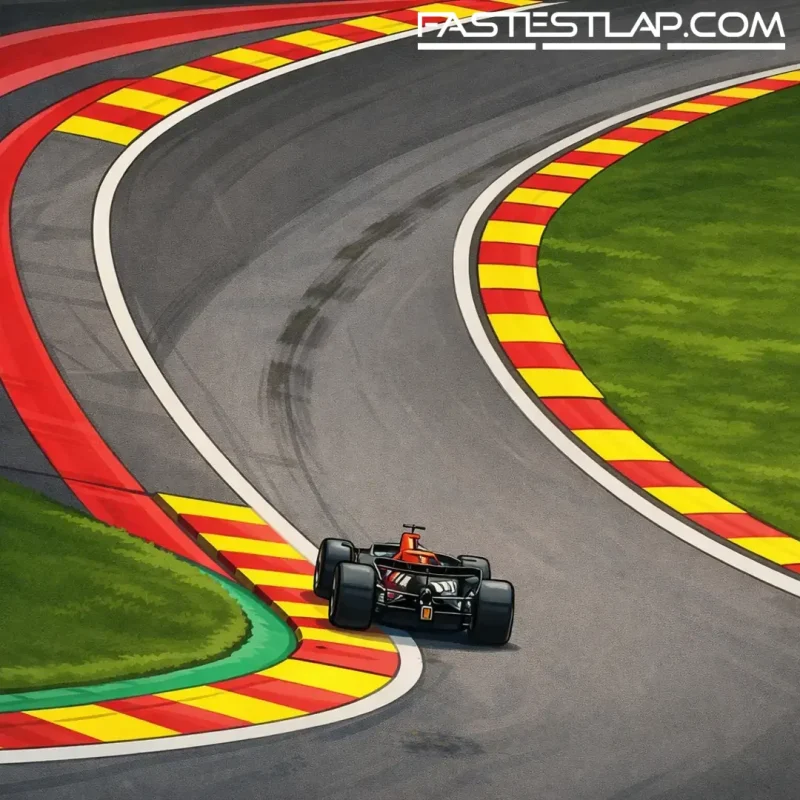
The five zones are spread logically across Spa’s long, speed-heavy lap. The first sits on the start/finish straight. The second is the new point of interest between La Source and Eau Rouge. After the cars crest Raidillon and spill onto the Kemmel Straight, they’ll have SM for a third time towards Les Combes. The fourth zone comes on the exit of Stavelot, but drivers must deactivate again on the approach to Blanchimont — a reminder that even in 2026, there are still corners at Spa where you don’t want anyone arriving with the car in the wrong configuration. Then, once Blanchimont is negotiated, the fifth and final zone allows Straight Mode on the run to the Bus Stop.
Only Albert Park has matched that five-zone figure this season; every other venue so far has been capped at four or fewer, with the spread reflecting circuit character: China had four, Japan just two, and the likes of Miami and Canada three apiece.
But the bigger story at Spa isn’t simply how often drivers are allowed to open the wings. It’s how they’re going to pay for it.
Spa is the longest circuit on the calendar, and under the 2026 power unit rules it’s expected to be a properly uncomfortable place to manage energy deployment. The extra Straight Mode opportunities will tempt drivers into chasing lap time and attacking more often, but there’s a cost: deploy too aggressively early and you can end up crawling through the middle of the lap with nothing left in the tank.
Fernando Alonso, speaking ahead of the weekend, laid out the problem in unusually blunt terms — and it’s one that will resonate up and down the pitlane, not just at Aston Martin.
“Silverstone and Spa, they are very thirsty on energy and you cannot deploy on all the straights,” Alonso said. “If you deploy at Spa from Turn 1 to 5, finito for the rest of the lap.
“You need to save a little bit there to have deployment from [Turn] 14 [Stavelot] to the Bus Stop. But if you deploy on those two straights, which is the optimal deployment, then there is a one-minute Sector 2 with no deployment at all.”
That’s the strategic squeeze in a nutshell: Spa asks for power everywhere, but the car can’t give it everywhere. And Alonso added another sting in the tail — that when deployment is cut, the drop-off is stark enough this year that cars can feel underpowered in a way that’s hard to hide.
“And with no deployment at all, we cannot forget that this year we have significantly less power than last year and less power than F2,” he said. “That’s the case when you cut the deployment. It’s a challenge.”
So while five SM zones reads like an overtaking gift on paper, it’s also a potential trap. More opportunities to reduce drag means more moments where drivers will be tempted to press the deployment button, and more scenarios where a misjudgement leaves you defenceless later — especially in that long, punishing middle sector where you’re already leaning on aero efficiency and balance through the faster sequences.
It also means race engineers will be busier than ever. The smart money this weekend isn’t just on who has the best top speed package, but on who can thread the needle: choosing where to spend energy, where to harvest, and when to accept being a sitting duck so you’re not one a lap later. Spa has a habit of turning small compromises into big lap-time swings — and with active aero now part of the equation in five separate bursts, 2026’s version of the Belgian Grand Prix could hinge on who blinks first in the energy game.