Aston Martin’s 2026 season has settled into an uncomfortable rhythm: Alonso and Stroll fighting more often with the stopwatch than the front of the midfield, and a car that looks like it needs a proper reset rather than another small tweak. Help is coming — but not immediately.
Honda chief engineer Shintaro Orihara confirmed at Silverstone that the manufacturer will run its current power unit specification for two more races before rolling out an updated unit after the summer break. Under the ADUO allowance, Honda was granted two extra upgrade opportunities after the season’s initial checks, and that’s now feeding directly into Aston Martin’s recovery plan.
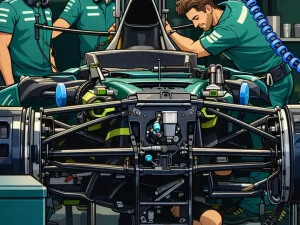
The timing matters. Aston Martin has already been signalling that its bigger swing will be on the chassis side, with Adrian Newey and the design group opting against a drip-feed of incremental parts in favour of a more substantial package for the AMR26. The team has suggested that chassis update could arrive before the shutdown — potentially as soon as the Hungarian Grand Prix — and Honda’s schedule points to a scenario where Aston Martin could have both its new chassis package and the upgraded power unit in play by Zandvoort in mid-August.
That’s the optimistic version, at least. The reality is that a “one big package” approach only looks clever if it lands on the right side of correlation and actually moves the needle. If it doesn’t, you’ve effectively spent a chunk of your season waiting for a step that isn’t there, while rivals bank smaller gains and refine their understanding week by week.
Spa this weekend is a useful reminder of why Honda is squeezing every last bit of learning out of the current spec before the upgrade arrives. Under the 2026 ruleset, energy management has become a defining limiter at certain venues, and the Belgian Grand Prix is one of the most unforgiving. Long straights, limited harvesting opportunities, and the usual questions over weather and track evolution make it a proper stress test of deployment planning.
“It will be a test for manufacturers in terms of energy management so we need to consider how we will deploy MGU-K power on the long straights,” Orihara said. “The harvesting here is quite limited, even considering the circuit length. This puts more emphasis on getting the deployment plan right.
“The straights are also a demand on the power unit in general – not only for performance but also for reliability.”
What stands out is Honda’s framing: Spa isn’t just about surviving the weekend, it’s about building a data set for what comes next — and not only for Spa itself. Orihara explicitly pointed to Monza as another circuit where the same questions will come back at even higher frequency, which hints at a broader concern: the current spec isn’t giving Honda and Aston Martin the operating window they want across the season’s high-speed outliers.
“We have two more races before we introduce the new engine,” Orihara added. “It’s important to keep learning with this current spec, so we can take those energy deployment findings into future races – like Monza, where we also have the long straights.”
And then there’s the other Spa constant: the forecast. Silverstone stayed dry, but the odds of getting through an entire Spa weekend without a meaningful wet session are never great — and Orihara didn’t hide from the value of that uncertainty, either.
“An added unknown is the changeable weather conditions at the circuit,” he said. “At Silverstone it remained dry, so Spa could be the first time where we have proper wet conditions in a session. In terms of the weather, anything can happen here.”
All of this feeds into Aston Martin’s bigger dilemma: when you’re not where you want to be competitively, it’s tempting to throw updates at the car as quickly as possible. But the cost cap is the cold water on that instinct, and Aston Martin’s trackside boss Mike Krack put it in terms everyone in the paddock understands — you can’t spend money you don’t have, and you can’t pretend accidents and repairs won’t happen later in the year.
“You go to the supermarket, and you have €100 in your pocket. You can only spend €100,” Krack said. “You develop your car, if you have spent your 100, you cannot spend any more.
“So you need to see when you have everything, and then one thing you must not forget is you can have crashes, so you need to keep some margin… It is a consistent balance between development and cost of racing, basically.”
That’s the subtext to Aston Martin’s “bigger package” philosophy: it’s not just a technical choice, it’s a budgeting one. Drip-feeding parts can be efficient if you’re confident each piece will stick, but it can also turn into a slow bleed of resource for marginal gains — particularly when you’re still diagnosing foundational limitations. Conversely, waiting to deliver a more coherent set of changes can make sense if you believe the car needs a more holistic shift in how it generates performance.
For Alonso and Stroll, the short-term picture doesn’t change much: Spa and the next round will likely be about damage limitation and taking what’s available. The more interesting question is what happens when the promised parts finally arrive. If Aston Martin can synchronise a meaningful chassis step with Honda’s post-break power unit update, it gives the team a rare mid-season opportunity to change the narrative in one hit.
But that’s the gamble. In 2026, you don’t just need upgrades — you need them to land cleanly, quickly, and in a way that doesn’t leave you chasing your own tail until the next set of regulations comes around. Aston Martin and Honda are betting that this is the moment the season turns.