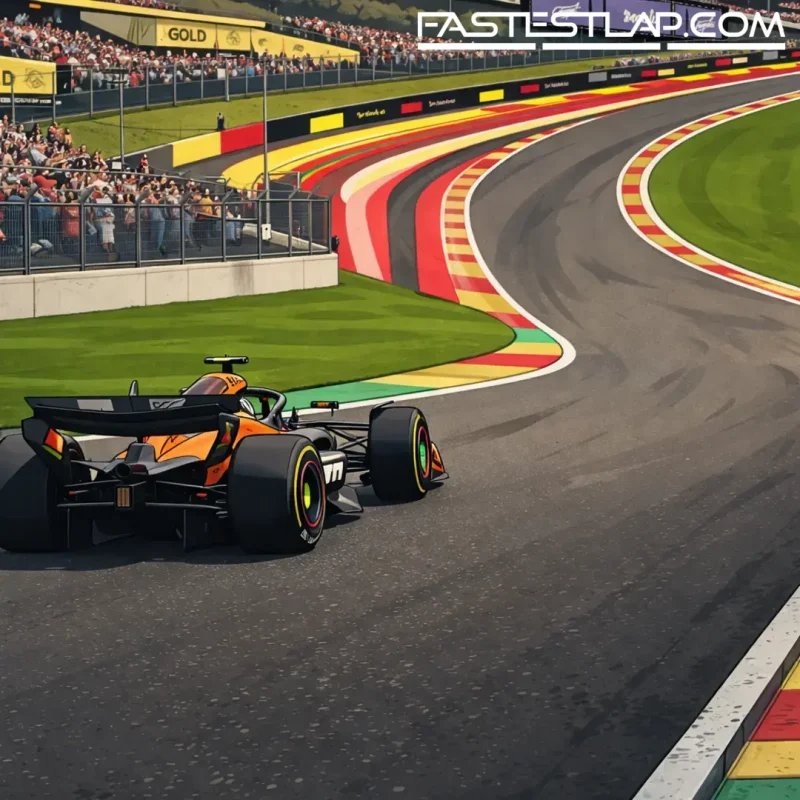
Spa has always been the place that strips Formula 1 back to its basics: long, climbing straights, big throttle percentages, and corners that punish any compromise in efficiency. Under the 2026 rules, it may also be the circuit that puts the sport’s least comfortable new truth right under the spotlight — that a growing chunk of the passing “show” is being dictated by energy maths rather than the old rhythms of pressure, placement and tyre management.
McLaren team principal Andrea Stella has been frank in the build-up to the Belgian Grand Prix: Spa-Francorchamps is primed to become an energy-management weekend first and a conventional racing weekend second. Not because teams are doing anything wrong, but because Spa is one of the calendar’s most energy-starved venues in this regulations cycle, and that scarcity shapes everything — when you lift, where you harvest, and when you burn what you’ve saved.
“Spa will be an interesting track for everyone,” Stella said, pointing out that, like Silverstone, it’s “a heavily energy-starving circuit.” The difference is that Spa’s long straights amplify the effect. Where a clever deployment window at Silverstone might buy you a sniff into Stowe or down the Wellington Straight, Spa turns it into a full-blown overtaking currency: if you arrive on a straight with more deployable energy than the car ahead, the speed delta can be substantial — and sometimes uncomfortably abrupt.
That’s the part McLaren’s drivers have been pushing back on. Stella revealed that both Lando Norris and Oscar Piastri raised concerns during the British Grand Prix weekend about how volatile those speed differences can be in the heat of battle. In other words, it’s not just that overtakes happen; it’s the way they happen — sudden, sometimes with little of the gradual build that makes a defence feel earned, and occasionally with a closing speed that creates its own safety and predictability questions.
“In listening to our drivers, they raise flags in terms of how unpredictable is the speed difference,” Stella said. “This is a point that we should listen to… I think we take away this element of concern from [Silverstone]; it may be similar in Spa, the straights are even longer in Spa, and there will be some challenges in terms of power unit exploitation. It will be about energy deployment for sure.”
Silverstone was a useful case study, even if it didn’t always look like it in the moment. The Sprint format earlier this season gave teams a precious extra competitive session to observe patterns, react and refine deployment and harvesting approaches before the grand prix itself. The Sprint was chaotic, but it effectively served as a live-fire test: by Sunday, the field had collectively got smarter, and the racing settled into something closer to “normal”, at least on the surface.
Spa doesn’t offer that same safety net this time. It’s a standard weekend format, which means less shared learning through the pecking order before it matters — and fewer chances to mask the underlying dynamic by iteration alone.
There’s also a circuit-specific wrinkle that could shape how teams even choose to show up aerodynamically. An updated Spa track map for 2026 features five Straight Mode zones across the lap — including one on the run towards Eau Rouge/Raidillon and another leading into Blanchimont, though it must be switched off before the flat-out left-hander. Only Albert Park has featured five such zones so far this season.
Five zones is a big number, and it changes the logic of “Spa wings”. Once upon a time, the Ardennes weekend was the home of the skinny rear wing: a deliberate sacrifice of downforce for top speed, because the lap time was hiding on Kemmel and from Stavelot to the Bus Stop. But active aero — and the way Straight Mode can slash drag on demand — blunts the incentive to go ultra-low drag in the traditional way.
“We will see whether some teams will actually bring some low drag packages, like we used to see in Spa,” Stella said. “Because with the Straight Mode now you are less incentivised to use smaller wings. Like [Silverstone], in the past, you would have come with a smaller wing, but teams didn’t do that [for the British GP]. It’s interesting to see if this happens in Spa.”
It’s a subtle but telling point: the 2026 cars aren’t just changing how drivers race each other, they’re changing the engineering theatre of a grand prix weekend too. If Straight Mode is doing much of the heavy lifting on the straights, teams may be more willing to carry a bit more wing than Spa orthodoxy would once allow — chasing stability through the fast corners while trusting the regulation tools to recover straight-line performance.
All of this should still produce overtaking. Quite possibly lots of it. Stella expects as much, for “the very same reason” Spa is so tricky: energy starvation creates the gaps in performance that open the door. The question hanging over the weekend is what kind of overtaking it will be — hard-fought moves set up over multiple corners, or the increasingly common 2026 pattern where the decisive moment is less about a driver outsmarting the car ahead and more about arriving at the right detection point with the right number on the energy dashboard.
Spa, more than most, has a habit of exposing what’s real. This year it might expose what the new era is still wrestling with: a championship that wants cars close enough to race, but not so energy-governed that the passes feel pre-programmed.