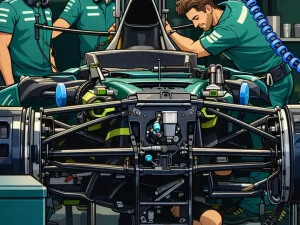
Ferrari turned up to Spa with something rarer than a low-drag rear wing: nothing.
After months of arriving at races with boxes of fresh carbon, revised geometries and the occasional “small” change that somehow touches half the car, the SF-26’s upgrade conveyor belt stopped for the Belgian Grand Prix. For only the second time this season, the Scuderia’s paperwork lists no new parts at all.
On the face of it, that’s just a line in an FIA document. In the context of the last fortnight, it reads more like a pointed response to the paddock noise around Ferrari’s development pace — and the inevitable budget-cap suspicion that follows any team that appears to be outbuilding its rivals.
Toto Wolff lit the touchpaper by openly wondering how Ferrari can keep bringing so much new hardware without feeling the squeeze. “In my opinion,” the Mercedes boss said, “they need to be running out of money soon, cost cap money, because we can’t do that, simply lacking the buffer and cost cap to be able to bring so many parts in the way they do.”
Fred Vasseur didn’t enjoy the implication. He bit back at Silverstone with a familiar complaint from team principals who feel they’re being judged by a different standard: when others develop they’re “genius”, when Ferrari does it, they’re “cheating”.
Now, at Spa, Ferrari’s answer isn’t another tranche of visible change. It’s restraint.
That doesn’t automatically mean the Italian team has suddenly been spooked into switching off the CAD stations. A “no upgrades” weekend can mean plenty of things: a planned pause to let the latest package breathe across a demanding circuit; a manufacturing bottleneck; or simply a conscious decision that Spa isn’t the place to introduce parts that need clean correlation time. But in a year where Ferrari’s upgrade rhythm has been unusually aggressive — and productive, given the SF-26 has already delivered two wins, with Lewis Hamilton taking Barcelona before Charles Leclerc won at Silverstone — the timing of this quiet weekend is hard to ignore.
While Ferrari left its spec sheet blank, the rest of the grid very much didn’t.
McLaren arrived with rear-wing revisions, tweaking the endplate and changing the rear-wing assembly. Mercedes, perhaps understandably given Wolff’s comments, brought alterations at both ends of the car. The team has reduced the camber of the upper rear-wing elements to trim local downforce, and also changed the rear drum winglets’ position and span in a bid to improve airflow. Up front, Mercedes has increased the top-edge camber on the front-wing endplate to improve performance.
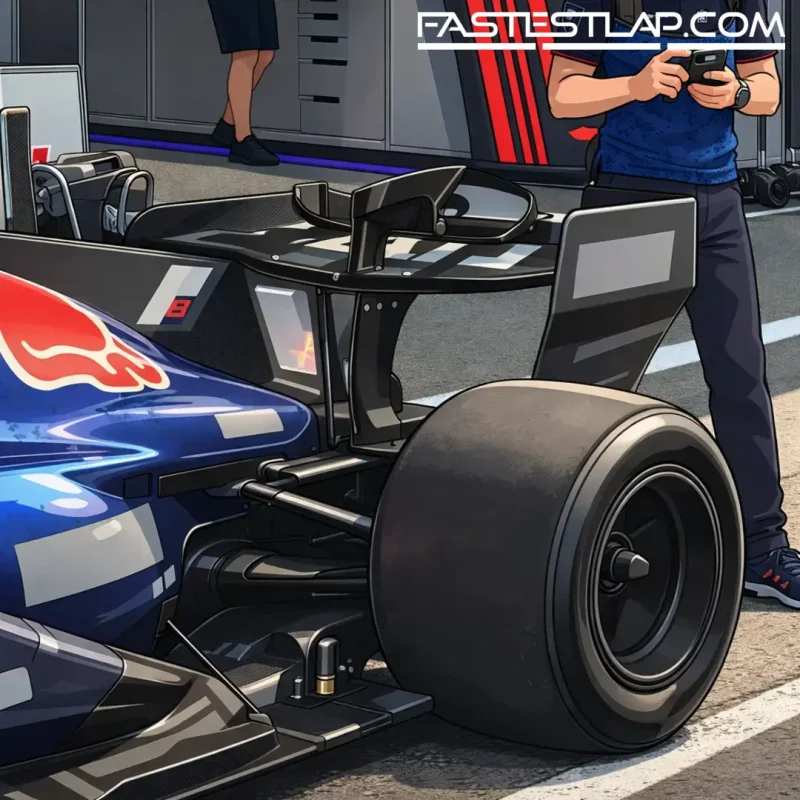
Red Bull, meanwhile, has gone in its own direction again. After dropping its so-called “Macarena” rear wing, it’s reverted to an older specification — but not without modification. With regulations now requiring the pylons to connect with the underside of the mainplane, Red Bull has revised the pylon profile to claw back load while keeping flow stability. It’s a very Red Bull solution: accept the constraint, then immediately start hunting for the grey areas of execution.
Further down the pitlane, Williams has continued to chip away with a new rear corner and updated floor body. The floor work includes a revised main floor profile that increases volume through the central part of the diffuser — the sort of change that won’t generate the social-media buzz of a new nose, but can shift the car’s behaviour in exactly the way engineers crave.
Racing Bulls has been the busiest of all, introducing a new engine cover, roll hoop, front corner and rear wing — a full quartet of components aimed at better airflow and downforce. Haas has added a new front wing, front corner and beam wing. Audi has brought a revised diffuser and rear wing. Alpine’s change is more specific, re-profiling the halo, while Cadillac has altered the geometry of its front-wing endplate.
And then there’s Aston Martin, which — like Ferrari — has arrived without a single new part declared. In Aston’s case, that absence has an obvious explanation: the team is already pointing everyone’s attention to Hungary, where it plans to introduce a B-spec AMR26. Spa, for Aston, looks like a holding pattern.
Ferrari doesn’t have that kind of public reset button scheduled, yet the absence of upgrades still carries consequences. When you’ve been “prolific”, to borrow the language often used around Maranello’s 2026 form, stopping becomes a story in itself. It inevitably invites questions: is the development curve flattening? Has Ferrari reached the point where it has to choose its battles more carefully? Or is it simply banking the gains from its recent push, with Barcelona and Silverstone already serving as proof the approach has worked?
There’s also the broader political read. In modern F1, cost-cap discourse is rarely just discourse — it’s leverage. Teams weaponise perception as much as performance, because being seen as the outfit that “must be” bending the rules can force scrutiny, slow momentum, and drag rivals into the conversation you want them to have. Vasseur clearly believes Ferrari is being painted into that corner. Turning up to a high-profile weekend with no upgrades doesn’t end the debate, but it does complicate the easy narrative.
The interesting part is what happens next. If Ferrari resumes its usual stream of updates immediately, Spa becomes a one-week punctuation mark — a pause, not a pivot. If this is the start of a more selective cadence, it’s a sign the team is managing not just lap time but optics, resource allocation, and the risk profile that comes with introducing parts late in a tight season.
Either way, Spa has exposed a simple truth of the 2026 paddock: development is no longer just an engineering race. It’s a reputational one, too — and this weekend, Ferrari chose to say less with carbon fibre and more with absence.