
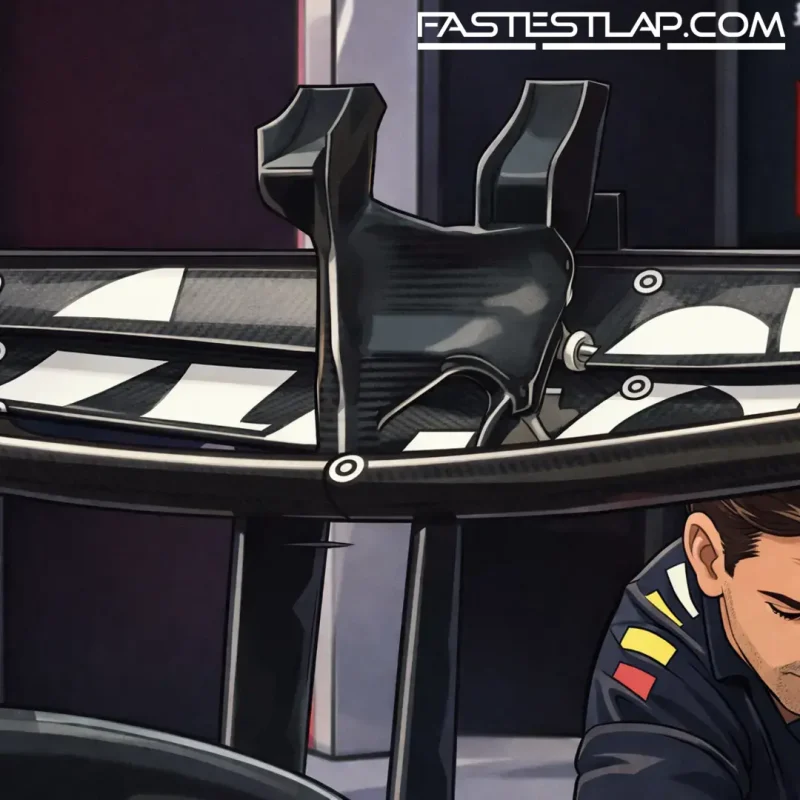
Monaco has a habit of making clever people do slightly desperate things, and the first proper glimpse of the rear ends in the pitlane this morning suggested the 2026 aero rulebook is already nudging teams into some wonderfully niche solutions.
Mercedes and Red Bull have both turned up in Monte Carlo with rear-wing assemblies that look a little over-dressed around the actuator area – extra winglets clustered around the activation pods, the sort of detail you only really notice when the car’s sat in the garage and you’re close enough to start counting fasteners.
That’s not an accident. Active aero won’t be available at Monaco this weekend, a safety-driven call that has effectively locked everyone into a fixed rear-wing position for the entire event. In other words: no moving elements to lean on for straight-line efficiency, and no in-session trim changes to mask compromises. If you want downforce here, you’re going to have to earn it the old-fashioned way, and if you want the car to breathe on the short bursts between corners, you’d better be creative with the airflow you’ve got.
Monaco is still the outlier on the calendar in terms of the sheer downforce the cars need to generate at relatively modest speeds, and the 2026 regulations have made rear wings one of the most fought-over territories. It’s not just about peak load; it’s about how that load is delivered, how stable it is through yaw on a street circuit, and how the wake plays with everything downstream – particularly the diffuser. With active elements removed for this one, those interactions get even more exposed.
Red Bull’s Monaco wing is the more obviously “different” at first glance, but it’s also the more conservative in concept compared to what Mercedes appears to be chasing. PlanetF1.com tech analyst Dr Obbs characterised Red Bull’s solution as similar in intent but less extreme than Mercedes’ approach, noting that Red Bull has retained its actuator pod while Mercedes has “abandoned the pod entirely”.
The reasoning, as Obbs laid it out, is classic modern aero thinking: chase cleaner air higher up, and manipulate the flow field so the rear wing and diffuser effectively prop each other up.
“The higher, the cleaner the incoming air. Less disturbed,” Obbs said. “But the more upwash you can create around the rear wing, the harder you can drive it as well. Because flow fields influence nearby flow fields, just like the rear wing actually helps to support the diffuser. It’s all connected.”
That last line is doing a lot of work, because Monaco will ruthlessly punish any mismatch between rear stability and traction. Teams can dial in all the wing angle they like, but if the car falls out of its aero window mid-corner, or if the rear tyre can’t be managed on exit, lap time disappears quickly – and qualifying at Monaco still carries the heavy implication of “that’s probably where you’ll finish”.
What’s intriguing is that these winglet additions around the actuator zone feel like they’re aiming to recover some of the “tuneability” that active aero normally provides, without actually moving anything. If you can clean up the local airflow, generate helpful upwash, and improve how the rear wing feeds the diffuser, you can potentially run the wing harder without paying as ugly a price in drag as you otherwise would. On a lap of Monaco, where the straights are short and the corners are relentless, that trade can make sense.
Whether anyone else has followed Mercedes and Red Bull down this particular rabbit hole is still unclear; it’s entirely possible some teams have opted for a more straightforward maximum-downforce solution and are betting that track position will blunt any top-speed vulnerabilities. But the fact two front-running organisations have independently arrived with visibly “busy” rear-wing hardware suggests the paddock has a fairly aligned read on where the lap time is hiding this weekend.
All of this lands against an already spicy competitive backdrop. Mercedes brought its first major upgrade package of the 2026 season to Canada and left with another win, Kimi Antonelli taking a fourth consecutive victory and stretching his championship lead to 43 points. The immediate takeaway from Montreal was dominance; Antonelli’s own takeaway was more cautious.
He said the team hasn’t yet seen the “full benefit” of the update because Canada’s conditions and demands were unusual and skewed by cooler temperatures. Monaco and Barcelona, he warned, will give Mercedes a clearer picture of what the package really does.
That’s a neat little subplot for the weekend: Mercedes turning up with a car it thinks has another gear to reveal, on a circuit where overtaking is scarce and the margins are dictated by confidence, precision, and how politely the rear axle behaves over bumps and camber changes. If their revised rear-wing philosophy works as intended in a fixed-aero weekend, it won’t just be a Monaco curiosity – it’ll be another hint that the team is reading the 2026 aero landscape better than most.
Red Bull, meanwhile, won’t need reminding that Monaco tends to amplify the cost of small weaknesses. If the car is even slightly reluctant in the slow stuff, you’re not “a couple of tenths down”; you’re staring at a Saturday problem that can define your Sunday. Bringing a bespoke rear-wing configuration with additional detail around the actuator suggests Red Bull is taking no chances on rear-end support, especially now that active aero can’t be used as a tool to soften compromises across the lap.
The broader point is that 2026 is quickly becoming a season where the rear wing isn’t just a bolt-on choice between “high” and “low” downforce. It’s an increasingly complex device for managing the entire back end of the car – load, balance, wake structure, and diffuser performance – and Monaco, of all places, is where those ideas get stress-tested. With the moveable elements parked for safety reasons, we’re about to find out which teams have built genuine robustness into their aero concepts, and which ones were leaning a little too heavily on the tricks they can’t use this weekend.









