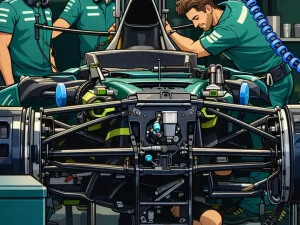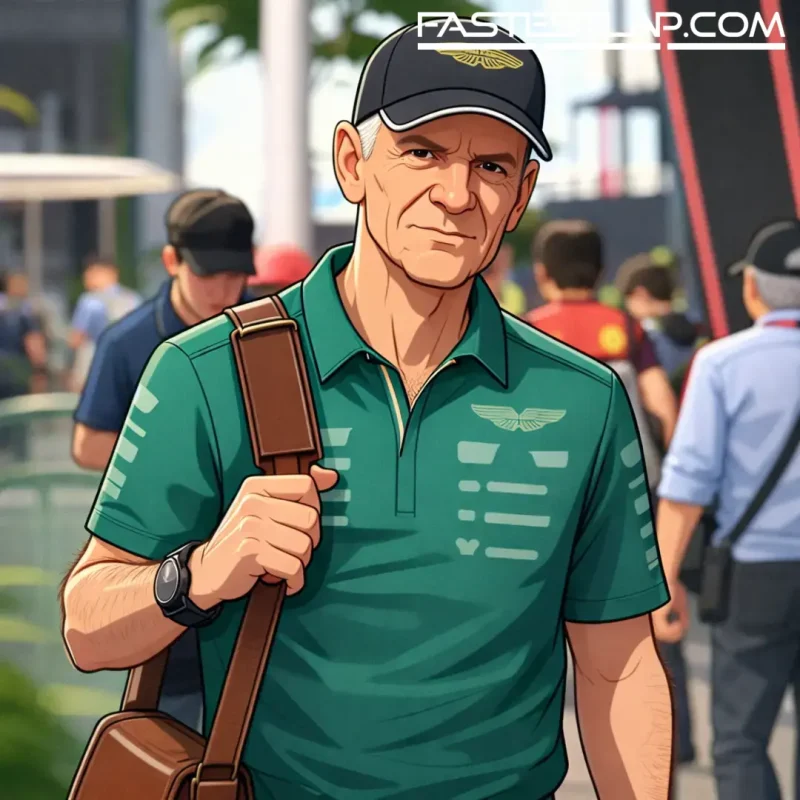
Adrian Newey didn’t come back to Monaco to do the glad-handing bit. He came back to measure, squint, and quietly reset Aston Martin’s 2026 season around a single premise: stop chasing it in public and start fixing it in private.
After a four-race absence, the 67-year-old Aston Martin team principal was back trackside in Monte Carlo — his first race since Melbourne — and he didn’t pretend the opening months have been anything other than grimly compromised. The AMR26, rushed into existence for the new regulation set, has left the team living hand-to-mouth on performance. Newey’s answer is to absorb the pain now and arrive later with something properly engineered, rather than a scattergun stream of half-baked patches.
On the grid he was vintage Newey: not parked behind a TV monitor or working the optics, but physically leaning over rival cars. He was spotted studying both McLaren machines — Lando Norris’s and Oscar Piastri’s — and also taking a close look at Pierre Gasly’s Alpine. It was the sort of paddock theatre that makes engineers smile and rivals slightly uncomfortable: the most famous pair of eyes in the business doing what they’ve always done, regardless of job title.
And, crucially, he offered a rare bit of clarity on where Aston Martin is heading next.
“It’s nice to be back,” Newey said in Monaco. “It’s the first race I’ve been to since Melbourne. I’ve just been working away on updating the car and an update that we will have ready probably just before the summer break.”
That line matters because it confirms what many in the paddock have suspected since Aston Martin’s underwhelming winter: this isn’t going to be rescued by a new front wing here and a floor tweak there. Newey has pushed the team into a different operating mode since Melbourne — less reactive, more structural — essentially acknowledging that the early AMR26 concept and the way it was delivered left them no credible route to clawing back time with incremental work.
He’d already been candid earlier in the year about how badly preparation went. Aston Martin arrived late to January’s pre-season shakedown in Barcelona, and Newey estimated the project was around four months behind rivals — “the car only came together at the last minute,” as he put it. Monaco added the next layer: the response hasn’t been to panic and pile on parts, but to slow down and install processes that should’ve been bedded in long before the first race.
Asked how he’s keeping Fernando Alonso and Lance Stroll pointed in the right direction, Newey framed it as a test of patience as much as pace.
“It’s a long, hard slog for them obviously,” he said. “We took the decision after Melbourne that, rather than doing piecemeal updates, we’d take our time to put systems in place and do our research much more carefully. Everything was such a rush to get the car out for Melbourne, we said: ‘OK, we’ll endure the short-term pain and hopefully make a decent step when we make it.’”
That’s Newey the team-builder, not just Newey the designer. “Systems” is a loaded word in modern F1. It can mean anything from how CFD and wind tunnel correlation is handled to how quickly the factory can turn a design loop into production parts — and how confident the team is that what it’s bolting on is actually faster. If Aston Martin truly was scrambling into Melbourne with a car that “came together at the last minute”, you can safely assume plenty of those loops were stretched thin or skipped entirely. In that context, “piecemeal updates” aren’t just ineffective; they can be actively misleading, sending you down development dead ends you don’t have time to validate.
Newey’s Monaco weekend also happened to coincide with Aston Martin finally getting on the board in 2026. Alonso was promoted to 10th after Cadillac’s Sergio Perez received a post-race penalty, handing Aston Martin its first point of the season — and the first point under its new technical partnership with Honda. It wasn’t the sort of on-track breakthrough that changes the mood in the motorhome overnight, but it did at least stop the bleeding in the standings and give the operation something tangible to cling to while it waits for Newey’s bigger swing.
There was also a notable shift in how Aston Martin handled the weekend’s public-facing duties. Newey didn’t do additional media work beyond his grid interview, with ambassador Pedro de la Rosa taking on the team representatives’ press conference on Friday and handling post-race engagements as well. Mike Krack — no longer the team boss and now acting as chief trackside officer — did his slot earlier in the weekend. It all underlined what Newey himself admitted back in Australia: being team principal is “a little bit” distracting from the work he’s best at. Aston Martin, it seems, is trying not to waste his bandwidth.
That plays into the longer-term shape of the project too. Newey is expected to attend more races this season after his Monaco return, but not on the ever-present schedule you see from other team principals. The plan is closer to what Andy Cowell did before him — roughly 10 to 14 weekends a year — with Newey selecting events where his presence has the most value.
And while it’s a strange image at first — a team principal dipping in and out — it’s probably the most honest way to deploy him. Aston Martin didn’t hire Newey to be a paddock politician. It hired him to stop a big, expensive organisation from tripping over itself when the rules reset.
The next judgement point, then, is simple. When that pre-summer-break upgrade arrives, it can’t just be “new parts”. It has to look like a different level of thinking: a car that’s been researched properly, correlated properly, and delivered properly. Monaco hinted Newey’s already moved the team away from firefighting. Now Aston Martin has to prove it can build what he’s drawing.