Aston Martin’s 2026 has quickly become an exercise in damage limitation — and, if you listen closely to Fernando Alonso and Lance Stroll in Barcelona, a test of how much faith the team can bank on one big swing rather than the usual drip-feed of fixes.
The early months of the new regulations haven’t merely left Aston Martin short of its own expectations; they’ve left it isolated. With Honda as its power unit partner, the team has managed just a single point so far this season, and the raw pace picture in Spain was grim: in qualifying at the Circuit de Barcelona-Catalunya, Aston Martin was around a second off the nearest rival. Sunday then delivered a double DNF, the kind of weekend that drains morale as much as it empties the points column.
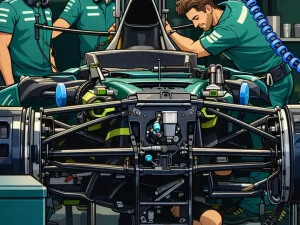
That context matters, because Aston Martin’s choice has been to resist the temptation of constant small upgrades and instead funnel resources into a larger mid-season package for the AMR26. It’s a high-stakes approach in any year; in the first season of a new rules cycle, it’s even more so. There’s no confirmed date yet, but the expectation in the paddock is that it lands either just before or just after the summer break — which effectively means Aston Martin is asking its drivers and trackside group to survive the next run of races with what they’ve got.
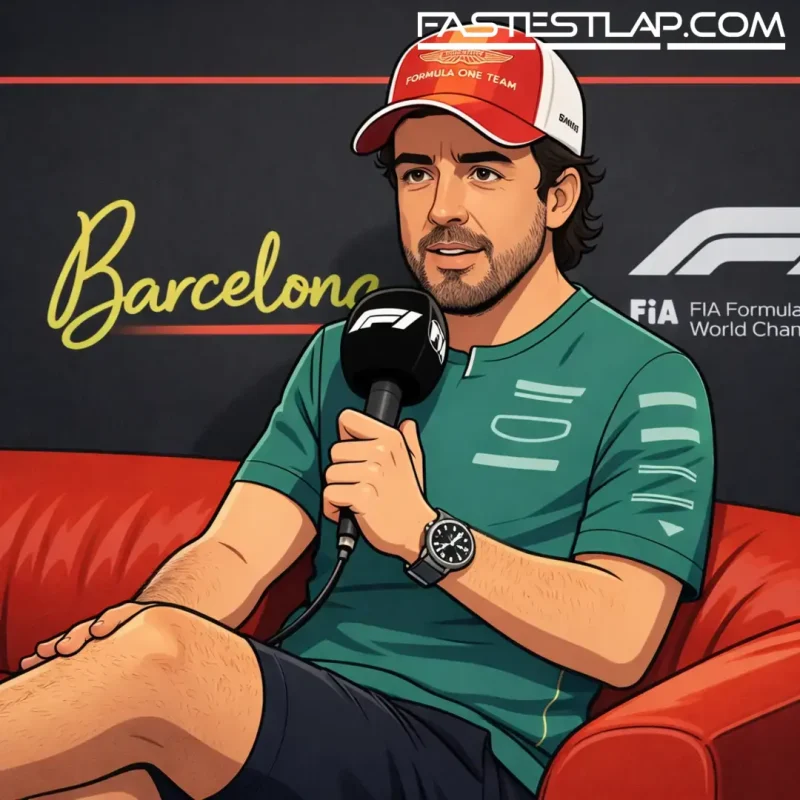
Alonso, never one to dress up a difficult situation, made it clear the team is clinging to that upgrade as the moment the season can finally begin in earnest. Asked whether the forthcoming package is designed purely to lift 2026 performance or whether it’s also laying foundations for next year, he didn’t bite on an either-or answer.
“Well, both,” Alonso said. “It works into 2027 because definitely we need to improve our situation, but I think our hope is that the second part of the year will be a more competitive one, and we can start fighting in the midfield. Yes, that’s the aim.”
There’s a lot packed into those lines. “Both” is the realistic admission that Aston Martin can’t afford to develop blindly for a short-term spike if it means hard-coding the wrong ideas into next year’s car. But it’s also a subtle acknowledgment that the team doesn’t have the luxury of writing off 2026, not with a new era underway and the competitive order still forming. If you’re not learning on-track now, you’re donating time to everyone else.
Stroll’s comments, meanwhile, leaned into the “wait for the parts” mood that can settle over teams when the current spec has reached its limit. He framed the coming upgrade as the dividing line between simply turning up and actually racing.
“That’s the battle we’re in right now until we have an upgrade,” Stroll said. “We’re a team, so have people like Adrian, who didn’t join a long time ago, and Enrico [Cardile], they’re extremely talented people.
“Adrian is the most successful person ever in Formula 1. So I think that just everybody’s waiting for the upgrade, and will it be enough to fight at the front where we were in even 2023 in these years? Maybe not, but it’s already a good step in the right direction, and then, in the future, I’m sure we can be very strong.”
It’s a revealing namecheck. Invoking Adrian Newey isn’t just about technical reassurance; it’s about authority. When results are this poor, teams don’t only need performance — they need a narrative that makes the struggle feel temporary and controlled rather than existential. Newey and Cardile represent the promise that the current form is an aberration, not a new normal.
But the subtext is unavoidable: Aston Martin is pinning a lot on a single “reset” moment. If the package arrives and the car still looks like a backmarker, the second half of the year won’t be about charging into the midfield — it’ll be about explaining why that leap didn’t happen, and what that means for 2027. Conversely, if the update does what the factory believes it can do, it won’t just rescue the points tally; it will validate the team’s development philosophy under these regulations and give it a platform to build on without panic.
Pressed on timing, Stroll kept it simple.
“As soon as we can,” he said. “So, if it’s going to be just before the summer or just after, we’re pushing flat out, and we see when we can get it.”
For now, that’s Aston Martin’s reality: a team living week-to-week at the back, asking its drivers to absorb the hits, while the factory bets that one concentrated evolution can change the shape of its season. Alonso has seen enough cycles in this sport to know hope is cheap — but he also knows momentum can be priceless once you find it. The question is whether Aston Martin’s long-awaited package is a spark… or just a bandage.