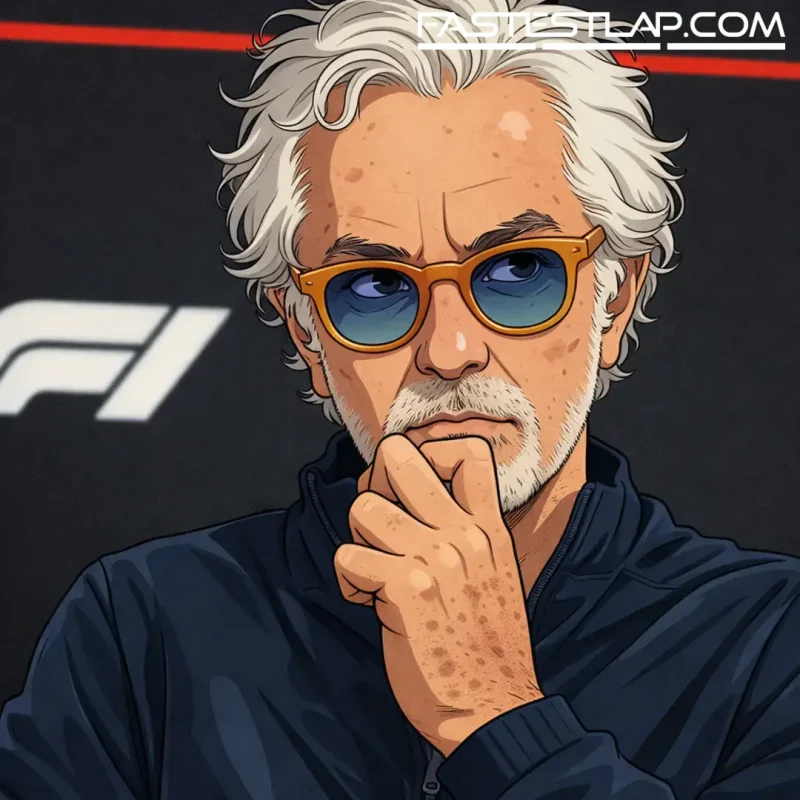
Flavio Briatore isn’t in the mood for romanticising Alpine’s start to 2026. Yes, the points are on the board, the team’s climbed to fifth in the Constructors’ Championship after five weekends, and the whole operation looks healthier than it did a year ago. But listen to Briatore talk and you get the sense he views that as the bare minimum for a factory outfit — not a cause for self-congratulation.
The tell is how quickly he shuts down the easiest storyline in the paddock: blame or praise the drivers. Pierre Gasly is contracted through 2028, Franco Colapinto is in the car this season thanks to an option Alpine triggered, and the outside world is already doing what it always does — projecting next year’s line-up through whatever Sunday narrative is freshest.
Briatore’s basically saying: save it. Alpine’s deficit, in his view, is too structural to be solved by swapping the person holding the steering wheel.
He points to the most uncomfortable comparison Alpine can be measured against right now: it’s not being outgunned by a rival with a unique technical advantage, it’s being outpaced by teams running broadly comparable power. “You have McLaren with the same engine we have, you have Mercedes with the same engine, and we are six, seven tenths behind,” he said. That’s the kind of reference that lands like an accusation inside a factory, because it removes the convenient excuses.
Gasly and Colapinto have combined for 35 points, with Gasly leading the intra-team battle. On paper that’s tidy. In qualifying, though, the ceiling is obvious. Across the last two Grands Prix — Miami and Canada — the fastest Alpine on average has been around seven-tenths off the leading McLaren driver. For Briatore, that number matters more than the odd good Sunday, because it speaks to the underlying performance of the car rather than the chaos of a race.
And it’s in that context that he reaches for the Verstappen line — not as a dig at his own drivers, but as a way of framing the scale of the problem. The best driver in the world might drag a car a couple of tenths, maybe three, beyond where it “should” be. If you’re giving away seven or eight tenths, you’re not asking for a hero; you’re asking for a miracle.
“Sure, the driver made a difference,” Briatore admitted. “If you have one guy like maybe Max, make you two tenths, three tenths. If you are seven, eight tenths behind, you don’t have any driver makes this difference.”
It’s classic Briatore — blunt, slightly theatrical, and designed to refocus attention where he wants it. But it’s also a fairly modern performance message. The 2026 field is tight enough that tenths are everything, yet the competitive order still hinges on how efficiently teams turn their resources into lap time. Briatore is effectively saying Alpine’s bottleneck isn’t talent in the cockpit, it’s the machinery and the machinery around the machinery: development rate, execution, and the unglamorous operational stuff that turns a “decent” weekend into a properly threatening one.
That’s why he keeps coming back to process. Not just “work on the car” in the generic sense, but a list that sounds like it’s been lifted straight out of an internal performance review: pit stops, aerodynamics, doing “much, much better”. He describes the driver question as “the last part, the last bit”, and insists the financial effort has to go where it can actually move the needle.
The subtext is hard to miss. If Alpine’s qualifying gap to McLaren is being used as the yardstick — same engine, very different lap time — then the scrutiny falls on areas that can’t be solved by a contract announcement. That can mean correlation issues, development direction, or simply not extracting the maximum from the package week to week. Whatever the root cause, Briatore is publicly allocating responsibility upwards, away from Gasly and Colapinto, and towards the team’s ability to build and run a sharper car.
Colapinto, though, still sits in an awkward middle ground. Alpine has the option structure on its side, and Briatore openly acknowledges they “need looking at” him. That’s not a vote of confidence or a warning shot — it’s the language of an evaluation that hasn’t reached its conclusion. In other words, Colapinto’s 2027 prospects won’t be decided by a single scrappy points finish or a headline-grabbing qualifying, but by whether Alpine believes it has a car worth optimising around its driver line-up at all.
Briatore’s dissatisfaction is, in a way, a compliment. It suggests Alpine’s internal targets are no longer about being the “best of the rest” on the right day, but about fighting the teams it’s benchmarking itself against on equal hardware. Fifth after five rounds, 35 points in the bank, and yet the boss is talking like the project is underdelivering. That’s not the language of a rebuilding outfit happy to exist — it’s the impatience of an organisation that thinks it should be further up the road already.
And if Briatore is right about the size of the gap, the driver market chatter can wait. Alpine won’t buy back seven-tenths with a new name on the garage door. It’ll only get there the hard way: a quicker car, cleaner weekends, and a development curve that finally starts to look like the teams it keeps pointing at.