
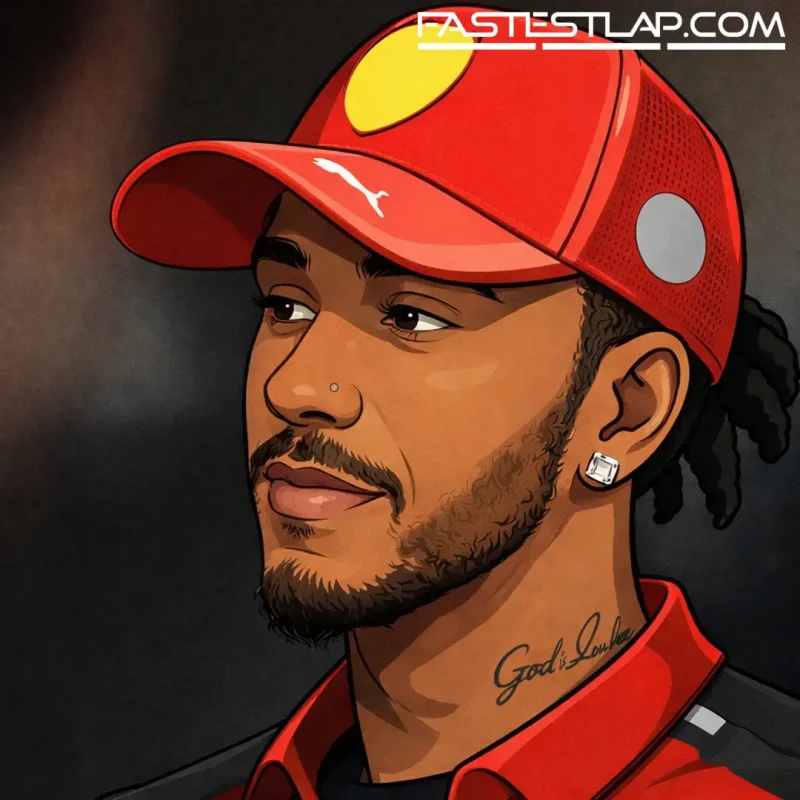
Lewis Hamilton didn’t waste time entertaining Max Verstappen’s latest appeal to the stewards.
After their Lap 11 flashpoint at the 2026 Austrian Grand Prix — the sort of high-speed, high-stakes knife fight that still makes Spielberg feel like a throwback — Verstappen was quick on the radio with “clear penalty” as he abandoned the outside line and drifted out towards the gravel. The FIA took a look. Nothing came of it.
Hamilton’s take afterwards was as sharp as it was revealing: if you’re trying to hang it around the outside of a driver of Verstappen’s calibre, you’d better be sure you’re actually entitled to that piece of track.
“He went off the outside. You don’t expect to go around the outside of a champion,” Hamilton said. “I wouldn’t expect to go around the outside of him there and hold the line. So he was behind at the apex, and therefore he should have backed out.”
It was a very Hamilton way of framing it — less about outrage, more about racing geometry and the cold, implicit contract between two drivers who’ve spent years testing the limits of what the other will and won’t concede. In that sense, it wasn’t so much a dig as a reminder: if you arrive second, don’t act surprised when you don’t get treated like you arrived first.
The incident itself had all the ingredients of an old rivalry refusing to go quietly. As George Russell edged away up front, Verstappen hunted down Hamilton and launched the move into Turn 3. He got ahead, briefly. Hamilton immediately hit back and the pair ran side-by-side through the fast sweeps — the kind of corner sequence where commitment is non-negotiable and the smallest misread becomes a trip to the run-off.
Verstappen, with the outside line squeezed to nothing, opted for self-preservation. Then came the radio message.
The stewards’ decision not to intervene was consistent with how these moments are increasingly being handled: hard racing, both cars surviving, no obvious “smoking gun” contact or forcing-off beyond what’s become normalised at the sharp end. If anything, the subtext was clear — if you choose the outside there, you’re accepting the risk that the inside car won’t politely disappear.
And Austria didn’t stop at one exchange.
After the first pit-stop cycle, Hamilton and Verstappen were at it again. Verstappen went through at Turn 3, Hamilton tried to counter. They ended up alongside once more through the sweeps, before Verstappen committed more forcefully down the inside at Turn 6 and finally made it stick. There was an edge to it — not reckless, but emphatic — the sort of move that says: enough of the trading paint, I’m leaving with the position this time.
From there, their afternoons went in opposite directions. Verstappen converted the momentum into a season-best second place, a result that will feel like a release after a run of races where Red Bull hadn’t consistently looked like the natural runner-up. Hamilton, meanwhile, could only salvage fifth on a day when Ferrari’s tyre degradation issues turned his race into damage limitation rather than a platform to build on.
That’s what made the whole Verstappen-penalty conversation feel slightly beside the point. Even if Hamilton had been asked to cede a place — and he wasn’t — Ferrari still didn’t have the underlying grip consistency to turn Sunday into a repeat of Barcelona. Austria underlined just how thin the margin is between a win when conditions and behaviour line up, and a weekend where you spend the second half nursing tyres and swallowing lap time.
Hamilton didn’t dress it up. Ferrari brought a substantial upgrade package to Barcelona, a step that helped deliver his win there, but he’s already pushing for more.
“I am really grateful for the team continuing to push it, and to just take that first step,” Hamilton said. “The next one needs to be a much bigger step.”
There’s an important tone in that: appreciative, but impatient. It’s not the language of someone content to “be in the mix” — it’s the language of a driver who knows the calendar doesn’t wait, and that scrapping wheel-to-wheel with Verstappen is only truly valuable if it’s for wins rather than second-row consolation.
Next is Silverstone, Hamilton’s home race and a venue where his record — nine wins — still stands as one of the sport’s modern monuments. If Ferrari can give him a car that looks after its tyres and responds to upgrades with more than small gains, Austria might end up filed as a thrilling sideshow. If they can’t, it’ll read as a warning: even when Hamilton is sharp enough to go toe-to-toe with Verstappen, the bigger fight is still against the stopwatch — and, right now, Ferrari isn’t consistently winning that one.









