Barcelona hasn’t even started and it already feels like one of those weekends that defines how the rest of a season is talked about.
George Russell arrived in Spain still insisting he’s in this 2026 title fight, but the noise around him is getting louder — and sharper. David Coulthard didn’t bother with nuance when asked about Russell’s prospects against Kimi Antonelli. If Russell can’t beat the kid at Barcelona, Coulthard reckons Russell can forget the championship altogether.
It’s an intentionally brutal bar to set, but it captures the mood inside the paddock: Antonelli has stopped being “the exciting prospect” and turned into the reference point. Five Grand Prix wins in a row will do that. The standings paint the same picture. Antonelli leads by 66 points from Lewis Hamilton, with Russell a further two back again — close enough to taste, far enough to hurt, and with the momentum going in exactly one direction.
Russell’s response was telling not for the defiance — every driver says they believe — but for the admission behind it. “A lot of points down the drain,” he said, and that’s the crux of it. Not the raw deficit, but the sense that Mercedes has had too many weekends where the ceiling was high and the outcome wasn’t. At this level, “we’re not even 30 per cent of the way through” is true in a spreadsheet sense; psychologically, it can be irrelevant if the other car is banking wins like it’s inevitable.
That pressure only intensifies when the benchmark is in the garage next door. Russell doesn’t need reminding that intra-team context is where reputations get built and stripped fastest — especially when the other driver is the one stacking trophies and controlling the narrative.
Monaco, meanwhile, managed to produce a familiar subplot: Lance Stroll leaving rivals exasperated and radio messages spikier than the guardrails. Stroll’s race was messy even by Monaco’s usual “survive the chaos” standards — a moment in the tunnel that nearly became a full-blown incident, then holding up Antonelli and Charles Leclerc, and finally crashing at Turn 19 late on.
Antonelli’s reaction was not diplomatic. Leclerc went further, arguing it should’ve been a penalty. That matters because Monaco is the one place where being impeded isn’t just an inconvenience — it can be the race. If you’re trapped behind the wrong car at the wrong time, you’re stuck watching your own afternoon disappear in slow motion. Drivers will tolerate the odd squeeze; they don’t tolerate losing minutes behind a car that looks out of control or out of position.
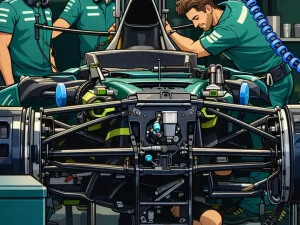
If Aston Martin needed a lift, it came in the form of Adrian Newey reappearing in the paddock — notebook in hand — and, perhaps more importantly, a clear timeline for when his fingerprints might start showing up on the AMR26.
Newey said he’s been “working away” while he was out, and that a substantial update should be ready just before the summer break. That’s the kind of phrase that makes rival teams listen, because it’s both specific enough to sound real and vague enough to hide the scale of what’s coming. Newey being spotted studying the McLaren MCL40 and Alpine A526 in Monaco only added to the theatre: the sport’s most famous design brain doing what he’s always done, hunting for detail and advantage wherever it might live.
His return coincided with Aston Martin’s first points of the season, helped by Fernando Alonso being promoted to 10th after a post-race penalty for Cadillac’s Sergio Perez. In pure points terms it’s a small step; in mood terms it’s oxygen. If there’s a team that’s needed belief — internally and externally — it’s Aston Martin, and Newey promising something tangible before the break is the closest thing to a reset button they’ve had all year.
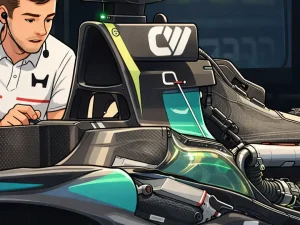
Newey wasn’t the only one peering over someone else’s work in Monaco. Lewis Hamilton was caught doing something drivers and engineers love to pretend they don’t: inspecting a rival car up close. In this case, it was Antonelli’s race-winning Mercedes W17, and Hamilton wasn’t subtle about it, crouching down to get a proper look at the rear.
Hamilton spent the race chasing Antonelli without ever really looking like he had the tools to force the issue, so the post-race inspection felt like the next-best way to extract something useful from a frustrating afternoon. He openly framed it as intel he could take back to Ferrari — not in the “steal their secret” fantasy sense, but in the practical way drivers contribute when they’ve had a long look at a car’s behaviour, its stability, and where it seems to gain.
“There’s lots of things that we need to be adding to this car,” Hamilton said afterwards. It was a blunt assessment, and it landed because it wasn’t dressed up as a one-off Monaco problem. When a driver of Hamilton’s experience starts talking in terms of what must be “added”, that’s usually code for a car that’s missing fundamental performance tools rather than chasing fine margins.
And then there’s Barcelona’s other story — one that’s easy to dismiss as “just FP1” until you remember what it represents.
Cadillac has confirmed Colton Herta will replace Sergio Perez for Friday’s opening practice session, giving the 26-year-old American his first official F1 weekend running. It’s the formal moment on a path that’s been talked about for years: IndyCar success, a deliberate pivot into Formula 2 with HiTech, and now an actual F1 session where the timing screens will tell a story no press release can control.
Herta’s expectations are sensibly framed — clean running, help the team gather data, and get comfortable with procedures — and he’s highlighted time in Cadillac’s simulator in Charlotte as part of the preparation. That’s exactly how these outings should be approached if you want more of them. The stopwatch matters, but it’s not the only thing being judged; teams watch how a driver handles the programme, the feedback, the traffic, the tyres, the radio rhythm. All the unglamorous stuff that decides whether a one-off becomes a pattern.
Herta won’t be the only stand-in this weekend either, with teams beginning to work through the season’s mandated four FP1 outings for young drivers. But his matters because it’s Cadillac, it’s Perez stepping out, and it’s happening at a time when the market is restless and every session feels like an audition for something.
So yes, Barcelona will be about lap time and upgrades and strategy. But it’s also shaping up as a referendum weekend — on Russell’s ability to haul himself back into a title fight that’s drifting away, on whether Aston Martin can finally turn ambition into performance, and on which of F1’s side stories is about to become a real one.