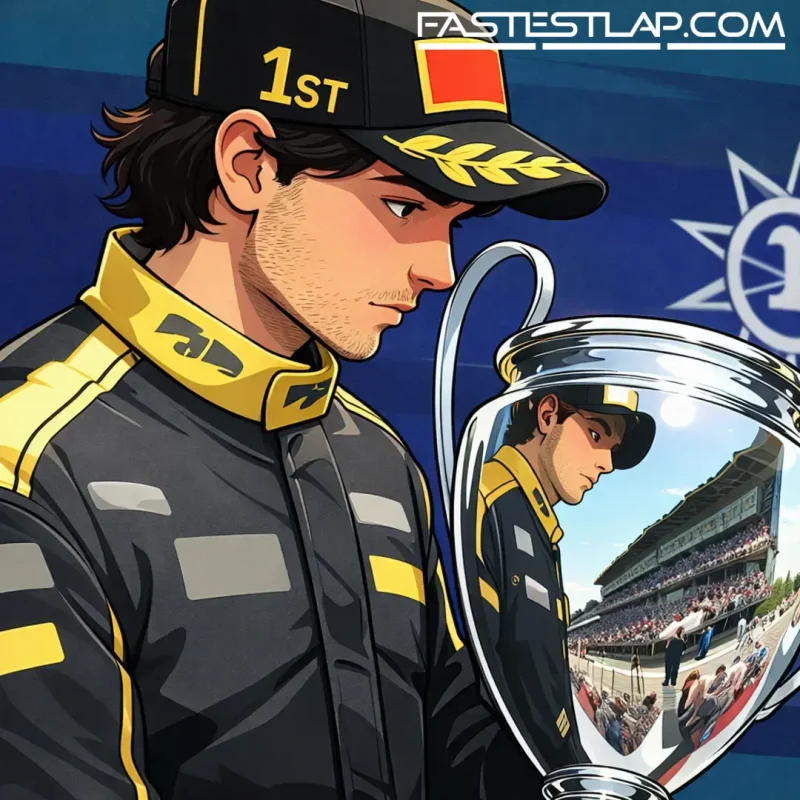
Rafael Camara’s first Formula 2 win in Barcelona didn’t just tick the obvious box on his 2026 checklist — it also served as a timely reminder of how quickly narratives can harden in the junior paddock, and how quickly they can be torn up again.
Coming into this season as the reigning Formula 3 champion and a Ferrari-backed prospect placed in an Invicta Racing organisation that’s become synonymous with being in the F2 title conversation, Camara arrived with a target on his back. That’s the price of a gilded CV in a category that doesn’t wait around for you to find your feet.
Monaco, though, left a bruise. A feature race that went badly and loudly tends to do that, because F2’s noise travels — social media, paddock whispers, the inevitable amateur forensics about who’s at fault. By the time the circus got to Barcelona, Camara wasn’t just chasing points; he was chasing control of the story.
He got it in the best way possible: pole position, then a feature race win built on a stint that demanded discipline as much as speed. Extending his opening run on the soft tyre to 22 laps was the kind of call that only pays off if the driver is on it every lap, managing the drop-off without falling into the clutches of the undercut. Camara executed it, and once the strategy opened the door, he walked through it.
Invicta team principal James Robinson didn’t hide the sense of relief. Speaking after the race, he said the team felt “very vindicated” to finally turn pace into points — a line that tells you plenty about how much they felt had been left on the table earlier in the year.
Robinson also went out of his way to swat away what he described as “a few comments” he’d seen online about Camara’s relationship with his engineer, Pau Rivera, stressing “that could not be more wrong” and calling the dynamic inside the garage “absolutely magnificent”.
In a further statement, Robinson doubled down on where he felt the win was won: “It was a big relief to finally get that win for Rafa on Sunday and convert his undoubted pace into points.
“After the disappointment of Monaco and Montreal this was the perfect way to bounce back. It was a great reward for the entire team after the mechanics heroics in Montreal and Monaco, and the engineering group (especially Rafa’s engineer specifically) deserve a lot of credit for the race strategy, although it couldn’t have been done if Rafa didn’t execute it, which he did perfectly.”
It’s notable, too, that Robinson didn’t forget Joshua Durksen after what he called a “disappointing race”, insisting Invicta remains confident the driver “has got what it takes to win at this level”. That’s the other side of weekends like Barcelona: one side of the garage is celebrating a breakthrough, the other is trying to stop a bad Sunday from turning into a bad month.
While Camara grabbed the biggest moment, Gabriele Mini left Barcelona doing what championship leaders have to do: steadying the ship when conditions aren’t perfect. After a pointless Monaco feature race, Mini responded with a double podium — second in the sprint, third in the feature — and emerged with a six-point championship lead over Red Bull junior Nikola Tsolov. Camara’s Barcelona haul lifts him to third, 17 points behind Mini.
Mini has been refreshingly candid about the balance of power, suggesting MP Motorsport isn’t always the outright fastest package, but insisting execution is keeping them at the sharp end. “I think almost every time apart from the Monaco Feature and the Australia weekend with the issue I had, we almost always maximise the results,” Mini said. “We know that at the moment we can see some teams are very, very strong… At the same time, we maximise every single race and every single time we go on track.”
It’s not the most glamorous championship pitch — not for a driver, not for a fanbase looking for domination — but it’s often the one that wins titles in F2, where messy weekends arrive without warning and momentum can change on a single safety car.
Kush Maini rounded out the standout trio from Barcelona with a sprint victory that did more than pad the points column. It was his first win with ART Grand Prix, and it came with a performance that looked controlled rather than opportunistic. Maini said he’d been told he “flew off the line” at the start — which, in F2 sprint races, is half the job done — before managing the race to the flag. A ninth-place finish in the feature added two more points and capped a weekend that felt like a genuine step forward.
“Obviously very happy. I think that was the plan,” Maini said. “We’ve had good starts all year and I really think the team deserved this one… Normally ART, if anything, struggled in the race pace, but I think we proved today that the car was great all race.”
The weekend’s points, as awarded here, went Camara (3), Mini (2) and Maini (1). The season tally in this format after Barcelona reads: Tsolov on 8, Mini on 7, with Camara and Martinius Stenshorne on 3 apiece.
Over in Formula 3, Barcelona belonged to Theophile Nael. The Campos driver arrived with a 100 per cent pole record in F3 this season and finally converted that one-lap authority into a victory that demanded plenty more than clean air. Hiyu Yamakoshi sat in his mirrors for long stretches, and Nael had to manage tyres while keeping the DRS threat under control.
“Super happy to first win in FIA Formula 3 for me, after a long time,” Nael said. “It was quite difficult, to be honest. Hiyu behind was pushing quite hard, so I had to manage my tyres and still keep him out of the DRS.”
It was a proper F3 feature race win: pressure, rhythm, and just enough restraint at the end to avoid the sort of late mistake that turns a breakthrough into a regret.
James Wharton took the F3 sprint in more stop-start fashion, navigating two safety car restarts and fending off renewed pressure to claim his second win of the season. “We’ve definitely had the pace all year, and we just need to qualify a bit better,” Wharton said — a familiar complaint in that category, where your weekend can be won or lost in a single compromised lap on Friday.
And then there was Yamakoshi, whose 2026 has already carried its share of frustration. He thought he’d won the Monaco sprint, only to be disqualified afterwards for a technical infringement. Barcelona could easily have been the weekend where he went quiet, but instead he answered with a double points finish and second in the feature, lifting him to seventh in the standings and restoring some of the momentum that Monaco threatened to steal.
The F3 weekend points here went Nael (3), Wharton (2) and Yamakoshi (1). The running tally shows Ugo Ugochukwu leading on 4, with Nael and Brando Badoer on 3.
Barcelona, then, delivered a neat snapshot of how the ladder really works: reputations are fragile, margins are thin, and the fastest way to quiet the noise is still the oldest one in racing — put it on pole, then go and win the thing.