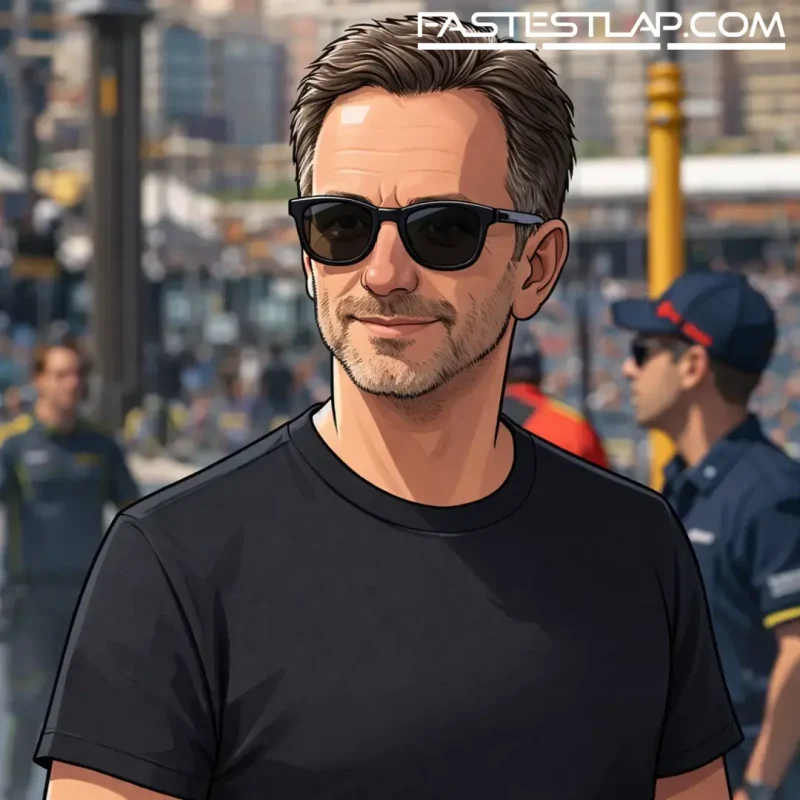
Christian Horner is about to do what he always did best in the paddock: control the room.
This autumn, the former Red Bull Racing boss will publish a memoir titled *DRIVE*, a book that promises a full-throttle retelling of the 20-year stretch in which he became one of modern Formula 1’s defining powerbrokers. It lands on October 22, and it’s being positioned—by those around it, and by Horner himself—as more than a nostalgia lap. In a sport that’s never short of politics, it reads like a bid to put his version of events on the record while the consequences of his exit are still unfolding.
Horner’s story, up to now, is the archetypal F1 rise: a young, relatively untested leader handed the keys in 2005 as Red Bull arrived and took over what had been Stewart and then Jaguar. Two decades later, that operation had been turned into one of the sport’s great dynasties. Under Horner, Red Bull produced two eras of sustained dominance, made champions of Sebastian Vettel, and stacked up eight Drivers’ titles, six Constructors’ crowns, and 124 of the team’s 130 Grand Prix victories.
Those numbers are the easy part. The harder bit—the reason the book will be devoured inside the paddock as much as outside it—is the machinery behind them: the hiring calls, the internal battles, the moments of brinkmanship with rivals, and the way Red Bull learned to weaponise its own identity as a racing team that didn’t behave like a traditional racing team.
Horner says the book is built around that idea: that F1 is “ultimately a people business”. He’s leaning into the human texture rather than writing an engineering manual, framing *DRIVE* as a reflection on “the people, the decisions, the challenges and the extraordinary cast of characters” he encountered across the journey. In other words, it’s set up as the insider’s tour of how power is actually assembled in Formula 1—how you keep a team sharp when you’re winning, and how you stop it splintering when the pressure shifts.
It also arrives at a pointed moment.
Horner’s tenure ended abruptly last season, with Red Bull GmbH—now steered by Mark Mateschitz and Oliver Mintzlaff after Dietrich Mateschitz’s death in 2022—moving to take back marketing control of the wider organisation and, as the line goes in the paddock, quieten the noise that had surrounded the team. Since then, questions haven’t really stopped: about whether the succession plan was robust enough, about the stability of the structure that replaced him, and about whether Red Bull’s edge—its DNA, the thing that made it so hard to outmanoeuvre—was too tied to the particular ecosystem Horner built.
That’s what makes *DRIVE* more than a memoir; it’s a statement of relevance. Horner is no longer on the pit wall, but he is still very much in the conversation, and the book inevitably becomes part of that. When a figure with his track record says he’s going to explain how “seismic moments” in Red Bull history *actually* played out, the paddock hears something else too: a message that he’s not done shaping narratives, and that he still believes his version of Red Bull’s success story matters.
There’s also the personal subtext. Horner’s next move remains unclear, and in recent months he’s been linked to roles elsewhere. What’s been consistently said about his thinking is that he’s looking for an ownership position—less employee, more architect. That would track with the way he operated at Red Bull: not just managing a team, but running an empire inside an empire, with one hand on performance and the other on the sport’s constant chess match.
Against that backdrop, there’s a neat bit of timing too: one year on from his final race with Red Bull, Horner could yet resurface in the public eye at the British Grand Prix this weekend. If that happens, it’ll be hard not to see it as bookend theatre—Silverstone as both an exit point and a re-entry into the spotlight, even if he’s only there as an observer.
The publishing details underline how confident everyone involved is that this will land as an event rather than just another sports autobiography. The rights were won after what’s been described as an intense bidding war among publishers. Transworld Publishing will release it across the UK and Commonwealth in hardback, audiobook and ebook, with Horner narrating the audio himself—an obvious choice, and one that will make the inevitable soundbites all the more… usable.
Henry Vines, who acquired the rights for Transworld, called it “unguarded” and “packed with remarkable personal revelations and Formula 1 insights”, promising “an entirely new perspective on both the man and the sport”.
There’s a fine line here, of course. The paddock has seen enough “tell-all” books that tell surprisingly little. But Horner was never a passive character in F1, and whatever you think of him, he understood leverage—how to apply it, when to hold it, and when to make sure everyone knew you had it. If *DRIVE* reflects even a fraction of that clarity, it won’t just be a recap of trophies and famous Sundays.
It’ll be a reminder that in Formula 1, the stories that stick aren’t always about lap time. They’re about who made the calls, who survived them, and who gets to explain them afterwards.