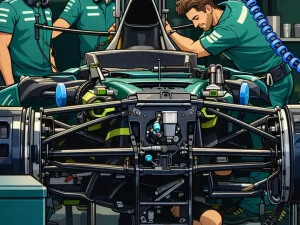
Carlos Sainz has added his voice to the paddock’s growing cost-cap scepticism, questioning how Formula 1’s heavyweight teams continue to roll out upgrade packages at a pace the rest of the grid can’t realistically match.
Eight rounds into the 22-race 2026 season, the same familiar names — Ferrari, Red Bull and McLaren — have been the most aggressive on the development front. All three arrived in Miami with notable changes, Ferrari followed up again with further SF-26 updates in Barcelona, and then Red Bull and McLaren answered back in Austria. In between, there’s been the steady drip-feed of circuit-specific parts that, taken together, adds up to a constant state of evolution.
For teams further down the order, it’s become the weekly ritual: the FIA document drops on Friday, the top teams’ lists run long, and everyone else wonders what they’re missing.
Fernando Alonso put it bluntly in Austria when he suggested Aston Martin has been told there’s simply “no money” for incremental upgrades because it’s committing resources to a B-spec car that could appear at the Dutch Grand Prix. Alonso, never shy of a pointed aside, joked that perhaps the front-runners have a “money machine” hidden in the factory.
Sainz doesn’t have Alonso’s taste for theatre, but his conclusion isn’t far off.
“It is not only Williams,” Sainz said. “If you look at any other team, I think everyone is scratching their heads at how the top teams manage to do what they’ve done this year.
“And you look at the last five races, no one is bringing more upgrades than the top teams, so this is still impressive what they’re able to do.”
It’s the kind of comment that lands because it’s coming from someone who’s seen both sides of the sport’s current economy. Sainz has spent his recent seasons inside front-running structures, and now he’s learning what the same regulations feel like when you’re fighting in the midfield with a programme still being rebuilt.
F1’s 2026 budget cap sits at $215 million, a figure designed to close the field by limiting how much raw spending can distort performance. Yet Sainz’s point — and Alonso’s before him — is that limiting the total doesn’t magically level the ability to generate parts, validate them, manufacture them and bring them to the track in a relentless cadence.
Sainz, though, is careful not to hide behind the argument. In fact, his most interesting admission is that Williams’ problem isn’t simply a lack of funds.
“It shows that it’s not all money,” he said. “Which at the same time is in a good way, because we know money is not the issue in Williams, and we have the budgets, and we have the investment from the board on so many things. The team has been investing a lot of money in all the facilities we have now.”
That’s the line that should matter most at Grove. If the chequebook isn’t the bottleneck, then the uncomfortable bit starts: what exactly is? Sainz points to the things you can’t fix with a single purchase order — processes, efficiency, work methods — the unglamorous layers of performance that determine whether an upgrade cycle is repeatable or a one-off push.
“A lot of it is processes, efficiencies, work methods, and that’s where it gets complicated,” he said. “Because that’s where we need to get it right, and we need to analyse, and obviously also hire talent from other teams to help us understand in which areas we are still not strong enough.”
It’s a telling diagnosis, not least because it hints at how the cost cap has shifted the competitive fight. The sport used to be a straight contest of resources; now it’s increasingly about how well those resources are converted into lap time. The richest teams don’t just have money — they’ve had decades to refine the machine that turns money into performance, and to protect the institutional knowledge that makes the machine run smoothly.
Williams’ 2026 scoreboard reflects where it is in that journey: 11 points on the board, eighth in the constructors’ championship, 10 points behind Haas and nine ahead of Audi. It’s enough to show there’s progress, but not enough to pretend the gap is closing on its own.
Sainz’s comments also serve as a subtle reality check for anyone expecting a quick, romantic comeback story. Facilities can be upgraded. Investment can be secured. But the hardest part is building the operational rhythm — the decision-making, the validation pipeline, the confidence in correlation — that allows you to bring parts frequently and know they’ll work. That’s what the leaders are doing, and it’s why their upgrade lists keep coming.
In the meantime, Sainz and Alonso have essentially asked the question many in the midfield mutter privately: in a supposedly constrained era, why does it still look so easy for the same teams to keep moving the goalposts? F1 may have capped the spending, but it hasn’t capped the advantage of being excellent at spending it.