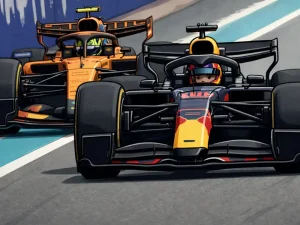
Juan Pablo Montoya has never been one for nostalgia, and he’s not about to start now — not when the sport is already flirting with the idea of winding the clock back to V8s.
In the wake of the Miami Grand Prix, the Colombian came out swinging in favour of Formula 1’s polarising 2026 rule-set, arguing the new energy-led racing is producing something the series has been crying out for: actual, two-way combat. Not the old “wait for the detection line and press the button” routine.
His timing is pointed. FIA president Mohammed Ben Sulayem has been talking up a return to V8 engines — “It’s coming,” he declared — with the earliest suggestion being 2030. It’s the kind of message that lands well with fans who miss noise and simplicity. Montoya isn’t buying the romantic version of that era, and he’s even less interested in binning a set of regulations that, in his eyes, has finally stripped away the most artificial part of modern overtaking.
The debate cropped up on the BBC Chequered Flag podcast, where 1996 world champion Damon Hill admitted he’s still getting his head around what he’s seeing in 2026. The sport has moved into a rhythm where the decisive moments aren’t always telegraphed by a long, obvious chase — and Hill’s point was that, as a viewer, it can look messy.
“It’s confusing a little bit, because we don’t know when they’re deploying boost and stuff,” Hill said, describing a pattern many have already labelled “yo-yo racing”. The pass happens, the car in front seems to streak away, then the roles reverse and you’re left asking how the move actually stuck — or didn’t.
But where Hill sees a layer of fog, Montoya sees a genuine fight. And, crucially, he sees defensive agency returning, because the new dynamic is built around managing energy rather than waiting for a rear-wing flap to do the heavy lifting.
“I like that,” Montoya shot back, before getting to the heart of it: “For me, DRS was such a BS.”
Montoya’s argument is simple and, frankly, hard to dismiss if you’ve watched enough DRS-era races with a cynical eye. Under the old system — which ended at the close of 2025 — the defender often wasn’t defending so much as bracing. If you were inside a second at the detection line, you were usually gone by the end of the straight unless there was a massive performance offset or the attacker made an unforced error.
Montoya put it in his own blunt way: with DRS, “you were a sitting duck”. Nine-tenths or a second, he said, is a sizeable margin in F1 — yet the attacker would “blow by” anyway and the broadcast would sell it as a highlight.
What’s changed in 2026, in his view, is that the defender has tools again — not a gimmick, but choices. Hill noted that the style is “very new” yet “actually quite good”, even if it’s harder to read live. Montoya went further, arguing the new rules reward anticipation: if you can see the move coming, you can alter your approach earlier, switch into recharge mode, and have enough in the battery to punch back on the next straight.
That’s the bit that’s split the paddock since these regulations arrived. Drivers have been vocal about the battery-dependent feel of the cars — particularly the way qualifying and overtaking can hinge on energy state — and plenty of fans have found the pattern jarring compared to the straightforward chase-and-pass they’re used to.
But Montoya’s defence lands on an uncomfortable truth for anyone campaigning for a pure throwback: “clean” isn’t always “good”. A perfectly legible overtake can still be a foregone conclusion if the car behind is effectively handed a pace advantage. Meanwhile, a slightly scrappy sequence — pass, repass, counter — can be the closest thing to properly contested racing we’ve had in years.
And then there’s the V8 conversation. Montoya raced through the V10 era and was still around when V8s arrived in 2006, during his final half-season in Formula 1. If anyone is entitled to wax lyrical about the old days, it’s him. Instead, he poured cold water on the idea that simply turning up the volume would magically fix the show.
“People say, ‘Oh, your time was so good’, I say, ‘Watch a race, it’s so boring’,” Montoya said. “Even for us. It was sometimes like a short test session.”
That’s not just a cheap shot at a bygone generation. It’s a reminder that spectacle isn’t guaranteed by cylinder count, and that eras get mythologised because we remember the great races — not the long, processional ones that made up a fair chunk of any season.
Formula 1, for its part, has already acknowledged that 2026 needed help. The sport and the FIA have moved to encourage more flat-out qualifying by reducing the need for aggressive harvesting and “super clipping”, and the race power boost has been toned down. Still, many drivers have viewed those as tweaks rather than a proper cure.
A bigger shift is already on the books for 2027, with the balance between electrical and internal combustion power set to change — an admission that the first year of this new formula is not the final draft.
So this is where the argument gets interesting. The sport is simultaneously talking about reshaping the 2026 concept for 2027 *and* indulging a V8 return narrative for the end of the decade. Montoya’s position cuts through the noise: if the goal is racing that feels earned, with drivers able to attack and defend without one-sided assists, then binning the current direction just because V8s sound better would be an emotional decision dressed up as common sense.
And Montoya, as ever, has no patience for that.