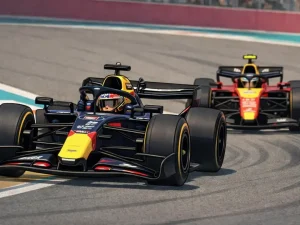
Ferrari arrived in Miami with the biggest shopping list in the pitlane and left with the nagging suspicion that it didn’t quite know what it had bought.
Eleven separate updates went onto the SF-26 for the first race back, yet the race result read like a team still searching rather than one closing in. Sixth and seventh on the road wasn’t the headline Ferrari wanted after a major development push, and it got worse post-race when Charles Leclerc’s early promise unravelled into a spin, damage, and a 20-second penalty that dropped him from sixth to eighth for repeated chicane-cutting judged to have gained an advantage.
The uncomfortable part for Ferrari isn’t simply that the upgrades didn’t catapult it to the front. It’s what happens inside the factory when a big package lands and the stopwatch refuses to play along.
Former Ferrari race engineer Rob Smedley, speaking on the High Performance Racing podcast, put it bluntly: these are the weekends that can bend an organisation out of shape.
“It’s slightly soul-destroying,” Smedley said, and his point was less about morale than momentum. When a team commits to a package of this size, it’s betting not only on downforce and balance but on the entire chain of tools that got it there — wind tunnel, CFD, simulator, correlation processes. If the track doesn’t validate the numbers, the tidy forward march of development turns into something far messier: questions, rechecks, and time lost.
From a technical perspective, Smedley warned that it can trigger a “negative loop”. The danger is that instead of building the next step, engineers are pulled into a reverse-engineering exercise — going back through the tunnel and simulation to find where expectation and reality diverged. That doesn’t just slow a team down; it can jam the pipeline, because the same infrastructure you need to create performance is now tied up trying to explain why the last set didn’t deliver.
There’s an important nuance here. Nobody is presenting proof that Ferrari has a full-blown correlation crisis. Fred Vasseur maintained in Miami that the upgrades worked as expected, while Leclerc hinted the more painful possibility: perhaps they did work, but rivals simply did more.
That would still leave Ferrari with a problem — just a different kind. Because if the package behaved, and Ferrari remains where it is, then the development rate relative to McLaren and Red Bull is the concern, not the measurement tools.
Either way, the paddock vibe after Miami was that the competitive order is tightening at the wrong moment for Ferrari. The Scuderia had looked like Mercedes’ nearest regular threat in the early phase of 2026, but Miami added weight to the idea that McLaren has found another gear and that Max Verstappen’s Red Bull is not going away quietly. Mercedes, meanwhile, didn’t even bring an upgrade package to Miami and is expected to roll something out in Canada — the kind of timing that tends to make rivals uneasy.
And then there’s Lewis Hamilton’s own tell ahead of Montreal: he says he won’t use Ferrari’s simulator before the Canadian Grand Prix because the virtual car and the real one aren’t aligning. That’s the sort of detail teams hate becoming public, because it speaks directly to trust in the tools. Drivers can work around an awkward car for a weekend; it’s much harder to work around uncertainty in the process that’s supposed to fix it.
Otmar Szafnauer, never one to sugar-coat how factories function under pressure, backed up Smedley’s broader warning. If a team has to divert effort into correlation work, it’s a double hit: finite resources get redirected away from performance, and the engineers who should be focused on making the car quicker are pulled into diagnosing why the models aren’t matching the circuit.
“You have finite resources and now you’re putting those resources on correlation, not making the car go faster,” Szafnauer said. And he’s right about the strategic cost: even if you solve the underlying issue, the calendar doesn’t stop while you’re doing it. Rivals keep bringing parts.
Szafnauer also offered a revealing paddock anecdote from Miami, saying he’d spoken on the Friday to Mercedes’ chief trackside engineering officer Andrew Shovlin — someone he knows well from their BAR days — and floated the idea that McLaren, not Ferrari, would become Mercedes’ biggest challenger.
According to Szafnauer, Shovlin disagreed at the time and pointed to Ferrari as the more likely threat. But Miami’s weekend, especially viewed through the lens of Ferrari’s large upgrade count and modest gain, seems to have nudged Szafnauer towards a sharper conclusion: Ferrari might be second in the standings, but only temporarily.
McLaren sits 16 points behind Ferrari in the early Constructors’ picture, close enough that a couple of weekends of cleaner execution — or one more step like Miami hinted at — can flip that order quickly. And this is where Ferrari’s Miami weekend really bites: big upgrade packages are supposed to be the moments you create breathing room, not the moments you start looking over your shoulder.
Canada now lands with a different kind of pressure. Ferrari doesn’t just need lap time; it needs clarity. If the SF-26’s Miami updates truly behaved “as expected”, then the expectation itself has to move, and quickly. If they didn’t, Ferrari has a tougher job — not because it can’t fix issues, but because the sport punishes anyone forced to spend races auditing their own toolbox while everyone else keeps building.