
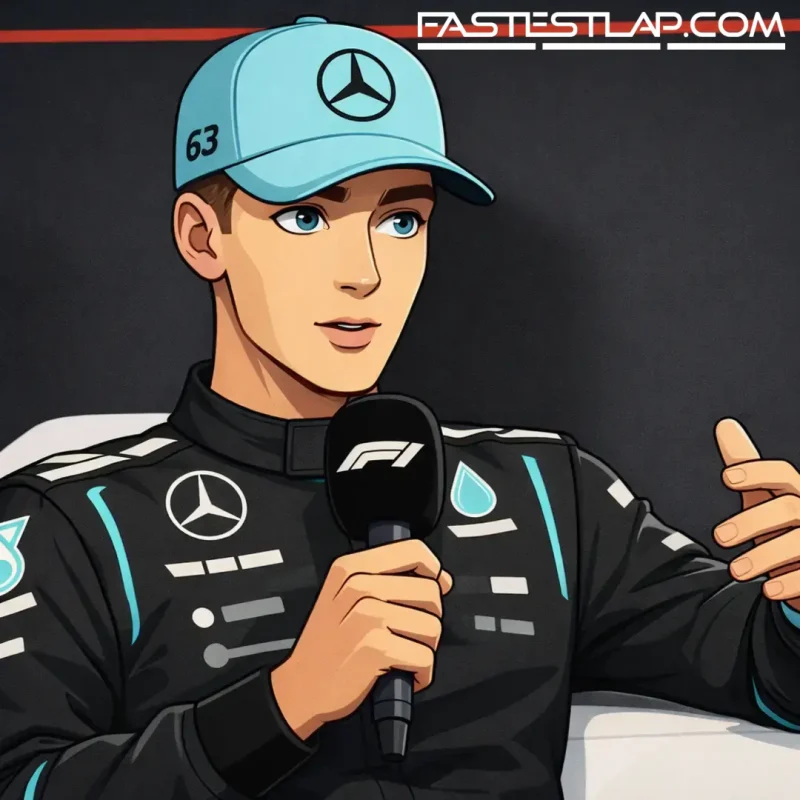
George Russell isn’t buying the idea that Formula 1 needs to “fix” its 2026 rules package — not after living through what he called the best wheel-to-wheel fight he’s seen in the sport since Lewis Hamilton and Nico Rosberg went at it in Bahrain 2014.
The Mercedes driver’s point wasn’t made in a vacuum, either. In Canada, Russell and team-mate Kimi Antonelli traded the lead in a properly tense, high-stakes scrap before Russell’s battery finally cried enough. And in Russell’s mind, that’s not evidence the current regulations are broken. It’s the opposite: a pretty loud endorsement of what these cars and power units can produce when two evenly matched drivers are allowed to lean on them.
“I loved it,” Russell said. “I thought it was great, and I’ve not had a battle like this in years.
“I haven’t seen a battle like this, probably since Lewis and Nico in Bahrain 2014 and these new cars allow you to do that. These new engines allow me to do that.”
That “new engines” line is doing a lot of work — and it’s where the politics really starts to creep in. The 2026 era has been noisy since day one, with complaints that racing can feel overly shaped by energy management, power deployment and the sometimes stark difference between cars that are “in the window” electrically and those that aren’t. Critics have framed certain overtakes as too dependent on who’s got the bigger shove left in reserve, rather than who’s braver on the brakes.
Russell has consistently pushed back on that, and yes, it’s impossible to ignore the context: Mercedes has often looked like it’s got the package under control. But his argument in Montreal leaned less on team advantage and more on the simple fact that drivers can actually follow and fight — and, crucially, do it without the battle dying the moment someone gets within a second.
“I don’t know why anybody wants to change them,” he said, “because we had amazing battles in Melbourne, we had great battles in China, Kimi and I have had a great battle today and yesterday, and that’s only possible because of how these power units are so that’s my view.”
Russell’s remarks land as a fairly direct counterpunch to Max Verstappen, who has been far more sceptical about where F1 is heading with this technical direction. Verstappen’s frustration surfaced again after qualifying in Canada, where he warned — in unusually blunt terms even by his standards — that he’s not interested in sticking around into 2027 unless there’s a compromise.
“Well, if it stays like this, it’s going to be a long year next year, which I don’t want,” Verstappen said. “I can tell you, if it stays like this, it’s just mentally not doable.”
That “mentally” line is telling. It speaks to a driver’s experience of these weekends — the constant need to hit precise energy targets, the way races can swing on whether the car is harvesting or deploying at the wrong moment, and how quickly rhythm gets broken when the system doesn’t give you what you’re asking for. Russell’s Canadian battle ended because the battery gave out. That, too, is part of this era’s reality, and it’s why some in the paddock view the spectacle as one failure mode away from deflating.
The sport is already edging toward change. An agreement in principle has been reached to adjust power delivery for next season, shifting to a 60–40 split in favour of the internal combustion engine over the electrical component. It’s a meaningful signal that F1’s decision-makers have heard the complaints — but it’s not done yet. The tweak still needs to be officially voted through, and until that happens, teams will keep posturing for the version of “better racing” that also happens to suit their competitive picture.
Red Bull team principal Laurent Mekies struck an optimistic tone about the likelihood of it passing, insisting the paddock will ultimately prioritise the show.
“I’m optimistic we’ll find the right solutions,” Mekies said. “I’m optimistic we’ll find a majority of people agreeing on improving the race.
“When it comes to what matters for the sport, I think at some stage we will all put aside what we feel it may or may not do to our relative competitiveness to do a step in the right direction for the sport. I think ultimately we’ll get to that point.”
Russell’s stance — and the timing of it — matters because it frames the debate around a simple question: are we solving a problem, or smoothing out something that’s finally producing genuine, sustained fights at the front?
Canada gave ammunition to both sides. On one hand, Russell vs Antonelli was a showcase: pressure, response, adaptation, and the kind of racing where neither driver looked like they were simply waiting for DRS to do the job. On the other, the fact the fight ended with a battery issue is exactly the kind of thing Verstappen and others point to when they talk about these cars demanding too much compromise to be enjoyable, even for the best drivers on the grid.
What’s clear is that the next vote isn’t just a technical adjustment. It’s a philosophical one. Russell is effectively arguing that F1’s finally got a platform that lets drivers race each other again, and that the sport should be careful not to overcorrect because a few voices don’t like how it feels from the cockpit.
Verstappen is arguing that if the cockpit experience becomes a grind, the whole thing becomes unsustainable — no matter what it looks like on TV.
And somewhere between those two positions sits the uncomfortable truth of this rules cycle: the racing can be brilliant, and the product can still be fragile.









