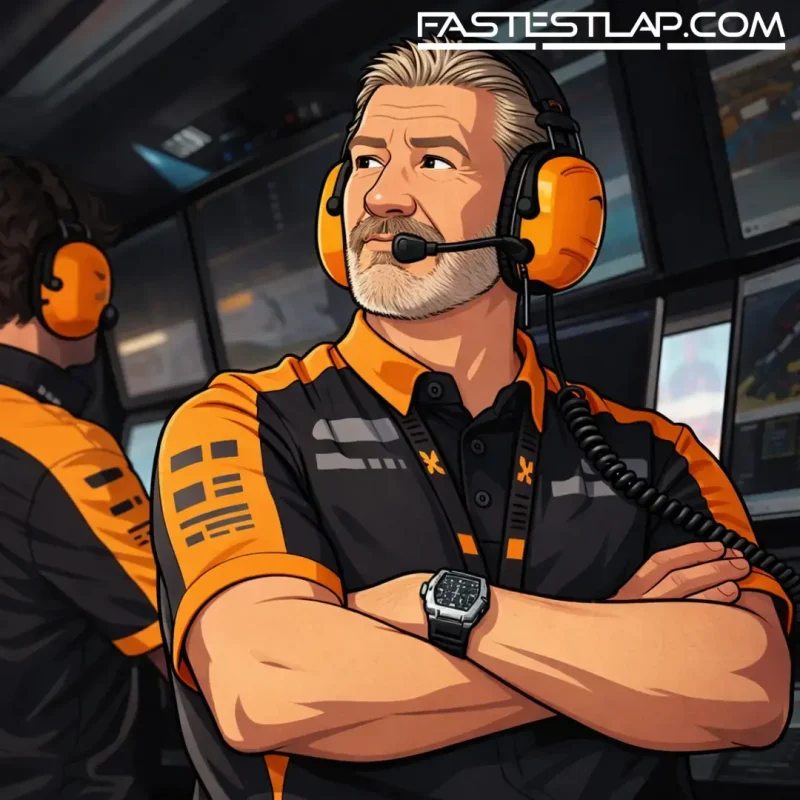
Zak Brown has never needed much encouragement to lob a grenade across the pitlane, but even by his standards this was an intriguing one: a public vote of confidence for Christian Horner to come back into Formula 1.
Brown and Horner spent years trading barbs when Red Bull and McLaren were fighting their own wars – sporting, political, occasionally personal. Yet asked about Horner’s future, the McLaren CEO didn’t reach for the old rivalry. He reached for something closer to admiration.
“Christian was a great personality for the sport,” Brown said, speaking to invited media on Wednesday. “Sport always has great personalities. They come in, come and go. I think it’d be great to have Christian back in the sport. He’s a great operator. His track record speaks for itself.”
It’s hard to argue with the record. Horner leaves behind eight drivers’ titles and seven constructors’ championships as Red Bull team principal, plus a reputation for extracting advantage from any grey area that would hold still long enough to be examined. He also became, in the eyes of many rivals, the paddock’s favourite antagonist – the one who’d turn up to a knife fight with a grin and an extra knife.
But Red Bull’s internal landscape is now almost unrecognisable from the powerhouse it was. Horner was dismissed in a shock move shortly after the 2025 British Grand Prix, with the team dealing with declining form and a swirl of off-track issues. The exits didn’t stop there: Adrian Newey departed to Aston Martin, Jonathan Wheatley moved on, and Helmut Marko also left last year. For a team that once looked immovable, it’s been a startlingly fast unpicking.
Brown’s point, though, wasn’t nostalgia. It was that Horner is too wired into this world to stay away for long.
“I’d be shocked if he wasn’t back in the sport, whether it was with Alpine or someone else,” Brown said.
The Alpine mention isn’t random. Horner has been linked to a bid connected to Alpine’s ownership picture, with talk of a move involving Otro Capital’s 24 per cent stake. The broader detail is still a haze, but the direction of travel is clear enough: Horner’s options appear to be opening rather than closing.
Brown even framed Horner’s return as something the paddock could use. In an era where team bosses are increasingly careful, corporate and camera-trained, Horner represented a different type of operator – one who understood that power in F1 doesn’t just come from lap time, it comes from influence. Brown all but said the sport is short of figures who can drive a narrative as well as a programme.
“I’d rather have 10 weak team principals, but that’s not going to happen any time soon,” Brown quipped, before adding that there’s “huge talent” coming through.
If Brown sounded oddly generous towards a former foe, it may also be because Red Bull’s upheaval has created a vacuum – and vacuums in F1 get filled quickly. Which brings us to Laurent Mekies, Horner’s successor and the man now tasked with overseeing what Brown described as a “reset” and a “redirect”.
Mekies took over in the immediate aftermath of Horner’s removal. Under his watch, Max Verstappen mounted an inspired late push in the championship fight, but it wasn’t enough to salvage the season. Now, in 2026, Red Bull’s challenges are more structural than seasonal: the team is in the early phase of producing its own power unit in partnership with Ford, and the start has been bruising. After three grands prix weekends, Red Bull has just 16 points.
Then came another gut-punch: Verstappen’s long-time race engineer Gianpiero Lambiase is set to join McLaren no later than 2028. It’s not an immediate loss on the timing, but it’s a loud one on symbolism. When the engineer-driver axis fractures, it tends to signal more than a simple career move.
Brown, unsurprisingly, didn’t present Red Bull as a wounded animal ready to be put down. He did, however, paint a picture of a team needing to reassemble itself almost from scratch in key areas.
“One would be very foolish to write Red Bull off,” he said. “I think they have to kind of do a little bit of a reset, right? They lost a lot of people – Christian, Wheatley, GP, Newey, Dan Fallows… so I think much like what I came into… the majority of the pit wall has changed.”
And that’s the crux. Red Bull’s competitive dip can be explained away as the messy reality of a new cycle, especially with a new power unit programme to bed in. What’s harder to dismiss is the sheer volume of institutional memory walking out the door. Great teams can survive a departure. They rarely enjoy surviving a cascade.
Brown believes Mekies can do it.
“I rate Laurent, I think he does a very good job, he’s technical, he’s young, and I think he’s got to rebuild the people that he lost and rebuild the team, and I have no doubt he will,” Brown said.
The comparison to McLaren is telling. Brown has lived the slow grind of dragging a team back to the front, unlocking talent that was already there but misfiring. He’s suggesting Red Bull’s situation is similar now: the ingredients remain, the recipe has been ripped up.
As for Horner, Brown’s endorsement lands as both compliment and challenge to the rest of the grid. Because if Horner really is on the verge of a return – Alpine or otherwise – it won’t just be another senior hire. It’ll be the reintroduction of a figure who understands exactly how to bend a paddock conversation to his will, and who will arrive with unfinished business.
In a sport entering a new technical era and watching the old order wobble, that might be exactly the kind of chaos Formula 1 is about to make room for again.