
Ferrari will arrive in Barcelona with an unusually driver-specific tweak on the agenda: Charles Leclerc is changing his braking configuration, shifting to Carbone Industries pads and discs in a bid to stabilise a feel he says has been slipping away from him over the last couple of weekends.
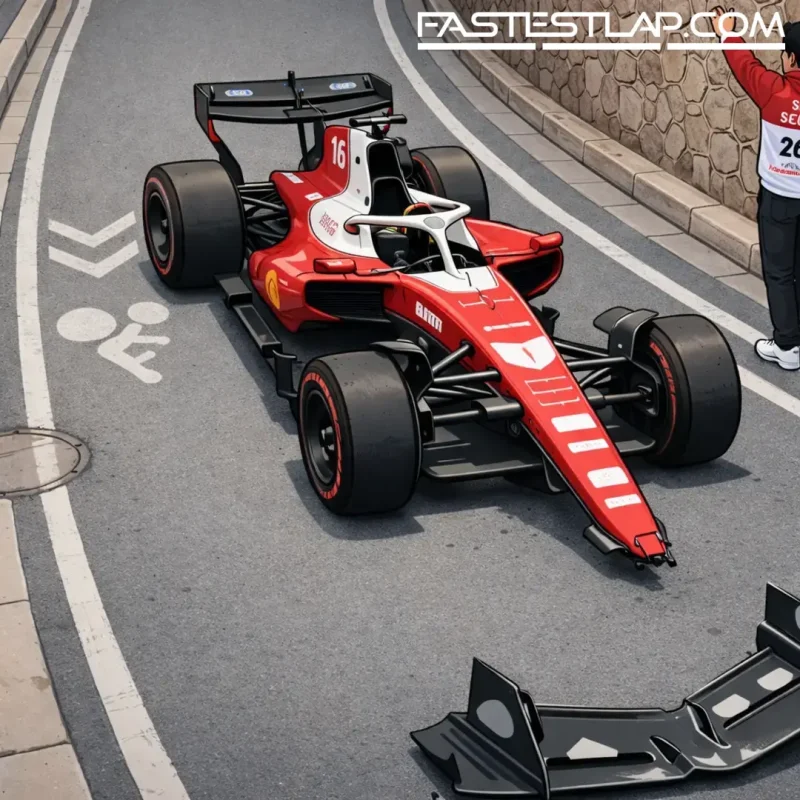
It’s a move that’s been coming since Monaco, where Leclerc’s race ended in the barriers when he was running in podium contention — an exit he pinned squarely on a braking problem in the cockpit and, later, in the debrief. Over team radio he erupted about his “f***king brakes”, and afterwards described them as “extremely inconsistent”, insisting that only his front-left corner was behaving normally.
For Barcelona, he’s effectively aligning his set-up with Lewis Hamilton’s. Hamilton had already switched brake configuration back at the Japanese Grand Prix, after pushing for the change for some time. Ferrari, by design, had been running the two cars split on key braking components, a common approach when a team is trying to broaden its operating window or validate different hardware in live conditions. But Leclerc’s patience with the trade-off has run out.
“I think it’s clear now that we are probably going to change a little bit the configuration,” Leclerc said on Thursday. “How much it will change? I still have to test it and to see how much it will change.
“I don’t expect a revolution, however. In some particular cases I expect it to be easier to manage, but then we’ll obviously see.”
That “don’t expect a revolution” caveat matters. Brakes in modern F1 aren’t just about stopping power — everyone has that. They’re about repeatability, confidence on the first hit, and the way the car transitions through decel and into rotation. When a driver says they want “consistency”, it’s usually code for wanting the same pedal every lap so they can live on the limit without second-guessing where the bite point is going to be.
And Leclerc was blunt about what he’s chasing with the change: “I think generally, it’s just you want consistency. That’s all I need.”
Hamilton, meanwhile, made it clear the alternative configuration wasn’t some last-minute experiment, but an option both drivers had tried.
“I changed my brakes in Japan,” Hamilton confirmed when asked about his set-up. “It’s been something that I’d asked for a long time ago.
“I look at every element of what we have and look to see how we can make it better. Ultimately, it’s down to driver preparation, preference, and feel.
“Both of us tested the option that I’m racing, and Charles didn’t want it. In the end, he chose the one he’s on, and now he’s changed his mind.”
That last line lands with a bit of edge, even if it was delivered matter-of-factly. Ferrari hasn’t exactly had a quiet season internally, and the dynamic of two high-profile drivers converging on one technical direction is never purely mechanical. When a team starts a weekend with two different solutions, it’s manageable. When one driver abandons their path to adopt the other’s, it can tighten the political and engineering focus in a hurry.
There’s also the supplier angle. Ferrari is backed by Brembo, and Leclerc’s Monaco comments inevitably drew attention. Brembo responded by branding the remarks “premature”, pointing to its long relationship with Ferrari and stressing that incidents like this need proper telemetry analysis with the team before conclusions are drawn.
“In cases such as this, it is necessary to examine the telemetry data together with the team’s engineers in order to accurately determine the origin of the incident,” the company said.
Barcelona, then, becomes more than a simple parts swap. It’s Ferrari putting a stake in the ground on what its drivers need from the pedal — and, quietly, admitting that the split approach has cost Leclerc more confidence than it has bought the team useful information.
“It was a decision that we made as a team to kind of have the cars split,” Leclerc explained. “And the last two weekends have been more difficult than what I initially anticipated, and now we’ll go in the direction of Lewis.”
The immediate question is whether the change actually cures what Leclerc felt in Monaco, or simply gives him a more predictable platform to work around whatever’s going on. Either way, the timing is telling. Barcelona is a place where drivers lean hard on the brakes all weekend and where a car’s behaviour under deceleration tends to expose anything marginal. If Leclerc gets the pedal he’s been missing, it won’t show up as a headline-grabbing “revolution” — it’ll show up in the small stuff: later, cleaner braking references; less steering correction on entry; and the kind of calm over the radio Ferrari could do with right now.









