
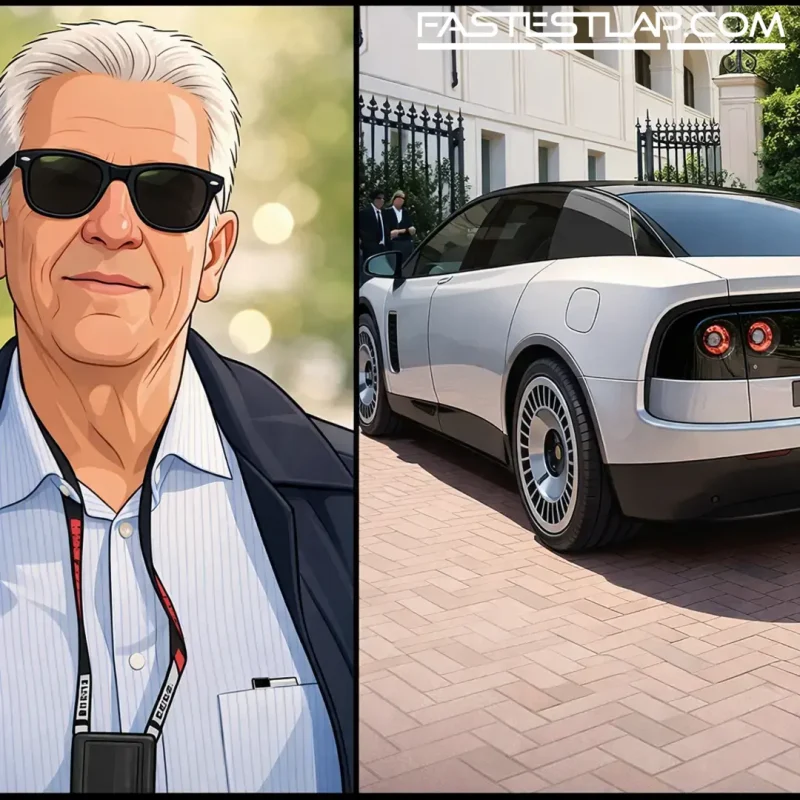
Ferrari knew exactly what it was doing when it pulled the covers off the Luce in Rome. Not just unveiling its first all-electric road car, but planting a flag in territory where sentiment runs hotter than lap times: what, exactly, is allowed to wear a Prancing Horse?
The backlash arrived on schedule, and it came with a famous name attached. Luca di Montezemolo, the former chairman who embodies a particular era of Ferrari identity, didn’t nibble around the edges. His warning was blunt — that Ferrari risks “destroying a legend” — and his suggested remedy was even more pointed: take the badge off the Luce altogether.
That sort of critique lands differently when it’s coming from within the family, even if Di Montezemolo no longer sits at the top table. And Ferrari’s response has been just as unmistakable: we’ve heard you, and we’re not blinking.
Piero Ferrari, vice chairman and the last direct link to the company’s founding name, has effectively drawn the line. He isn’t interested in litigating the Luce’s legitimacy through nostalgia or hypotheticals. His message to critics is simple: drive it.
“Those who want to criticise can criticise,” Ferrari said, before adding the part that really matters. Go and see it, try it — and you’ll likely change your mind once you’ve been behind the wheel.
It’s a very Ferrari way of framing the argument: don’t debate the idea, judge the sensation. The company has always sold experience as much as engineering, an emotional transaction where the product is validated by how it makes you feel. In that sense, the Luce isn’t being positioned as an exception to tradition, but as the next test of it.
Of course, even by Ferrari standards, this is a leap. The Luce is not just the brand’s first EV; it’s also its first five-seat model — a double departure that guarantees it won’t be assessed on its own merits alone. It’ll be treated as a symbol, either of modern ambition or of creeping dilution, depending on where you sit.
Ferrari doesn’t seem remotely surprised by that dynamic. Emanuele Carando, the company’s head of global product marketing, essentially shrugged at the inevitable discourse, describing “incredible discussion” as part of the plan. Great lovers, plenty of haters — and, in his view, that’s fine. For a brand that trades on mythology, being ignored is far more dangerous than being argued over.
Ferrari also made sure its Formula 1 stars were in the room. Lewis Hamilton and Charles Leclerc had the honour of unveiling the Luce and then taking it for a test drive afterwards — a carefully chosen image, because if there’s a modern authority on what Ferrari should feel like, it’s the two people currently strapped into its grand prix cars.
Both came away as advocates. Leclerc, in particular, leaned into the language Ferrari wants repeated: that it still feels special.
“You feel special when you drive this Ferrari,” he said, praising the way the company has carried that sensation into “a completely new category” with electric vehicles. In other words: different powertrain, same spell.
That’s the central tightrope here. Ferrari isn’t trying to convince the faithful that an EV can be “as good” as the cars they already revere. It’s trying to argue something subtler — that Ferrari-ness isn’t exclusively tied to cylinders and combustion, but to the whole package: response, control, theatre, and the sense that you’re operating something deliberately engineered to be coveted.
Di Montezemolo’s reaction suggests that for some, the badge is inseparable from a certain mechanical romance. Ferrari’s counter is that the badge is earned by the totality of the product, not by the method of propulsion. That’s not a technical debate so much as a philosophical one, and it’s why this conversation has been so charged so quickly.
Ferrari is also asking customers to buy into the bet in hard numbers. The Luce is set to cost $640,000, with deliveries due to begin in the fourth quarter of 2026. That pricing is its own statement: this isn’t Ferrari dabbling in a side project, or chasing volume, or softening the brand for mass appeal. It’s being sold as a flagship-level object — and Ferrari will expect it to be judged, and revered, accordingly.
Whether the wider audience follows Piero Ferrari’s advice and lets the drive do the talking is another matter. But from Ferrari’s perspective, the argument is already being fought on the terrain it prefers: emotion, identity, and the insistence that the only verdict that counts is the one delivered from the driver’s seat.
In the end, the Luce was always going to be polarising. Ferrari’s only real misstep would have been pretending it wouldn’t be. Instead, it has chosen a more interesting posture: come and try it — and if you still hate it afterwards, at least you’ll be arguing with your hands on the steering wheel, not from the sidelines.









