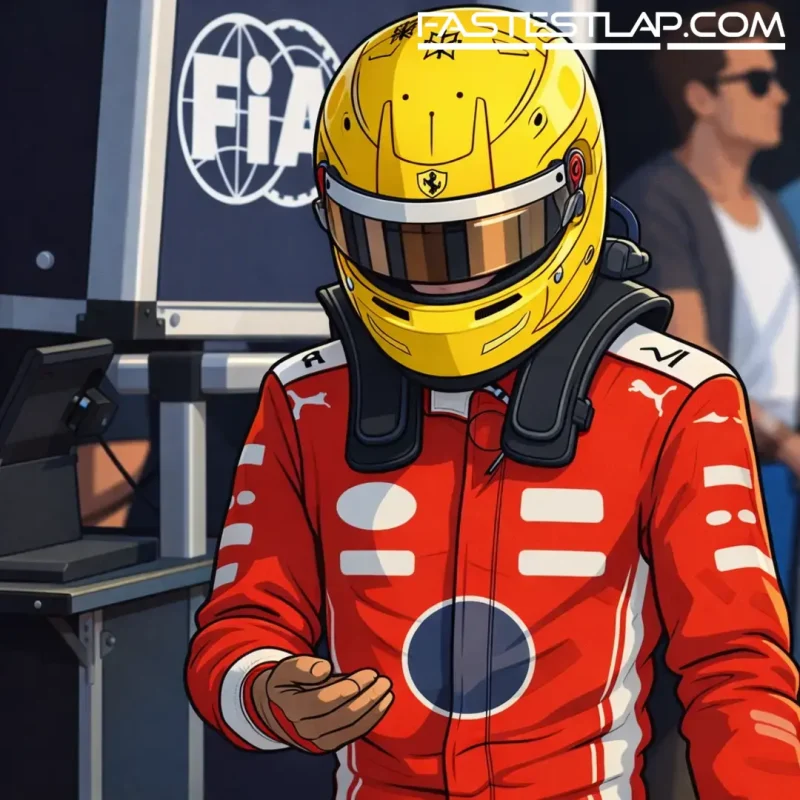
Aldo Costa isn’t in the business of cheap shots, and that’s why his verdict on Lewis Hamilton has landed with a dull thud rather than a bang. When a long-time Ferrari and Mercedes engineer starts talking about the “inevitable” curve of decline, it hits differently to the usual talk-show noise. It’s not an attack on Hamilton’s legacy; it’s the cold, unsentimental logic that underpins F1’s most brutal truth: time always gets its lap back.
Hamilton’s move to Ferrari was framed as romance and risk in equal measure — the last great swing for an eighth title after the ground-effect era derailed his Mercedes dominance from 2022 onwards. Twelve years at Brackley, then the red reset button. The storyline practically wrote itself. But four rounds into 2026, the plot has started to look less like a fairytale and more like a hard negotiation with reality.
There have been flashes. Hamilton finally broke his Ferrari grand prix podium duck with third in China, and he earned it in a proper scrap with Charles Leclerc late in the race. If you were looking for a sign that the old instincts haven’t gone anywhere, that was it: elbows out, positions defended, pressure applied at the right moment. The trouble is that those moments have been too isolated to change the direction of the wider picture.
In the races that have defined Ferrari’s early season narrative, Leclerc has more often looked like the reference point. He beat Hamilton wheel-to-wheel in Australia and again in the Sprint in China, with the pair running home in formation both times. Japan was shaped by Hamilton’s late power trouble, which robbed him of the chance to defend, and in Miami Leclerc simply had more pace in the upgraded SF-26 before a post-race penalty shuffled the official order and flattered Hamilton’s finishing position. On points, it’s tight enough between the Ferrari pair — eight points separate them, with Lando Norris sitting between the two — but the week-to-week momentum hasn’t really felt 50/50.
The larger issue is the championship context. Hamilton is already 49 points behind leader Kimi Antonelli after four rounds. That’s not season-ending in May if you’ve got a car capable of winning regularly, but it does leave very little room for “finding something” on Saturdays, ironing out operational details, or waiting for upgrades to transform the pecking order. This is the trap veterans fall into: the season starts making demands that require not just speed, but relentless perfection — and perfection is harder to manufacture when you’re still learning a new environment, new voices, and new habits under pressure.
Costa, speaking on the *Terruzzi Racconta* podcast, approached it from the angle anyone in a garage understands. “From an emotional point of view, I would love to see him finally achieve his dream of winning that eighth world title with Ferrari,” he said, before adding the part that made people sit up: Hamilton is 41, and “every driver eventually reaches a point where their performance begins to decline a little.”
Costa was careful not to pretend he can diagnose it from a distance. He left that to “his race engineers and the people working closely with him”. But he underlined the inevitability: “That moment inevitably comes for everyone, there’s not much you can do about it.” And he pointed to the other uncomfortable variable in Hamilton’s equation: “He also finds himself alongside an extremely strong teammate.”
That last line matters. Ferrari didn’t hire Hamilton to be an experienced number two, and Hamilton didn’t go there to be managed into a dignified finale. Yet Leclerc is in the prime years, deeply embedded in the team’s rhythms, and fast enough that “good weekends” from Hamilton won’t be enough — not when the margins are measured in tenths and the narrative is written in qualifying gaps and first-lap positioning.
Costa’s comments have arrived right behind another, more blunt intervention from Ralf Schumacher. The former F1 driver, now a Sky pundit, has urged Hamilton to retire, arguing that he has nothing left to prove after 20 seasons. Schumacher praised what he called a “fantastic” comeback this year, then delivered the punchline with typical dryness: “But I think everything has an end, except sausages, they have two.”
Schumacher also lumped Fernando Alonso into the same category, suggesting both veterans should “vacate their cockpits at the end of the year and give young people a chance.”
The easy reaction is to dismiss this as former-driver theatre — and some of it is. But it also reflects a wider paddock impatience that surfaces whenever a legend is no longer obviously ahead of the curve. F1 is always selling the next thing. If you aren’t winning, the sport starts moving on around you, loudly.
Still, the data points from 2026 don’t cleanly support the idea that Hamilton is simply “finished”. He’s already shown he can fight, and he’s not being obliterated in the standings by his teammate. The more nuanced question — and the one Costa is really pointing at — is whether Hamilton can still sustain the kind of week-in, week-out edge that turns good seasons into title seasons, particularly in an era of new overbody aero regulations where adaptation is a competitive weapon in itself.
And there’s the rub with Ferrari. If the SF-26 isn’t a consistent race-winning car, the eighth title conversation becomes academic, decline or no decline. Hamilton can still drive brilliantly and finish third, fourth, fifth — and that’s not what he came for. At this point, the hill he has to climb isn’t just Antonelli’s lead; it’s Leclerc across the garage, the clock in the mirror, and a championship that’s already asking him to chase rather than control.
The season is young, but the questions are already old: can Hamilton make Ferrari bend to him quickly enough, and can he string together the kind of ruthless run that doesn’t leave any room for age, adaptation, or circumstance to become the story? Costa’s warning isn’t that Hamilton has lost it. It’s that F1 eventually stops waiting for anyone — even Lewis Hamilton.