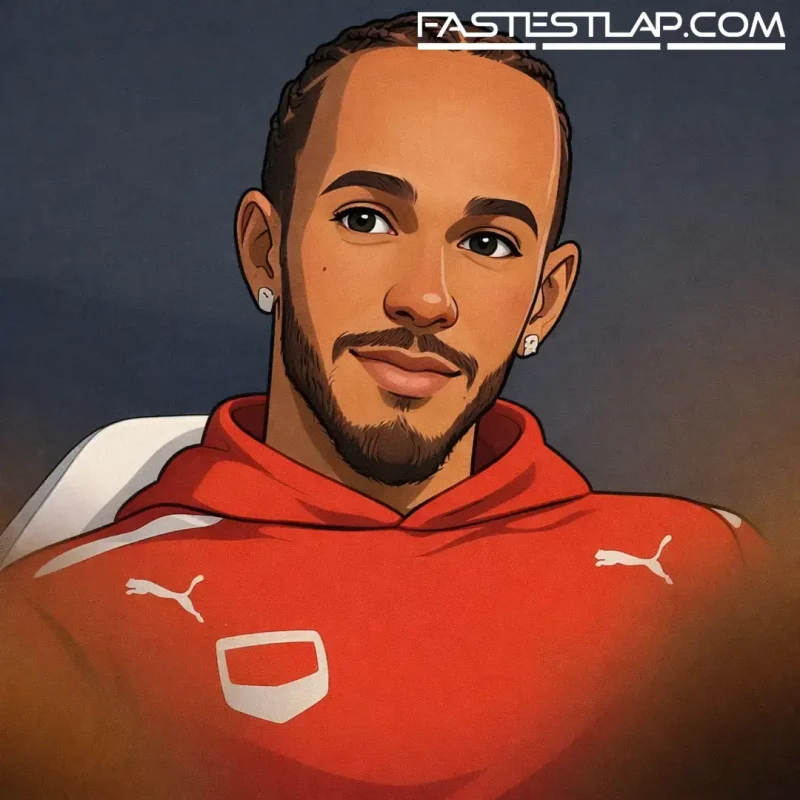
Lewis Hamilton has spent the last decade as the sport’s most obvious reference point for how to manage a championship campaign inside a top team. In Montréal, standing on a Canadian Grand Prix podium he shared with Kimi Antonelli, he made it clear he won’t be volunteering as the teenager’s on-call mentor while the 2026 title fight is still very much alive.
Antonelli’s win in Canada was his fourth in a row — a sequence that’s already carved out a little piece of history as the first time a driver has started their victory tally with four consecutive wins. It also stretched his advantage in the standings to 43 points after Mercedes team-mate George Russell failed to score, retiring from the race.
Hamilton, meanwhile, left Montreal with his best result so far as a Ferrari driver, finishing second behind Antonelli. It was one of those weekends that managed to feel both familiar and faintly strange: Hamilton back on a North American podium, the grandstands roaring, but the winner’s cap sitting on the head of the kid in the next seat.
Asked about Antonelli’s sudden transformation from promising prospect to championship pacesetter, Hamilton was complimentary — and deliberately unhelpful.
“I think you forget that we’re competitors, so he’s already doing a great job. I’m not going to give him any more pointers!” Hamilton said, laughing as he drew a line under the idea that wisdom is freely traded when silverware is on the table.
That’s not cold-blooded so much as brutally honest. Hamilton’s own ambitions — and Ferrari’s — don’t leave much room for playing elder statesman to the driver currently dismantling the field. The moment you start giving “just one small tip” to the guy with all the momentum, you’re not being magnanimous; you’re being naive.
Still, Hamilton couldn’t resist framing Antonelli’s rise through a lens he knows better than anyone: what it feels like to arrive in Formula 1 ready to fight for a championship before you’ve even learned where the emotional trapdoors are.
Hamilton was 22 when he entered F1 at McLaren in 2007 and immediately found himself in a title fight, eventually falling short to Kimi Räikkönen. Sitting alongside Antonelli in Canada, he pointed out that the landscape for young drivers has shifted — not just in terms of media scrutiny and social noise, but in how teams now build protective structures around their prized assets.
For Hamilton, the key difference isn’t talent. It’s the scaffolding.
He described 2007 as “intense”, saying the support systems simply weren’t in place in the way they are now — even if he “wouldn’t change it for the world” given what it taught him. In contrast, he credited Toto Wolff and Mercedes for surrounding Antonelli with “the right support” to keep him steady, highlighting the mental side as much as the technical and competitive demands.
It’s a telling observation, and not just because it doubles as a compliment to Antonelli. Hamilton is effectively acknowledging that the modern top team treats the driver as a high-performance project: not merely fast, but sustainably fast. This isn’t about softening someone; it’s about removing avoidable instability so the speed shows up every weekend, not just when life’s going well.
Mercedes, of all outfits, would naturally be sensitive to that. They’ve lived through championship years where the psychological load inside the garage was as decisive as the car. Antonelli now benefits from a team that has institutional memory of what pressure does — and how quickly it can spread if it’s not managed.
The intrigue, of course, is that the person with the biggest stake in stopping Antonelli isn’t Hamilton at all. It’s Russell, the established Mercedes lead who suddenly finds himself staring at a 43-point gap and a team-mate who’s winning as if it’s routine. No amount of internal “support” changes the basic mathematics of that dynamic: if Antonelli keeps banking wins, Russell’s margin for error is essentially gone.
And yet Hamilton’s presence in this picture matters. Not because he’s going to whisper secrets into Antonelli’s ear — he won’t — but because he’s a living reminder of how violently a debut-era title fight can swing. Hamilton knows how quickly momentum can turn into scrutiny, how one messy weekend can trigger a spiral of questions, and how the pressure changes shape once everyone in the paddock stops treating results as a novelty.
Antonelli, to this point, has looked disarmingly unmoved by all of it. Four straight wins will do that: confidence hardens, radio messages get calmer, and the whole operation starts behaving like it expects to be there. But the season is long, Russell is too good to stay quiet forever, and Mercedes will have to navigate the awkward reality that “supporting a driver” can become “choosing a driver” faster than any team admits in public.
Hamilton offered his verdict on where Antonelli stands right now without dressing it up as guidance. The teenager doesn’t need it, he implied — not with the structure Mercedes has put around him, and not with the form he’s in.
He may be right. But Hamilton’s refusal to play consultant is its own little reminder: the paddock might enjoy a feel-good storyline, yet the people on the grid are still paid to take it away from each other. In 2026, Antonelli’s title push has become the sport’s headline. Hamilton’s job — and Russell’s — is to make sure it doesn’t become a coronation.