Ferrari turned up to Miami with the kind of upgrade list that usually signals a team either very confident in its numbers — or very uneasy about where it really stands.
Eleven new parts went onto the SF-26 across a weekend with essentially no margin for methodical back-to-back work, and that decision is now being framed as the sort of self-inflicted complication that can muddy conclusions as much as it can unlock lap time. James Hinchcliffe, speaking on the F1 Nation podcast, put it bluntly: Ferrari ignored what he called the “number one rule of engineering” — change one thing at a time, so you can actually understand what’s helping and what’s hurting.
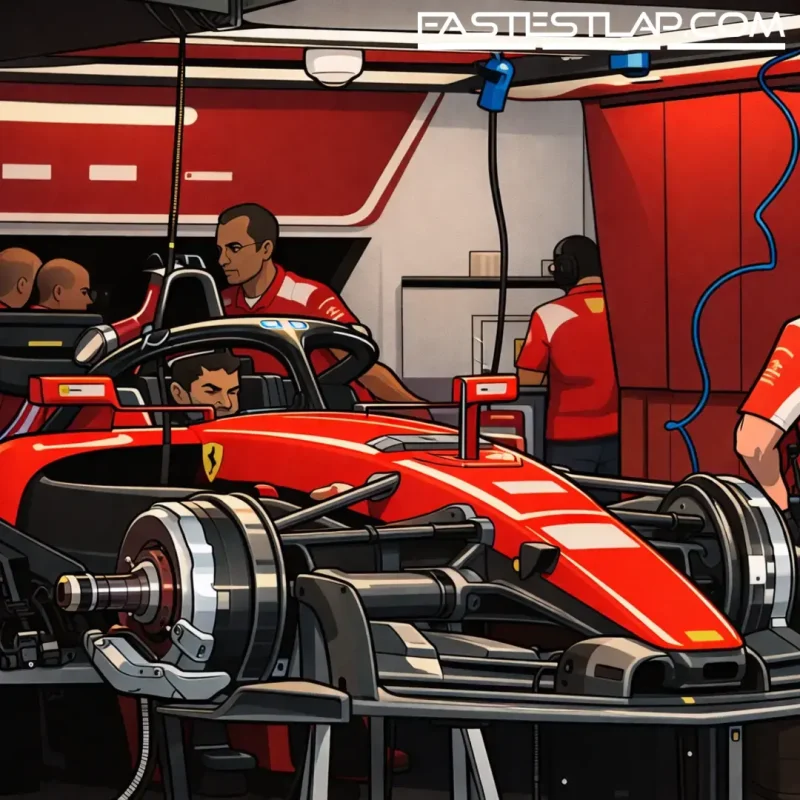
In a cost-capped era with limited track running and Miami’s single practice session, it wasn’t hard to see his point. Ferrari’s package included a new floor and diffuser, plus revisions to its “Macarena” rear wing aimed at improving drag reduction while boosting load when the car’s in its cornering configuration. That’s not trimming around the edges; that’s going straight at the car’s core aerodynamic platform. If the expected step doesn’t arrive — or arrives inconsistently — you’re left untangling a knot of interacting variables rather than pinpointing a single misfire.
McLaren, by comparison, played it far straighter. Seven new parts is still a meaningful hit, but it’s a scale that allows engineers to build a cleaner picture of cause and effect, especially when the updates span the floor, engine cover, front and rear corner changes and a new rear wing on the MCL40. The upshot in Miami was unambiguous: McLaren not only won the Sprint, it left the Grand Prix with a double podium behind Kimi Antonelli and, in the process, shoved Ferrari off the rostrum for the first time this season.
Ferrari did improve — just not as much as McLaren did. That’s the sting.
Hinchcliffe’s argument isn’t that Ferrari’s engineers suddenly forgot how to develop a Formula 1 car. It’s that the modern constraints punish any attempt to brute-force a solution. With no testing and limited practice, bolting on a shopping list of components turns the weekend into a live experiment where the data set is noisy and the deadlines are immediate. Drivers feel a different car. Engineers see different traces. Correlation starts masquerading as causation.
“You’re bolting on 11 or 12 different components,” Hinchcliffe said, “and it really makes the job for the engineers difficult… the job for the drivers difficult to isolate what’s helping, what’s changing, what’s hurting.”
And that’s before you get to the uncomfortable reality that nothing on an F1 car works in isolation. A floor change talks to the diffuser. A rear wing revision alters how sensitive the platform is. One component can “work” only if another is doing its job properly. If the balance window shifts, you may end up chasing set-up rather than learning the upgrade.
It also reframes the broader picture of Ferrari’s early-season position. The team arrived in Miami trailing Mercedes after the opening rounds, and this was clearly a moment earmarked to claw back ground. Throwing the kitchen sink at the SF-26 reads like a response to pressure — internal as much as external — to show visible progress. But if the upgrade hit is too big to evaluate properly, the weekend risks becoming less about points and more about confusion carried into the next flyaway.
McLaren’s approach, on the other hand, has the whiff of a team comfortable in its process. Hinchcliffe suggested the restrained rollout may even have been intentional — a way to keep development time on parts that weren’t quite ready, while also making it easier to identify any weak links in the package that did make it to the circuit.
“It’s one of those sneaky things that you could see masterminded by Andrea Stella,” Hinchcliffe said, pitching it as a calculated choice: delay a few items, keep refining them for “another couple days”, and arrive with an upgrade set you can actually read.
There’s a second-order benefit to that kind of discipline, too. When the car responds in a predictable way to a defined set of changes, you build momentum. The team’s simulator correlation tightens. The race engineers can be braver with set-up because they trust the direction. In 2026, with so many weekends structured to limit experimentation, that confidence is worth lap time in itself.
The numbers from Miami underline why this matters. McLaren scored 48 points over the weekend, cutting into both Mercedes and Ferrari. The Woking team now sits 16 points behind Ferrari and 86 behind Mercedes — still a sizeable deficit to the championship leaders, but not the kind that forces panic upgrades just to feel like you’re doing something.
For Ferrari, Miami is now a homework assignment. Not because the upgrade concept is necessarily wrong, but because the method of introduction may have made the answer harder to find. The Scuderia can absolutely recover from that — plenty of teams have had a “messy” upgrade weekend and come back stronger — but the price is time. And time is the one currency you can’t buy back once the calendar starts accelerating.
The irony is that Ferrari’s ambition in Miami was obvious. So was McLaren’s patience. On this evidence, patience looked like the sharper tool.