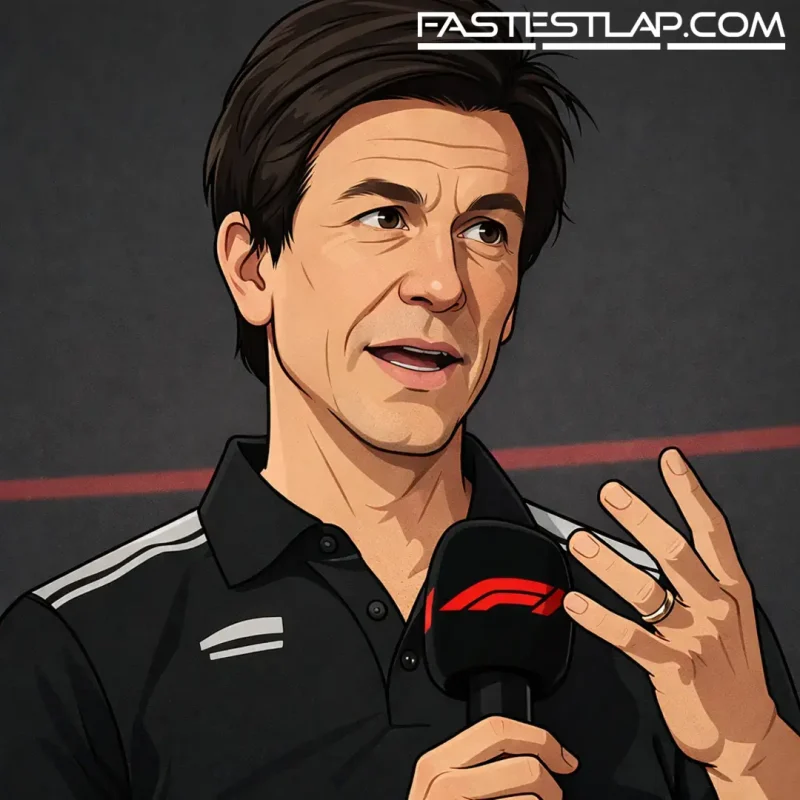
Toto Wolff didn’t bother with nuance in Miami. After a weekend that finally put Mercedes under something resembling proper heat, the team principal suggested anyone still looking for reasons to moan about the racing should “hide”.
It was a pointed line, but it landed because Miami delivered the one thing the early part of 2026 had largely withheld: uncertainty. Mercedes arrived at the fourth round of the season having set the pace through the opening races, only for the sport’s enforced spring break to act as a reset button. Rivals came back armed with updates and, crucially for this new era, a slightly different energy-management landscape.
Ferrari turned up with an eye-catching 11 new parts, while McLaren and Red Bull rolled out seven apiece. Alongside the hardware, there were tweaks to how the hybrid system could be used: qualifying saw maximum permitted recharge reduced from 8 MJ to 7 MJ, while in the grand prix boost mode was capped at 150kW and MGU-K deployment restricted to 250kW in some parts of the lap. It didn’t rewrite the regulations, but it was enough to move the goalposts for anyone who’d optimised their package around previous assumptions.
The immediate consequence was that Mercedes suddenly looked… human. McLaren controlled the Sprint, running 1-2 ahead of Charles Leclerc’s Ferrari to hand Mercedes its first defeat of the season in any race format. Over the longer weekend picture, the points told the story even more clearly: Mercedes was outscored for the first time in 2026, taking 45 to McLaren’s 48. Ferrari remains the buffer in the standings — still 70 points behind Mercedes but 16 ahead of McLaren — yet the sense in the paddock on Sunday night was that the air had shifted.
Mercedes still won the main prize. Kimi Antonelli converted pole into a third straight grand prix victory, but it was no cruise. Lando Norris, fresh off that Sprint win, spent the afternoon close enough to keep Antonelli honest all the way to the flag, with Oscar Piastri backing him up to make it another double podium for McLaren across the weekend. Five different drivers led the grand prix, and the rhythm of the race never quite settled into the familiar early-season Mercedes script.
That’s why Wolff was in no mood to hear complaints.
“If there’s one single person that has complaints about the race, I think they should hide, honestly,” he said afterwards. Wolff argued Miami’s configuration helped — “a little bit easier… not so energy-stuffed” — but his wider point was clear: when the competitive order wobbles and teams are forced into strategy, compromises and scrapping for position, Formula 1 looks like a sport again rather than a laboratory exercise.
Underneath the bravado, though, Mercedes knows what just happened. Wolff admitted the order “swung”, even if he maintained Mercedes is still “holding on to it”.
“The McLarens have made a big step,” he said. “Red Bull on pure pace were massive in qualifying, I guess the strategy didn’t really play well for them. In that respect, it wasn’t easy at all.”
The more revealing admission came when Wolff explained how Mercedes made life difficult for itself early in the weekend. With a Sprint format compressing track time into a single practice session, Miami isn’t the place to get cute — and Mercedes did anyway.
“I think that we over-complicated our life with where we wanted to put the car and the power unit in terms of energy management, and we realised that we just needed to go back to something more conventional,” he said.
Sector one was the tell. Mercedes haemorrhaged three to four tenths to McLaren and “most of the others” there on Friday, a deficit that doesn’t appear out of thin air at this level. Mercedes corrected course, and Antonelli’s Saturday and Sunday execution did the rest, but it was a reminder that under these regulations the lap-time is increasingly tied to how confidently a team manages the electrical side of performance — not just how much downforce it bolts on.
And that’s the bigger intrigue heading to Montreal in two weeks. Mercedes held back in Miami, introducing only two new parts because of the Sprint weekend constraints and the limited opportunity to validate changes. Wolff says the “bigger upgrade” is coming for Canada, and in a season that now looks far less predictable than it did three races ago, the next development cycle could define whether Mercedes returns to controlling terms — or whether Miami was the start of a genuine three-team fight.
Because McLaren didn’t just nick a Sprint win; it applied sustained pressure across an entire weekend and came away with more points than the team that still won the grand prix. That’s the kind of result that changes the tone inside a championship, even this early.
Miami was, as Wolff put it, “great advertising for Formula 1”. Mercedes will be hoping it doesn’t become a trailer for the rest of its season.