
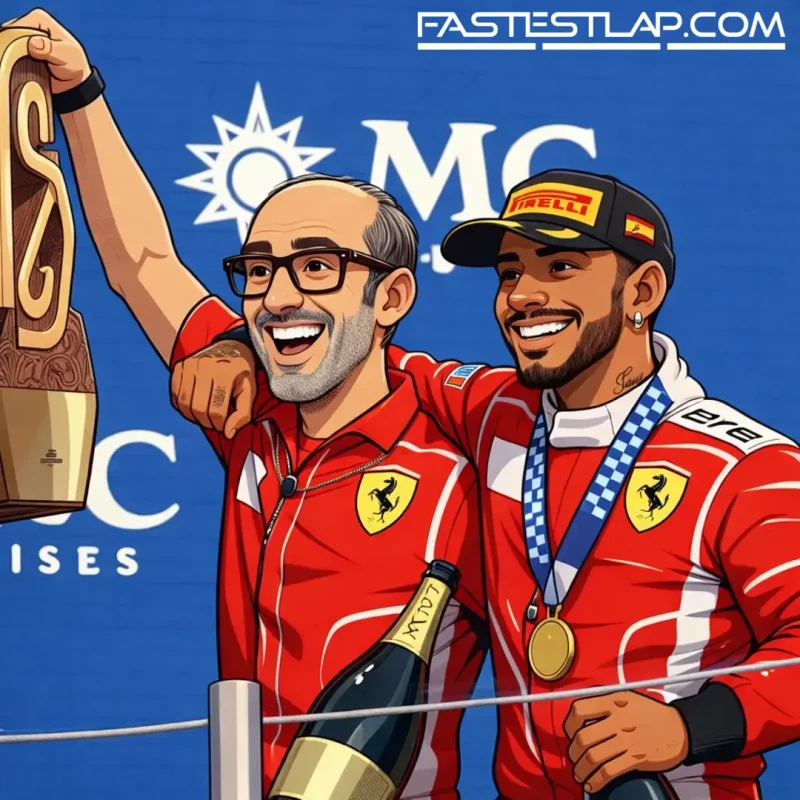
Lewis Hamilton didn’t just win in Barcelona. He looked, for the first time in Ferrari red, like he had a weekend stitched together by something every great title campaign eventually leans on: a driver-engineer partnership that works under pressure without needing to make a song and dance about it.
The face next to him on the top step at the Barcelona-Catalunya Grand Prix told its own story. Carlo Santi — 52, from Verona, and a long-standing Ferrari engineer — was up there too, taking in the biggest moment of Hamilton’s Ferrari reboot with the sort of restrained satisfaction you tend to see from the mechanics and engineers who’ve lived too many near-misses to celebrate early.
Santi is Hamilton’s new race engineer for 2026, a switch that’s mattered more than it probably should at this level. Hamilton’s first season at Ferrari was underwhelming, and whatever else was going on, it was hard to ignore the sense that his communication with then-engineer Riccardo Adami wasn’t quite landing. Adami has since been reassigned to lead the Ferrari Driver Academy, and Santi has stepped in for 2026 with the kind of low-noise competence that teams love and drivers notice immediately.
What makes it more striking is Hamilton’s admission that the relationship basically started from cold.
“We didn’t know each other, we’d never spoken and I didn’t really know much of… I didn’t know anything about him,” Hamilton said after the race. “And we met and I think got on straight away.”
That’s not the usual build-up for a pairing tasked with unpicking Ferrari’s internal pressure and translating it into something calm on the radio. But Barcelona — Hamilton’s first win as a Ferrari driver — looked like the product of trust built quickly and tested immediately.
The race swung on a Virtual Safety Car period that helped shape Hamilton’s route to victory. These moments are where driver-engineer dynamics either pay you back or expose you. Under VSC you’re living by deltas and margins; the driver needs information that’s clear, timely, and confidently delivered, and the engineer needs a driver who’ll commit to the plan without second-guessing every instruction. Ferrari and Hamilton got that dance right on Sunday, and for once it wasn’t a Ferrari win that felt like it required a thousand caveats.
Hamilton’s recent form has been trending this way for weeks. He took his first Ferrari podium earlier in the season in China, then followed up with back-to-back second places in Montreal and Monaco before converting in Barcelona. It’s a proper run now, not a one-off spike, and it’s dragged him right into the shape of the championship.
He leaves Spain second in the Drivers’ standings, 41 points behind Kimi Antonelli. That margin has been kept alive by Antonelli’s retirement in Barcelona, which appeared to be another Mercedes battery issue — a mechanical footnote that could turn into something louder if it keeps happening, because Hamilton is doing the one thing that reliably pressures the car ahead: he’s scoring relentlessly.
But if the points are the headline, the subtext is Hamilton sounding like a driver who’s re-found his rhythm with the voice in his ear. For more than a decade he had the same anchor at Mercedes in Peter “Bono” Bonnington, winning six of his seven world titles with that familiar cadence in his headset. This year, Bonnington is working with Antonelli, and Hamilton is learning how to win without the comfort of that old routine.
“It’s great to be able to connect with an engineer other than what I used to have,” Hamilton said. “I had it for such a long time and then you kind of lose that feeling because Bono’s now doing it with Kimi.”
He also painted a pretty vivid picture of the dynamic with Santi: the engineer as the quieter counterpart, the driver as the emotional engine in the relationship.
“It’s really great to be able to share that experience with him on that stage,” Hamilton added. “He’s very, very quiet. You could tell it’s hard for him to express his emotions. He’s just smiley and, you know, I’m giving him these big hugs and pulling him in, saying thank you.
“I like to think that this has probably reignited the love that he has as being an engineer as he has done for me as a driver.”
There’s something telling in that. Engineers don’t need their “love” reignited; they need their work to matter. At Ferrari, that can get lost in the noise — the politics, the expectations, the constant need to explain every swing in performance. Santi’s presence beside Hamilton after the win suggested a slightly different Ferrari: one where the relationship at the heart of the car is functional, even if it’s not flashy.
It’s also hard to ignore what this does inside Maranello. Ferrari didn’t hire Hamilton to be a curiosity or a marketing exercise. They hired him to win races and drag a team culture into a more ruthless, repeatable Saturday-to-Sunday execution. Barcelona was the first time the whole thing looked aligned: the pace, the calls, the calm, the conversion.
And if you’re looking for why the paddock will take this seriously, it’s simple. A Hamilton resurgence is never just about Hamilton. It forces everyone else — especially the championship leader — to adjust their own margins. The gap to Antonelli is still substantial, but momentum has a habit of making those numbers feel smaller than they are.
Ferrari have finally given Hamilton something he recognises: not the old Mercedes environment, not Bono on the radio, not the same rhythms — but the same outcome when it matters. A win that feels earned, and a partnership that already looks like it can carry weight.









