Monaco’s never needed much help being Monaco, but the FIA has still managed to make next weekend feel like a throwback.
Formula 1’s governing body has confirmed there will be no Straight Mode zone at the 2026 Monaco Grand Prix, meaning the moveable wings that headline the new regulations won’t be available at all across the race weekend. It’s a notable line in the sand: the first time since DRS arrived back in 2011 that a grand prix weekend has gone by without the series’ primary movable-wing overtaking tool in play.
That doesn’t mean the cars revert to being completely “passive”. Drivers will still have access to Overtake Mode — the energy deployment boost — when they’re within a second of the car ahead. At Monaco, the detection point will sit between Swimming Pool and Rascasse, with activation coming just before the Anthony Noghes sequence (Turns 18 and 19). In other words, F1 is still giving drivers a shove; it’s just taking away the most visible aerodynamic lever.
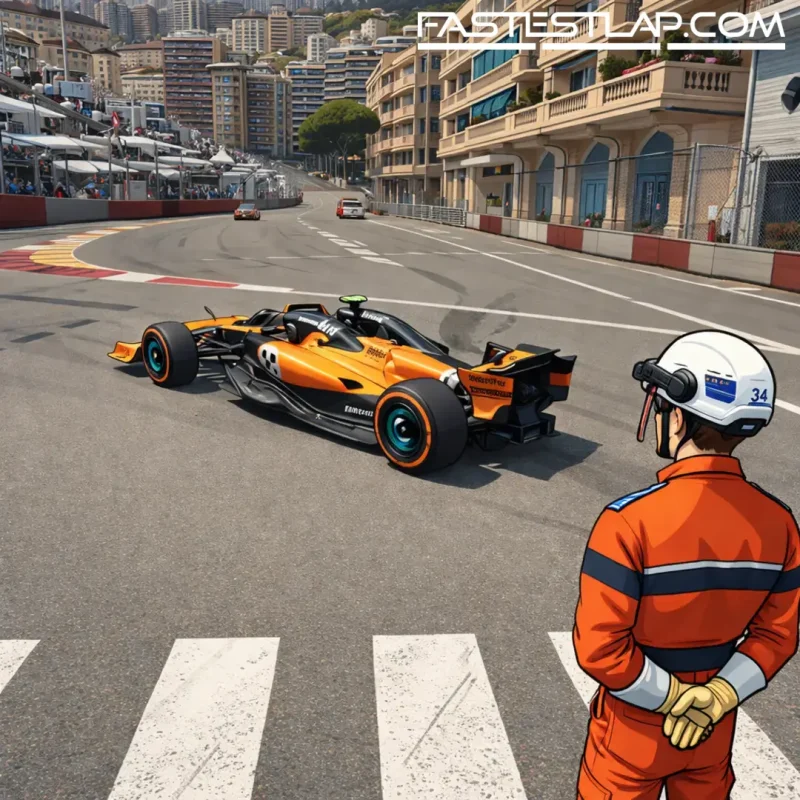
The decision is hard to miss on the map. Monaco’s only obvious candidate for Straight Mode would be the start/finish run from Anthony Noghes up to Sainte Devote — and even that isn’t really “straight” in the way modern deployment zones are designed. It’s curved, narrow, and bordered by the kind of barriers that turn a minor correction into a session-ending bill. With Straight Mode dropping downforce via its wing positions, the FIA has effectively decided the risk/reward doesn’t stack up around the principality’s margins.
It also makes Monaco the outlier on the early 2026 calendar rather than the template. Canada, for example, has three Straight Mode zones, underscoring how track-dependent the system is intended to be. Some venues can safely accommodate repeated wing transitions and the speed delta they create. Monaco, as ever, lives in its own world.
The knock-on effect is that qualifying just got heavier in the storyline again — not that it ever truly stopped being the story. Without Straight Mode, the classic Monaco equation returns: track position isn’t merely valuable, it’s structural. The cars may be different and the energy systems may give drivers more options on paper, but if you can’t meaningfully change the aerodynamic state down the only realistic run to Turn 1, you’re left relying on mistakes, pit timing, or the occasional brave lunge that only looks available until you’re actually alongside and out of road.
There’s been some optimism in the paddock that the 2026 cars’ energy deployment characteristics might lend Monaco a slightly more “racy” feel than recent years, particularly as drivers manage harvesting and deployment in the tight stuff. But Gabriel Bortoleto wasn’t exactly buying the sales pitch when asked in Canada — and he pointed to the same practical limitation that tends to flatten Monaco’s Sunday.
“I think it’s going to be difficult to overtake in Monaco if I’m honest with you,” Bortoleto said. “Because there is a lot of recharging in Monaco. You don’t really suffer with energy there.
“The SM will be off, if I understood correctly, so also the effect of the wing is not going to be there.
“I think hopefully it’s a bit more fun racing than last year, but we know that we have now these big cars, and unfortunately it’s not easy to overtake, so I don’t expect to be massively different from the past, but I hope to be wrong. Let’s see.”
That comment about recharging is doing a lot of work. If Monaco doesn’t stress the energy side of the package in the same way as a stop-start circuit with long straights, then Overtake Mode becomes a smaller differentiator — available, yes, but less likely to create the kind of sustained advantage that turns pressure into a pass. Straight Mode, by contrast, is designed to be a much more obvious enabler, and its absence puts the emphasis back on the fundamentals: tyre life at low degradation, pit windows that can be closed off by traffic, and the sheer reality that the walls are always closer than the ideas.
And while the sport experimented with format tweaks recently — last year Monaco trialled a mandatory two-stop rule — that one-off has been dropped for 2026. So there’s no regulatory nudge forcing strategic divergence, either. It’s back to the more traditional Monaco playbook, where teams will be looking at clean air like it’s a currency and drivers will be measuring risk not in lap time, but in whether it compromises Sunday before Saturday is even finished.
None of this means the race is doomed to be a procession. Monaco still has its own mechanisms for chaos: Safety Cars, red flags, the occasional strategy split that looks odd until it suddenly isn’t. But the FIA’s call effectively acknowledges what everyone already knows: if you can’t create a safe and meaningful Straight Mode zone here, you don’t pretend otherwise. You lean into Monaco as the championship’s high-wire act — the weekend where precision is the overtaking aid.
So, for 2026, the message is simple. The cars may be new, the rules may be new, the buttons may be new — but at Monaco, you’re still mostly racing the circuit.