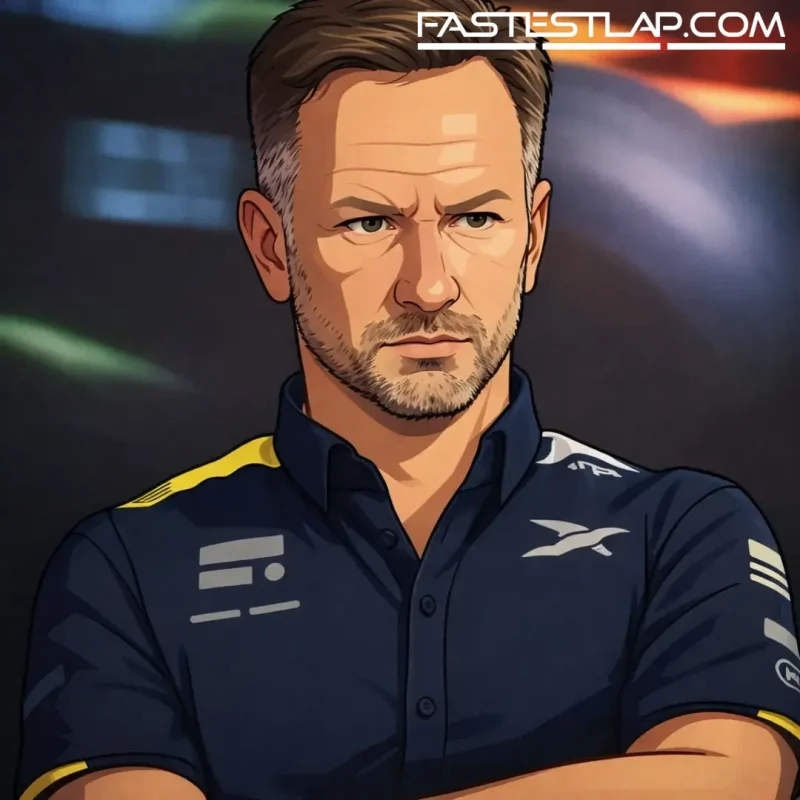
Mohammed Ben Sulayem has never been shy of an opinion, and his latest one is a fairly loud endorsement of Christian Horner’s relevance in Formula 1.
The FIA president says he’s “regularly” in contact with the former Red Bull team principal and is convinced Horner won’t find the door closed if he decides he wants back in. In fact, Ben Sulayem’s view is the opposite: in a sport that hoards proven winners, the paddock will do the chasing.
It’s a striking tone given Horner’s long history of verbal sparring with the governing body while he ran Red Bull. Ben Sulayem, though, painted that as theatre rather than malice — a man who “talks too much” but with “a clean heart”, as he put it. In other words: a political operator, yes, but one the FIA boss believes the sport is better for having in the mix.
That’s not just nostalgia talking. Horner didn’t leave Red Bull because the results dried up; he left after more than 20 years at the helm, with eight drivers’ titles (shared between Sebastian Vettel and Max Verstappen) and six constructors’ championships on his CV. He later agreed a settlement with Red Bull worth $100 million, a financial punctuation mark that underlined how seismic the split was.
Now the question isn’t whether Horner has the appetite or profile to return — it’s where the leverage points are, and which organisations are positioned to accommodate the kind of influence he’s used to.
Two strands have been running in parallel. One is Alpine, where Horner’s name has appeared not just in the usual “linked with” gossip cycle, but in the more concrete language of ownership interest. Alpine confirmed in January that a group of investors including Horner is among those interested in buying the 24 per cent stake currently held by Otro Capital. That immediately reframed Horner’s next move: not simply a team principal for hire, but potentially a figure with skin in the game.
And Alpine’s situation makes that particularly combustible. A minority stake isn’t day-to-day control, but it is a seat at the table — and in modern F1, influence tends to travel with capital as much as with job titles. It also adds an extra layer to the recent noise around rival interest: Mercedes has emerged as a competing bidder for that same Otro stake, with Flavio Briatore confirming Mercedes’ interest during the Chinese Grand Prix weekend. That’s a fascinating triangle if it develops — Horner and Mercedes, in any configuration, will always come with subtext.
The other strand is Aston Martin, where Horner has been persistently connected to executive chairman Lawrence Stroll. The understanding in the paddock is that Stroll would like Horner in a CEO-style position, and crucially, with equity. That isn’t a detail you throw in unless you’re serious: it’s the kind of offer that signals “build this in your image” rather than “come and run it for us”.
Ben Sulayem, speaking via comments reported by the Independent, sounded less like a regulator and more like someone describing the inevitability of gravitational pull.
“Who can remove Christian Horner’s name from motorsport and Formula 1? You can’t,” he said. “It was always successful, but success also has enemies as we know… If you ask me, we miss him in this sport and I do.
“I keep in touch with him. He was good for the team, good for the sport. We would welcome him back and someone like him will always find his way.”
Then came the line that will raise eyebrows in some corners, and probably get a few knowing smirks in others: “When he comes back, it will be like he went for a vacation.”
It’s an unusually warm framing from the FIA president, but it also hints at something else: the sport’s ecosystem, even at its most adversarial, is built on relationships that survive the headlines. Horner may have been a frequent antagonist in press conferences and team statements, but he was also an essential part of the show — a recognisable voice in an era when team principal politics became as much a battleground as tyre strategy.
Ben Sulayem doubled down on the idea that Horner’s next chapter will be dictated by demand rather than availability.
“When someone like him has that history behind him, you don’t look at his credibility. People will come to him,” he said, before adding a more pragmatic caveat: Horner would still need to make his intentions clear. “How do people know that you are interested if you don’t show your interest?”
That matters, because Horner has been spotted, but he hasn’t yet re-entered the day-to-day bloodstream of F1. He did, however, make a surprise appearance in the MotoGP paddock alongside Formula 1 CEO Stefano Domenicali last month, turning up at Jerez for the Spanish Grand Prix. With Liberty Media having completed its purchase of MotoGP last year, it didn’t take long for the speculative dots to be joined — senior role, new project, different theatre.
But those close to the situation insist a switch to MotoGP isn’t on the cards for Horner.
So we’re left with the more straightforward reading: Horner is circling F1 again, weighing where power and opportunity overlap. Alpine offers a route through investment and influence; Aston Martin offers the allure of a leadership carve-out with equity. Either way, Ben Sulayem’s comments are a reminder that, for all the public friction, the establishment still sees Horner as part of the sport’s natural order.
In Formula 1, reputations aren’t just what you win — they’re what you can shift. And the paddock still seems convinced Horner can move plenty.