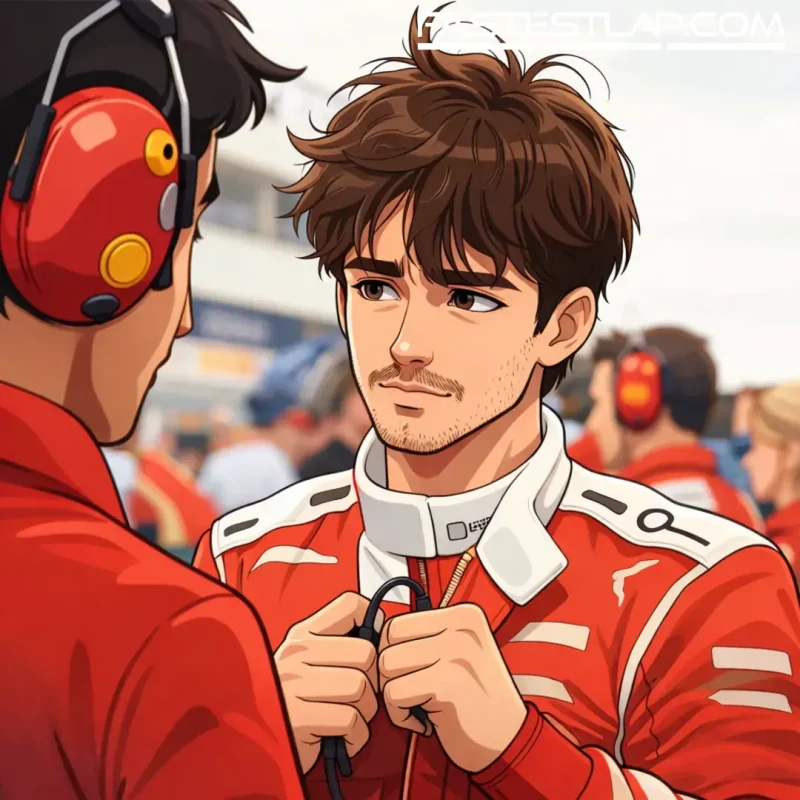
Charles Leclerc doesn’t sound like a driver desperate to win an argument. He sounds like one who’s already made his peace with the new world Formula 1 has built in 2026 — and is mildly amused that so many of his peers are still fighting it.
While plenty of the paddock has spent the opening stretch of this rules cycle lamenting the “unnatural” feel of the cars and the occasionally odd-looking choreography of lift, coast, harvest, deploy, Leclerc is pushing back. Not with rose-tinted nostalgia or PR polish, but with a fairly simple claim: the racing part is fine. Better than fine, in places.
“It’s improved a little bit,” Leclerc said after the Miami Grand Prix, the first race run under tweaks introduced following the opening three rounds of the season. And crucially, he didn’t dress it up as a revolution. “The battles in itself, I don’t think changed massively. The regulations will remain the regulations. We cannot do a revolution in the middle of the year, but it was a step in the right direction.”
That framing matters. The loudest complaints about 2026 haven’t been about lap time — F1 drivers can adapt to almost anything if it’s fast — but about how that lap time is produced. The cars’ increased reliance on electrical energy has forced a style that can look counterintuitive: sacrifice through the corner to bank energy, then hit hard on the straight. Earlier in the year, Leclerc himself captured the sensation in a line that stuck: it felt “like the mushroom in Mario Kart”.
Miami, though, was never expected to be the ideal stress test for the worst habits of 2026 driving. It’s an energy-rich venue, and even before the FIA’s revisions there was less necessity for the more extreme “super clipping” and exaggerated lift-and-coast that had drawn so much attention. The weekend also arrived with several caveats that make sweeping conclusions risky: the break before Miami gave teams time to develop, and the revised parameters arrived alongside the usual noise of car evolution.
Still, the rule changes were real — and the intent behind them was very clearly about keeping the sport’s new energy game from getting too spiky in the danger zones.
One of the key adjustments concerned boost usage. Drivers still get the big number — 350kW — on the straights, but for most of the lap the cap drops to 250kW. It was introduced on safety grounds, specifically to address the risk of high closing speeds that were underlined by Oliver Bearman’s crash at the Japanese Grand Prix. There’s a sporting side-effect too: battery-assisted lunges should be a little less theatrical, the sort of “point and shoot” moves that some drivers have argued feel too artificial.
Leclerc doesn’t buy that criticism. In fact, he’s been one of the few prepared to say so publicly.
“I have always disagreed with that,” he said. “I know I’m a bit of an outlier on the grid, but I felt that, at least for the fights I’ve had with the guys in front, when you’ve got cars that have a system, and that use the system in a similar way to yours, actually, the overtaking is really good.”
That line — “when you’ve got cars… that use the system in a similar way to yours” — is doing a lot of work. It hints at what’s really going on beneath the surface of the complaining: 2026 racing is less about pure bravery on the brakes and more about who arrives at the same piece of tarmac with the same amount of usable energy, deployed at the same time, with the same confidence that it’ll be there when you press the pedal.
In other words, it rewards alignment. Between car characteristics, software behaviour, driver habits, and how a team coaches its energy usage from the pit wall. When those things match, Leclerc argues, the fight looks like a fight again — not two cars taking turns to be powerful and powerless.
He also rejects the idea that 2026 suddenly introduced “strategy” as a concept, a point worth making given how often the debate gets boiled down to “DRS era simple, 2026 era complicated”.
“It’s a bit more strategic than last year,” he said. “But last year was also strategic with the DRS; if you wanted to overtake at a certain point to have the DRS, having it to pull away, so I don’t think it changed significantly.”
That’s Leclerc at his most persuasive: he’s not pretending the current cars are pure, or that what drivers do always looks natural. He’s saying F1 has always had levers — sometimes aerodynamic, sometimes procedural, now electrical — and the difference is mostly in what viewers have learned to accept.
And he’s not blind to the weirdness, either. “Surely there’s scope to fine tune the system, ways to try and use the system in a better way and optimise that,” he added. “It’s not always natural what we do sometimes in the car.”
The interesting thing is how modest his position actually is. He’s not calling the new rules a triumph. He’s not telling the FIA to stop listening. He’s saying the sport shouldn’t confuse “different” with “worse”, and shouldn’t panic just because the cars have introduced a new layer of decision-making that drivers — and fans — can’t always read at a glance.
For Ferrari, that’s a useful tone to strike. The team is still learning the sharp edges of 2026 like everyone else, and it won’t want its lead driver feeding a narrative that the spectacle is broken beyond repair. But Leclerc’s comments don’t sound like corporate messaging; they sound like someone who’s found a way to make the system work in combat, and doesn’t see the point in pretending otherwise.
The paddock will keep arguing about what F1 “should” look like. It always does. Leclerc’s heresy, if it is one, is simply this: the racing is not the problem people think it is — and with a bit more tuning, it might end up being the part of 2026 we talk about least. Because it’ll just work.