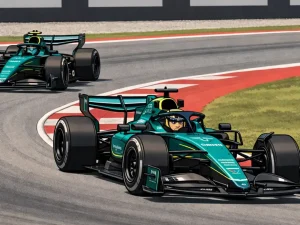
Pierre Gasly walked away from Miami with the sort of frustration that doesn’t show up neatly on the timing screens. On paper, it was another messy Sunday for Alpine’s lead car. In the cockpit, he felt the race swung against him within seconds — because he did the sensible thing.
Gasly says avoiding Max Verstappen’s stranded Red Bull on the opening lap cost him “five, six positions”, after a Turn 2 spin left Verstappen sitting broadside in the middle of the track. Gasly had launched well from ninth on the grid and was already thinking about the kind of first-lap consolidation that can set up a realistic points hunt in the midfield. Instead, he arrived at a slow-moving rear wing filling his vision far earlier than anyone would want.
The problem wasn’t simply that Verstappen was there. It was that Gasly was boxed in when he found him — Lewis Hamilton to his right, George Russell to his left — leaving him with essentially one option: stamp on the brakes and hope the pack behind didn’t use him as a reference point.
“Honestly, it was one of those situations where I took a really good start, and if I had a worse start, I would have actually got out of lap one in a better position,” Gasly admitted afterwards. “So it was quite unfortunate, quite unlucky timing. [To] exit Turn 1, [position] seven, or maybe close to six and then I see him coming back, and I had to hit the brake to avoid him, because obviously it was extremely slow.
“Then I just got swallowed by the whole bunch of cars behind me. So I think we lost five, six positions there.”
It’s a classic Miami paradox: the circuit punishes hesitation, yet the race can punish you for not being reckless enough. Gasly’s moment was the kind of split-second compromise that drivers make a dozen times a season — choose survival, lose track position; choose the gap, risk a DNF. When the cars are stacked three-wide and the margins are razor-thin, the “right” decision can still be the costly one.
Gasly wasn’t overly alarmed by the hit to his track position because he believed the Alpine had the pace to recover. But whatever optimism he had about salvaging the afternoon didn’t last. Later in the race he ended up in the barrier after contact with Racing Bulls driver Liam Lawson — a clash that became the real endpoint to any comeback narrative.
Lawson ultimately avoided a penalty, with the stewards determining a gearbox failure was to blame for the incident. Gasly, speaking before that verdict landed, framed it as a situation he’d tried to manage rather than provoke — aware Lawson would be stubborn and choosing to leave margin on the inside to keep it clean.
“I knew he was there,” Gasly said. “I knew [we were] side by side.
“I knew at that time, fortunately, he probably had to just accept losing the position, but I knew he’d still try, so that’s why I left the space for a car and a half on the inside, just for him, at least, to have the choice to stay there if he really wanted.
“But I haven’t seen exactly the footage, but clearly it was too optimistic from me.”
That last line is telling. Gasly didn’t sound like a driver furious at being taken out; he sounded like one replaying the “what if” decisions that define modern midfield racing. The cars are so close, and the opportunities so fleeting, that drivers are constantly weighing the value of conceding early versus holding firm and trusting others to do the same. In Miami, he conceded early to avoid Verstappen and paid for it. Later, he left space to avoid escalation and still ended up in the wall.
For Alpine, the weekend’s lesson is uncomfortable but familiar: when you’re fighting from P9 rather than the front row, you can do almost everything right and still get dragged into someone else’s chaos. And for Gasly, it’s another reminder that the difference between “smart” and “slow” is sometimes decided by the luck of where a spinning Red Bull comes to rest.