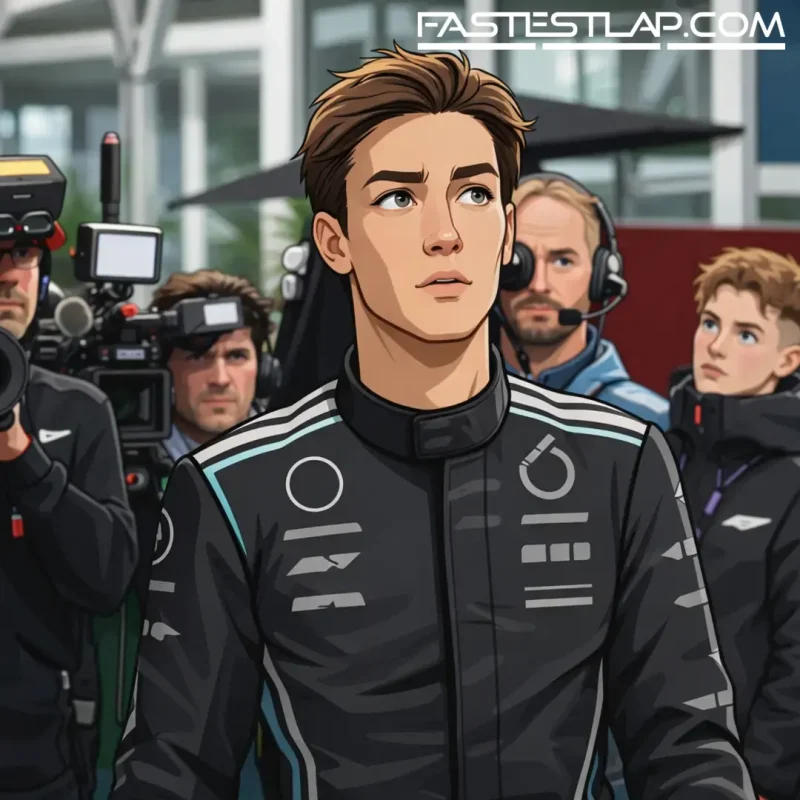
George Russell walked back into the Montreal paddock wearing the look of a driver who’d just watched a championship swing away from him through no fault of his right foot.
Mercedes’ Canadian Grand Prix had been shaping into another instalment of the team’s increasingly tense — and increasingly brilliant — internal fight. Russell and Kimi Antonelli were trading blows at the front, both quick enough to keep it clean, both aggressive enough to keep it honest. Then Russell’s car cried enough.
A battery failure pitched him out on the spot, turning what had been a live title chase into a harsher bit of arithmetic: Antonelli leaving Canada 43 points clear.
Russell didn’t try to dress it up afterwards. If anything, he was disarmingly blunt about where the momentum sits now.
“Right now, it’s his to lose,” Russell said. “So many points ahead.”
That’s the bit that stings, because Russell had arrived in Canada needing a response. Antonelli had taken three straight wins, and even for a driver with Russell’s self-belief, the sense was that Montreal had to be a turning point — not necessarily a must-win, but a weekend where he at least stopped the bleeding.
Instead, the margin ballooned. And Russell’s frustration boiled over in a way you rarely see from him. As the pack streamed past his stranded Mercedes, he threw his headrest onto the track — a moment of anger that earned him a suspended fine from the stewards. It wasn’t a calculated statement or a bit of theatre. It looked exactly like what it was: a driver feeling the season slipping away in real time.
Russell’s post-race comments carried that same mix of irritation and resignation. He pointed to the run of incidents that have repeatedly landed on his side of the garage door at the worst possible time: the safety car timing in Japan, a breakdown in China qualifying while fighting for pole, and now a failure from the lead fight in Canada.
“It’s almost like the gods don’t want me to be in this fight,” he said. “When I look at the safety car timing in Japan, breaking down in China Q3 fighting for pole, breaking down from the lead here today.”
There’s a psychological pivot embedded in what he said next — the kind drivers reach for when the numbers start to feel oppressive. Russell insisted the “pressure’s off” now, that he can go race-by-race with “nothing to lose”, aiming simply to win as often as possible and see what falls out later. It’s the right public posture, and it may even be the healthiest one internally, but it also underlines how quickly the dynamic has changed.
Because for a while, this was shaping up as the season’s defining duel: a senior Mercedes driver trying to assert his status against a young teammate who’s rapidly shedding the “future” label and living firmly in the present. In Canada, before the failure, the two were again locked together — close enough for real jeopardy, controlled enough to show there’s mutual respect beneath the competitiveness.
Russell said as much when asked about the risk of a team-mate clash.
“We know how we need to race,” he said. “I think we both had it under control, and it was… great, because I really, really enjoyed it personally.”
That last line mattered. Russell wasn’t just doing media duty; he sounded like a driver who’s still genuinely enjoying the knife-edge part of it — the part where you’re balancing tyre temperature, brake confidence and battery deployment, trying to create an overtake on a track where the margins are tight and the tools to pass are limited.
“It was exceptionally difficult on this circuit to break that one-second overtake mode,” he added. “In these cold conditions, the only way you get grip is by pushing the tyres to get the temperature, so you’re just spreading that needle of how hard you push, but knowing the consequences are quite big.”
That’s Montreal in a sentence: a place where you can be brave for 69 laps and then punished for one small misjudgement — or, in Russell’s case, punished for something that had nothing to do with judgement at all.
The uncomfortable reality for Russell is that DNFs don’t care about context. Antonelli doesn’t have to apologise for banking points when his teammate can’t. And with a 43-point gap now in place, the championship picture changes from “tight fight” to “Antonelli with breathing room”, which affects everything from risk appetite to how Mercedes manages strategy when both cars are in contention.
Russell admitted he doesn’t want to be standing there talking like this — conceding leverage, discussing “luck” — because drivers at the sharp end never really believe in luck. But they do believe in runs of outcomes, and Russell’s run has been punishing at precisely the moments he’s needed a clean, uncomplicated weekend.
“I don’t want to be stood here talking like that,” he said. “It is, of course, frustrating, and I want to be in that fight. Hopefully, the luck turns.”
If it does, this season still has the ingredients for a proper title battle: two Mercedes drivers with enough pace to win on merit, enough edge to keep it interesting, and — as Canada reminded everyone — enough fragility in the machinery to make any projection feel premature.
For now, though, Antonelli leaves Montreal not just leading the championship, but holding the one thing that changes how you race a teammate: a margin that lets you think long-term. Russell is the one who has to chase, and he knows it.