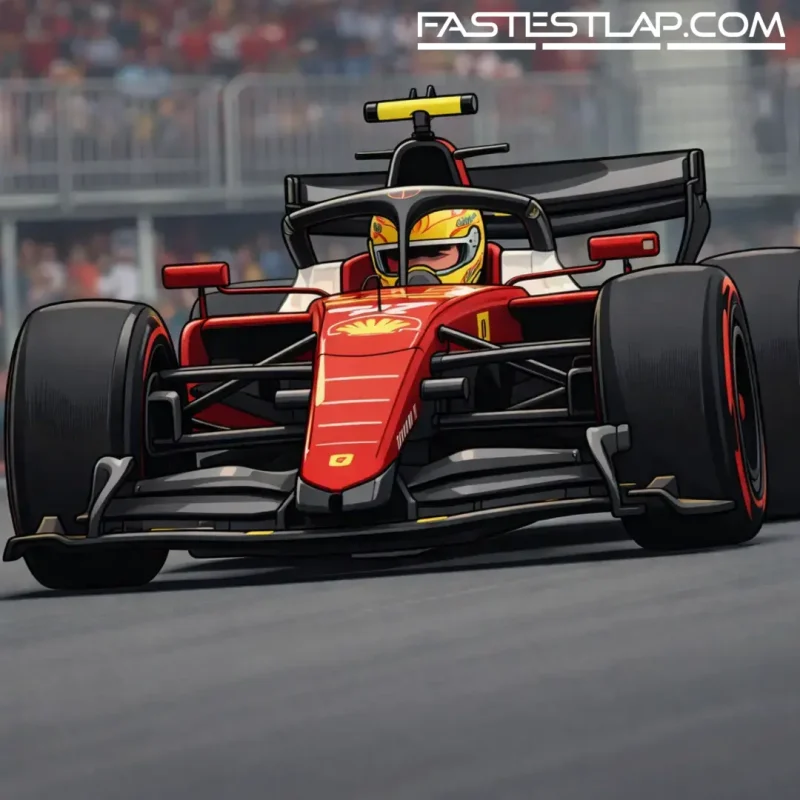
Lewis Hamilton arrived in 2026 as one of the more vocal big-name backers of Formula 1’s new rules. In Montreal, he got the version of the future he’d been selling: cars that can actually sit in each other’s wheeltracks, a race that didn’t dissolve into tyre management theatre, and a proper scrap with Max Verstappen that looked like it had been lifted from a different era.
And yet, when Hamilton climbed out of the Ferrari after securing second — his best grand prix result so far in red — the praise came with a very modern caveat. The racing’s better. The powertrain still isn’t.
Canada, with its season-low 6.0MJ of energy recharge per lap, was always going to be a stress test of the new formula. Less energy to play with forced drivers to live closer to the edge in qualifying and made the straights feel less like a guarantee and more like a negotiation. The result was the sort of weekend the rulemakers promised: overtakes in both Sprint and Grand Prix, and real fights at the front rather than choreographed DRS fly-bys.
Hamilton found himself right in the middle of it, trading blows with Verstappen in a battle for P2 after George Russell’s Mercedes dropped out with a battery issue. There was a nice symmetry to it — the old rivals again, only now with Hamilton doing it as Ferrari’s spearhead. But the part that stuck with him wasn’t the nostalgia; it was the way the car delivers its speed.
Asked post-race whether the new power unit procedures were becoming second nature after five rounds and a run of FIA tweaks, Hamilton didn’t dress it up.
“It’s definitely not second nature,” he said. “It still continues to be a weird feeling.
“You go down the power, you open up the SM [Straight Mode], and then the power dies halfway down the straight and the RPM starts dropping. It doesn’t feel what motorsport should be. The engine should be ringing its neck off right to the end of the straight and just pulling and pulling. That’s what they used to do in the V8 times or the V10 times.”
That’s Hamilton in his purest form: not just critiquing performance, but critiquing the sensation. The new cars can be quicker in the lap time column and more raceable in traffic, but if the driver feels the car go flat mid-straight — if the revs fall away instead of building — it jars against every instinct formed over two decades of flat-out racing.
Hamilton did make clear he sees what’s been gained. In his view the underlying car is “fundamentally a better design”, and the ability to follow closely is the headline win. It’s just that the power delivery, the bit fans instinctively associate with speed and spectacle, “is less exciting”.
The paddock’s push and pull over the 2026 concept has always been about trade-offs, and Canada made that tension obvious. The show improved because the drivers had to manage limits that are now baked into how you attack a lap and how you defend on the straights. But those same limits create moments where the car feels like it’s being told “no” in the middle of a full-throttle zone — an alien sensation for drivers raised on engines that simply kept pulling until the braking board.
Kimi Antonelli, meanwhile, is living the dream side of the new era. The Mercedes driver took a fourth consecutive victory with P1 in Canada, and he’s doing it with a power unit widely regarded as the benchmark at this early stage of the regulations. Even so, Antonelli admitted the system can still catch you out — and that the formula itself may not be at its finished product yet.
“Sometimes it triggers you a little bit how the system works,” Antonelli said, pointing to the FIA’s midstream adjustments giving teams a bit more allowance, which he felt had already made life easier. Like Hamilton, he also highlighted the obvious: following is better than last year, and that naturally creates more racing.
But even from the driver currently on top, there was an acceptance that the power unit side still has room to evolve. Antonelli talked openly about the possibility of further refinement in the coming years — potentially shifting the balance between electrical power and internal combustion — and framed it as another “step in the right direction”.
That’s the key context to Hamilton’s gripe: it’s not a simple “old good, new bad” rant. The 2026 cars are delivering the on-track product many have been crying out for, and even Hamilton’s comments read more like a plea to align the power unit’s feel with the chassis’ progress.
There’s already an agreement in place to tweak the electric-versus-combustion power ratio more in favour of the latter for 2027, though it still needs the crucial votes to become reality. Beyond that, FIA president Mohammed Ben Sulayem has gone a step further, publicly declaring an intention for F1 to return to V8 engines, targeting 2030 and “no later than 2031”.
For now, though, 2026 is what it is: a set of cars that can race properly again, powered by systems that sometimes make drivers feel like they’re arriving at the end of the straight with one hand tied behind their back. Montreal proved the sport can put on a cracking show within those constraints. Hamilton’s point is simpler — and harder to solve.
Give him the close-quarters racing. Just don’t make the car feel like it’s running out of breath before the job’s done.