Lewis Hamilton didn’t need to say much in Montreal — the body language did it for him.
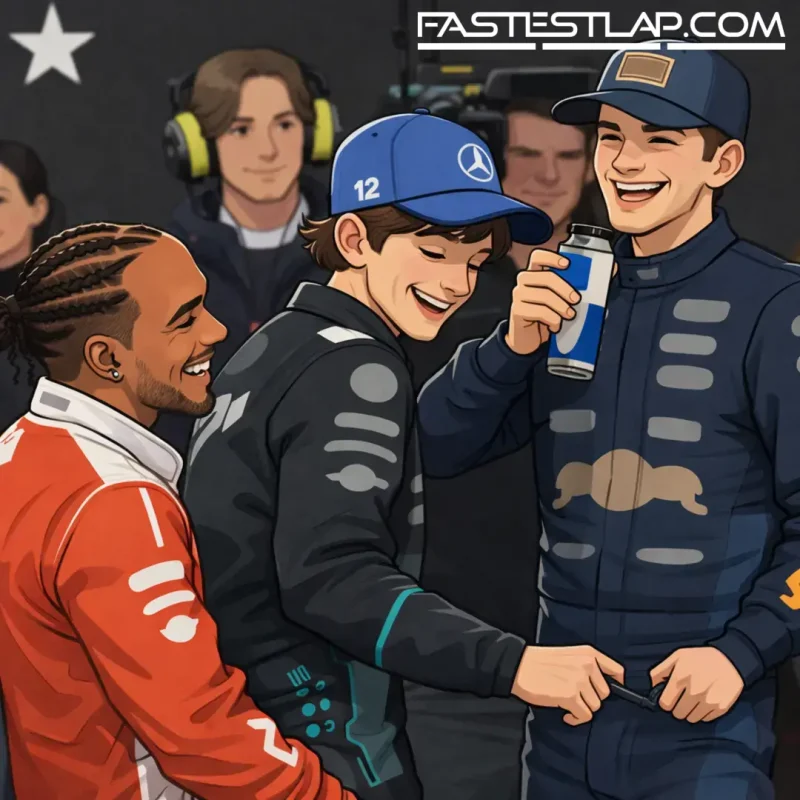
Seconds after climbing out of the Ferrari and taking in a hard-earned second place, Hamilton was already across the paddock space to Kimi Antonelli, hauling Mercedes’ new star into the air in a bear hug while Max Verstappen, freshly demoted to third, could only grin at the scene. It was one of those snapshots that tells you plenty about where Formula 1 is in 2026: the old order is still sharp enough to scrap, but the next one has arrived and it isn’t waiting politely.
On paper, Hamilton’s Canadian Grand Prix was his best day yet in red. Fifth on the grid, second at the flag, and a late, decisive pass on Verstappen to make it happen. But the detail that lingered was who he couldn’t touch. Up the road, Antonelli was managing the race from the front in the very Mercedes seat Hamilton walked away from — and doing it with a calm that’s starting to look less like beginner’s luck and more like a defining trait.
Martin Brundle summed it up neatly on the Sky F1 broadcast: a “bittersweet” afternoon for Hamilton. The sweetness is obvious. He raced forward, took a place at the start from Oscar Piastri’s McLaren, and then spent the afternoon in a proper knife-fight with Verstappen for podium position. When it mattered — lap 62, Turn 1, the sort of braking zone Verstappen usually uses as a deterrent — Hamilton went late, went brave, and went around the outside to snatch back P2. Old rival, new colours, same message.
The bitterness isn’t exactly hidden either. Antonelli wasn’t just winning; he was making it look like the natural state of things. With George Russell out on lap 30 with a power unit problem, the Mercedes “versus Mercedes” narrative evaporated into a one-car demonstration, and Antonelli didn’t wobble. Fourth grand prix win in succession, another big points haul, and the sort of control you rarely see from anyone this early in their career — never mind the youngest championship leader the sport’s had.
That’s the twist Hamilton has to live with now. Beating Verstappen is still a headline in itself, but it wasn’t the headline of this race. Montreal belonged to the driver Ferrari hoped would be replacing Hamilton in the public imagination; instead, he’s replacing him in something far more tangible — results.
Still, if anyone expected Hamilton to play the wounded veteran, they haven’t been paying attention for the last two decades. He was openly positive about Antonelli afterwards, yet you could hear the competitive edge in the way he framed it: admiration, yes, but no interest in handing over any secret map to success.
“I think you forget that we’re competitors,” Hamilton said, when asked what advice he’d offer a younger version of himself in Antonelli’s position. “He’s already doing a great job. I’m not going to give him any more pointers!”
It was classic Hamilton: generous without being soft. And then, as he often does, he widened the lens to something that matters in modern F1 just as much as outright speed — infrastructure.
Hamilton pointed to the support Antonelli is getting at Mercedes as a major difference compared to his own rookie season. Back in 2007, Hamilton arrived as a 22-year-old with enormous scrutiny and a very different kind of internal environment. In 2026, Antonelli has walked into a team that has built its entire operating model around smoothing the edges for elite talent: structure, mentors, specialists, and a clear sense of protection from the noise.
Hamilton didn’t romanticise his own path — if anything, he implied it was unnecessarily brutal — but he also didn’t claim it as an injustice. He called his first year “pretty intense”, acknowledged that Mercedes boss Toto Wolff has created a stronger support network than the one Hamilton felt he had at the time, and then landed on the line that always gives away how Hamilton really processes these moments: he wouldn’t change it.
That’s where the psychology gets interesting. Hamilton is clearly pleased with his own trajectory at Ferrari — this was the kind of scrappy, authoritative drive that builds credibility inside a new team — but he’s also watching his old team thrive without him. For most drivers, that would be an irritant. For Hamilton, it reads more like fuel: a reminder that the standard he set at Mercedes is now being used by someone else to win.
Verstappen’s presence in all of this only sharpened the contrast. The late pass into Turn 1 was the sort of move that, in a different era, might’ve been the race’s defining act. Instead it became the subplot: Hamilton reasserting himself against his most familiar rival, while the bigger story was a new championship leader stretching his legs at the front.
Montreal, then, wasn’t just a Ferrari step forward or a Mercedes victory — it was an illustration of the sport’s current shape. Hamilton can still do Hamilton things. Verstappen can still make everything uncomfortable. But Antonelli is building something that looks uncomfortably like momentum, and the rest of the grid is starting to realise it isn’t a phase.
Hamilton lifting Antonelli into the air might’ve looked like a sentimental gesture. In truth, it felt like something else: respect, recognition — and a quiet acknowledgement that F1’s next fight is already here.