Lewis Hamilton didn’t hang around in Monaco on Sunday pretending he hadn’t noticed what everyone else in the paddock can see with their own eyes: Mercedes has built the benchmark car of early 2026, and Kimi Antonelli is driving it like it’s on rails.
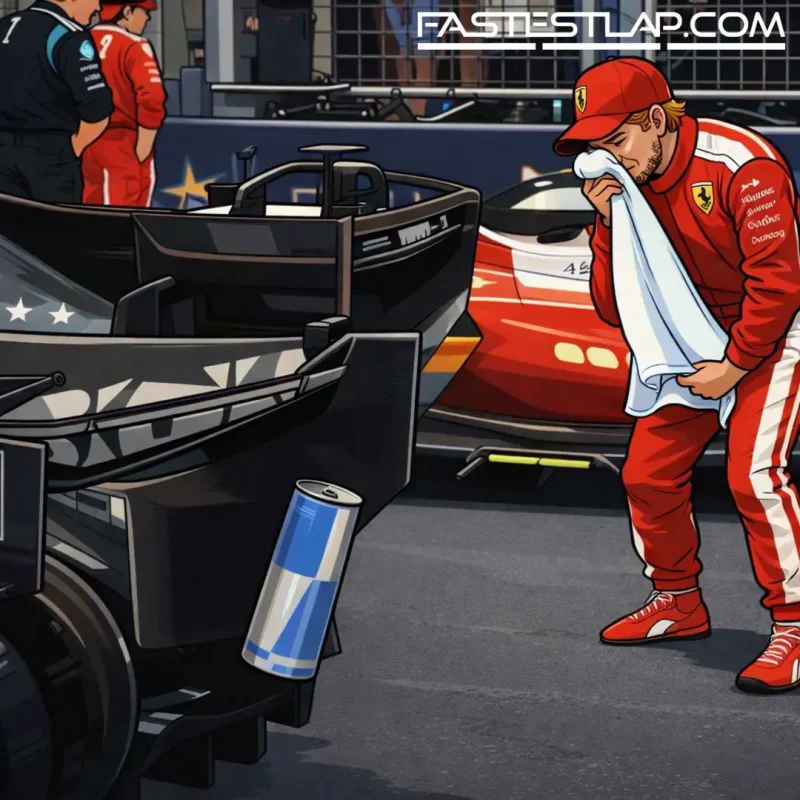
As the cameras followed Isack Hadjar through a post-race TV interview on the grid, Hamilton was in the background doing something that’s become increasingly familiar this season — dropping into a crouch behind Antonelli’s Mercedes W17 and taking a long, unapologetic look at the rear end and floor area. No theatre, no secrecy. Just a seven-time world champion trying to work out where the lap time is coming from, and what his own team needs to steal back.
Antonelli had just made it five wins on the bounce in Monte Carlo, extending his lead in the 2026 drivers’ championship to 66 points. More striking still, it means the Italian has started his grand prix-winning career with five consecutive victories — a first in Formula 1 history. It’s the kind of stat that feels less like trivia and more like an early warning sign for everyone else.
Hamilton, meanwhile, finished second to secure back-to-back podiums for the first time in almost two years. That result has lifted him to second in the standings, a small but significant detail in what’s been a season of Ferrari progress mixed with obvious frustration. Hadjar completed the podium, taking his second career top-three and his first since moving to Red Bull ahead of this season.
The interesting bit wasn’t that Hamilton went looking. It’s that he did it again.
This wasn’t a one-off curiosity sparked by Monaco’s unique demands. The W17 caught his eye earlier in the year in China as well, where he was also seen studying the car in parc fermé. You can dismiss it as a veteran’s habit — the old-school way drivers used to read cars before every surface was photographed to death — but Hamilton’s own words in Monaco made it clear there’s purpose behind it.
“The performance they have is next level,” he admitted afterwards, conceding Ferrari has “a lot of work to do” to reach Mercedes’ current standard.
“It was a good experience because it gives me a much better idea of where I need to have the team learn and improve, not only from what I’m feeling but what I’m seeing as well,” Hamilton said. “There’s lots of things that we need to be adding to this car.”
That’s a revealing way to frame it. Hamilton isn’t just talking about lap time in the abstract or complaining about balance in the debrief. He’s talking about a shopping list — physical development, visible solutions, areas where Mercedes has clearly landed on something that’s giving Antonelli a platform to be relentless.
And yes, it’s slightly delicious that the car he’s inspecting is the one being driven by the man who effectively took his seat at Mercedes from 2025 onwards. Antonelli isn’t merely winning; he’s doing it with the kind of calm, repeatable execution that usually takes seasons to build. Five straight wins, Monaco included, suggests this isn’t a hot streak. It’s the new order unless someone breaks it.
Hamilton’s gridside detective work also fit a wider Monaco theme: rival cars were being watched like hawks. Adrian Newey, now team principal at Aston Martin, was spotted doing his own slow walk-and-stare routine, paying close attention to the McLaren MCL40s of Lando Norris and Oscar Piastri, and also casting an eye over Pierre Gasly’s Alpine A526. In other words, the most experienced brains in the sport are behaving the same way — because the performance gaps in 2026 aren’t being solved by wishful thinking.
There’s a point in every major regulation era where development becomes less about sweeping concept changes and more about ruthless detail. Monaco’s tight confines always magnify that. You can’t hide weaknesses there, and you can’t fake mechanical grip or confidence on turn-in. If Hamilton is lingering at the back of the W17, he’s looking at exactly the areas where modern cars win and lose: how they manage flow to the rear, how stable they stay in low-speed rotation, and how much load they can carry without biting the driver.
Ferrari’s story, then, is caught in a familiar tension. The podiums are returning, the points are stacking up, and Hamilton is still sharp enough to take advantage when the opportunity appears. But Mercedes — with Antonelli in this form — is operating on a level that forces everyone else into uncomfortable honesty. The chasing teams aren’t just trying to “close up”. They’re trying to understand a philosophy that’s producing repeatable Sundays.
And if you’re wondering whether it’s unusual for a driver of Hamilton’s stature to be seen openly eyeballing a rival’s car on the grid: not really. It’s only unusual now because the broadcast catches everything, and because Hamilton is candid enough to explain it rather than shrug it off. In a championship that’s threatening to run away from Ferrari early, there’s value in that candour. It’s a reminder that even at 41, Hamilton’s instinct isn’t to accept the gap — it’s to measure it, then go looking for the tools to erase it.