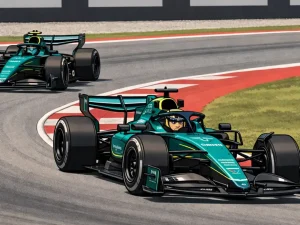
Lewis Hamilton walked out of Miami sounding less like a driver searching for tenths and more like one who’s had enough of chasing ghosts.
After a bruising weekend that never really came his way — over 15 seconds behind Charles Leclerc in the Sprint, then front-lap contact with Franco Colapinto in the Grand Prix that damaged his Ferrari and boxed him into a compromised run to seventh (later sixth after Leclerc’s post-race 20-second penalty) — Hamilton is binning a staple of modern preparation. He says he won’t use Ferrari’s simulator at all before Canada.
That’s not a throwaway comment from a driver venting after a messy Sunday. It’s a pointed statement about process, and in a team like Ferrari, process is politics.
“I’m going to have a different approach in the next race,” Hamilton said after Miami. “Because the way we’re preparing at the moment, it’s not helping.”
Hamilton’s issue isn’t that simulators are imperfect — everyone in the paddock knows they are. It’s that, in his view, Ferrari’s isn’t helping him arrive at the circuit with a baseline that makes sense, particularly on a Sprint weekend where the margin for course correction is tiny. With only one practice session, you don’t have the luxury of swinging big on suspension or aero direction and re-learning the car. You pick a foundation, you polish it, and you live with the consequences.
Hamilton’s complaint is that the foundation he’s arriving with has been built on sand.
“Ultimately, it’s always correlation,” he said. “We go on it, and then you get to the track, and the car feels different when you get to the track.”
He expanded on what he meant by preparation “not helping”, and the subtext was hard to miss: he feels he’s been led down the wrong path by the tools designed to prevent exactly that.
“I spend time on the simulator — you know I don’t like simulators in general — but I was at the simulator every week on the build-up to this race, and working on correlation constantly,” Hamilton explained. “You go on it, you prepare for the track, you drive it, and you get the car set up to a certain place, and then you come to the track, and that setup doesn’t work.”
In Miami, he reckons that left him boxed into an opening direction that simply wasn’t competitive enough early in the weekend — precisely when the groundwork gets laid. “In an ideal world, I should have started where Charles was at the beginning of the weekend,” he admitted, “and I think we would have just had a stronger weekend from there on.”
So Hamilton’s answer is to step away. No sim sessions between now and Montreal, though he’ll still head to the factory for meetings. The logic, as he frames it, is straightforward: if the simulator is feeding misleading cues, the safest thing is to stop letting it steer the ship.
“I’m not going to go on the simulator between now and the next race,” he said. “Just going to back away from it for a little bit and see. When we went to China, I had the best weekend, and without sim.”
It’s a bold line to draw in 2026, when teams live and die by correlation loops and pre-event modelling, and it lands with extra weight because Hamilton isn’t some sim-sceptic who never engages. By his own account, he’s been in there “every week” trying to make it work. This isn’t refusal — it’s an escalation.
And it comes with a second, very tangible warning: Ferrari’s straight-line deficit.
Canada is another circuit where drag level gets exposed brutally, and Hamilton isn’t dressing it up as a minor weakness. “We’re going to another track with long straights, and we’re losing three to four tenths just on straight line speed,” he said. “So that’s there, and it’s going to be there until we fix it.”
Ferrari can debate the exact number internally, but the driver’s message is clear: whatever the SF-26 is generating in the corners, it’s being handed back — and then some — on the straights. Hamilton’s insistence that the team must “cut drag” before Montreal reads like a demand for urgency, not a wishlist item for later in the summer.
What’s interesting is that Hamilton isn’t throwing the car itself under the bus. If anything, he’s sounded more upbeat across 2026 than during his difficult first year with the Scuderia, and he reiterated that he’s “generally happy” with the SF-26 and the broader feel of the new-era machinery.
The Miami problem, he suggested, was how the car arrived on Friday and how long it took to drag it somewhere usable: “It was very snappy on the way into corners, and then massive understeer mid-corner — so that’s not the balance that you would want.” Better by qualifying, improved again into the race, but the weekend’s damage was already done.
That distinction matters. Hamilton isn’t saying Ferrari has built him an unsuited car — he’s saying Ferrari is making life harder than it needs to be by starting in the wrong place, then spending precious track time chasing the correct window. And when Sprint format squeezes the schedule, the cost of that chase gets amplified.
Montreal, then, becomes more than the next race. It’s a small referendum on whether Hamilton’s “different approach” can outperform the team’s usual machinery of preparation — and whether Ferrari can respond quickly enough on the aerodynamic side to stop haemorrhaging lap time before the braking zones even begin.
Hamilton has won in Canada seven times. He doesn’t need reminding how to operate there. The question is whether Ferrari, right now, can give him a car that doesn’t require unlearning its own simulator first.