
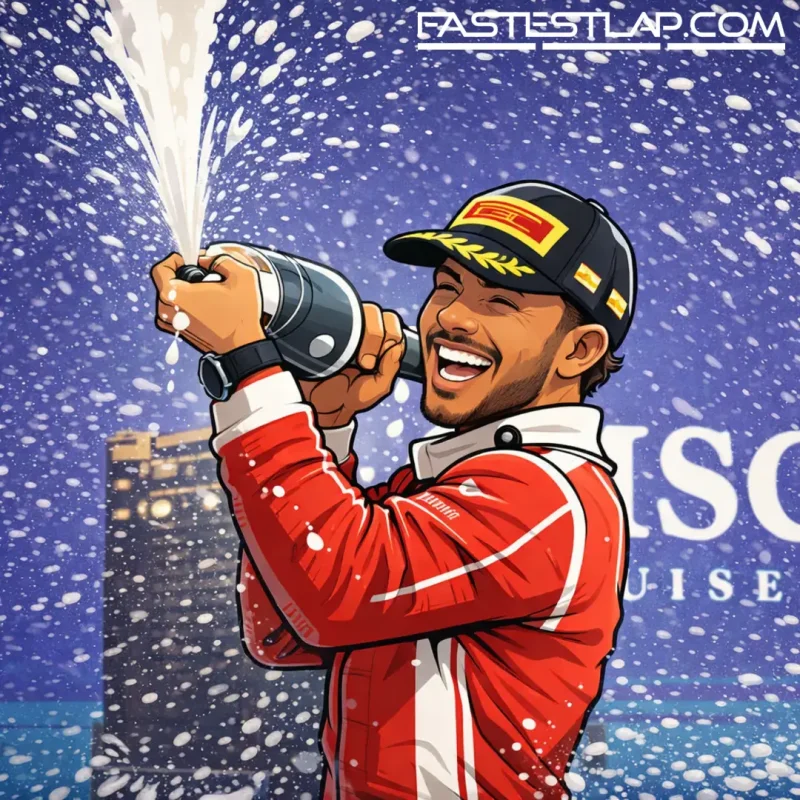
Lewis Hamilton didn’t just win in Barcelona — he hijacked the narrative.
For the past couple of seasons the paddock’s background noise around Hamilton has been the same: flashes of the old brilliance, sure, but not the sort of sustained, emphatic Sundays that close the case. In Spain, he closed it in 92 minutes and 28 seconds with a drive built on the kind of conviction you only see from a driver who’s stopped asking permission.
Ferrari set the tone before the lights even went out by committing Hamilton to the soft tyre and, with it, to an aggressive three-stop that instantly put Mercedes on the back foot strategically. George Russell had pole and early control on the medium, and Kimi Antonelli looked comfortable enough shadowing the lead group — but Hamilton’s race wasn’t about sitting in line and waiting for a “normal” Grand Prix to come to him. He boxed on lap 11 and effectively vanished into his own event: short, violent stints, full attack, no compromise on pace.
There was a stretch where Mercedes sounded more preoccupied with Lando Norris in their mirrors than the Ferrari ahead, which told you plenty about how unexpected Hamilton’s trajectory was becoming. He was creating his own margins, and when the opportunity to be theatrical arrived, he took it — the pass around the outside of Oscar Piastri was the sort of move that doesn’t happen when a driver is merely managing a result. It happens when he’s feeling the car and, more importantly, feeling himself again.
The Virtual Safety Car later in the race didn’t create the win so much as formalise it. Even without that timing break, the underlying point remained: Mercedes’ conservatism on a two-stop was always going to be vulnerable once tyre degradation became a real factor, and Barcelona finally delivered a race where the tyres mattered. Hamilton has made a habit of punishing cautious calls at this circuit before — ask Max Verstappen about 2021 — and in 2026 it was Mercedes who watched a Ferrari disappear up the road on fresher rubber.
The more interesting layer, though, is what this suggests about Ferrari’s internal shape. Fred Vasseur was keen to frame the progress as collective, and that’s fair, but it’s hard to ignore how alive the Hamilton operation suddenly looks. The chemistry between Hamilton and Carlo Santi on the radio sounded immediate: animated, encouraging, sharp. Hamilton has spent years with a familiar voice in his ear and, whatever the technical competence of the previous set-up, this one feels like it’s giving him the kind of emotional bandwidth he thrives on. Santi joining him on the podium — his first since helping Kimi Räikkönen’s last win in Austin in 2018 — was a neat snapshot of a partnership clicking in real time.
And Hamilton, almost mischievously, signed off the performance with fastest lap on lap 44. Not necessary. Entirely the point.
Mercedes left Spain with a haul of frustration packaged as damage limitation. Russell, to his credit, didn’t try to dress it up. Yes, he clawed 18 points back on Antonelli in the standings, but that was circumstance, not leverage: Antonelli’s power unit failure spared Russell the more uncomfortable headline of converting pole into third.
Russell’s first stint was clean and controlled, and on the medium he did what you’d expect from a front-row starter. The issues began when the race moved onto the hard tyre. Russell simply didn’t have Antonelli’s pace, and in trying to protect track position he ended up bleeding time — not only compromising his own race, but also delaying the Mercedes pair enough that Hamilton’s alternative strategy became a threat even before the VSC shuffled the deck.
Russell’s post-race comments were unusually revealing: he all but admitted the early stop wasn’t the one he’d choose “in a race on my own”, and floated that mirroring a three-stop might have been smarter — while acknowledging the fear of leaving himself exposed if Antonelli stayed on two. It was a rare glimpse of a driver caught between racing to win and racing not to lose to the car in the other garage. Right now, that’s the story of his season.
As for Antonelli, he somehow managed to be both winner and victim of the afternoon. After being dropped early, he reset, let the race come back to him, and then latched onto Russell with increasing authority through the middle phase. He didn’t force anything silly; if anything, he was arguably too patient, and you can’t help wondering whether being stuck behind Russell cost him the track position that might’ve mattered when Hamilton re-entered the picture.
Still, Antonelli did what top drivers do: he found a way past. His pass on Russell was brave and precise — and then, moments later, his car shut down and the whole debate became hypothetical. The disappointment looked real, but not crushing. That’s telling. He knows what he’s building, and every weekend like this chips away at the idea that Russell is simply the established “future champion” at Mercedes and Antonelli the talented apprentice.
If there was a loser in the midfield, Nico Hülkenberg’s DNF deserves its own category. Audi’s season continues to look better than the points suggest, and Spain was another case of performance being mugged by randomness. Hülkenberg’s explanation was almost absurd: a stone kicked up by Liam Lawson’s wheel at Turn 12 triggered the emergency switch on the rollhoop and effectively killed the car. He coasted in, bewildered, and the points window closed. Lawson finished ninth, which only sharpened the sense that Audi left something on the table.
Red Bull, meanwhile, had a quietly productive day even if the headline outfit didn’t. Max Verstappen never really looked like a podium threat — the RB22 seems quick enough to live above the midfield but not enough to hassle the front three — yet the wider picture for Red Bull Powertrains was healthier: all four RBPT-powered cars ended in the top 10 on a circuit that exposes power and efficiency. Isack Hadjar salvaged a messy start with an overtaking-heavy recovery drive, and Racing Bulls banked a double points finish, helped along by a post-race penalty for Franco Colapinto.
Williams’ weekend had the drained feel of a team enduring, rather than competing. Barcelona was always going to be brutal given the car’s current limitations, and Alex Albon looked unusually downbeat. Knocked out in Q1 while Carlos Sainz reached Q2, Albon’s Sunday effectively became a test session after an onboard camera issue forced a stop anyway. There was mention of aberrant behaviour that he suspected was mechanical, but with parc fermé limiting options, the priority shifted from points-hunting to understanding what they’ve got.
Alpine provided the counterpoint: a difficult car, a messy Saturday, and then a clean, opportunistic Sunday. Pierre Gasly admitted he’d have snapped your hand off for seventh after qualifying, even though the same odd braking behaviour — a yawing instability — didn’t fully disappear in the race. The difference was that in the heat and degradation, Alpine’s pace and a well-timed two-stop played into their hands, with the VSC helping Gasly shake Lawson at just the right moment. It’s becoming their thing: the drivers complain, the car bites, and they still walk away with points.
Aston Martin, though, was the weekend’s grim punchline. Both cars retired with mechanical problems — Fernando Alonso’s tied to the power unit’s battery side, Lance Stroll’s to the gearbox — and even before the failures the car looked nowhere. The mood was sour and it spilled into the media pen, with Stroll bluntly dismissive after outqualifying Alonso, and Alonso himself describing what he felt was the “worst engine and worst car” on Saturday. Mike Krack’s post-race apology to the sea of green-shirted fans said it all: this was a home race that felt like an away fixture.
Barcelona tends to reveal truth because it demands everything. This year it revealed a few, some uncomfortable — and one that Ferrari will happily live with: Lewis Hamilton is not a heritage act. Not if the car stays close enough, and not if this version of the Ferrari garage keeps feeding the part of him that still wants to take chunks out of races rather than simply survive them.









