Lewis Hamilton has always insisted the most dangerous moment in a new relationship is the first win — the point where relief turns into expectation. Barcelona felt exactly like that for Ferrari.
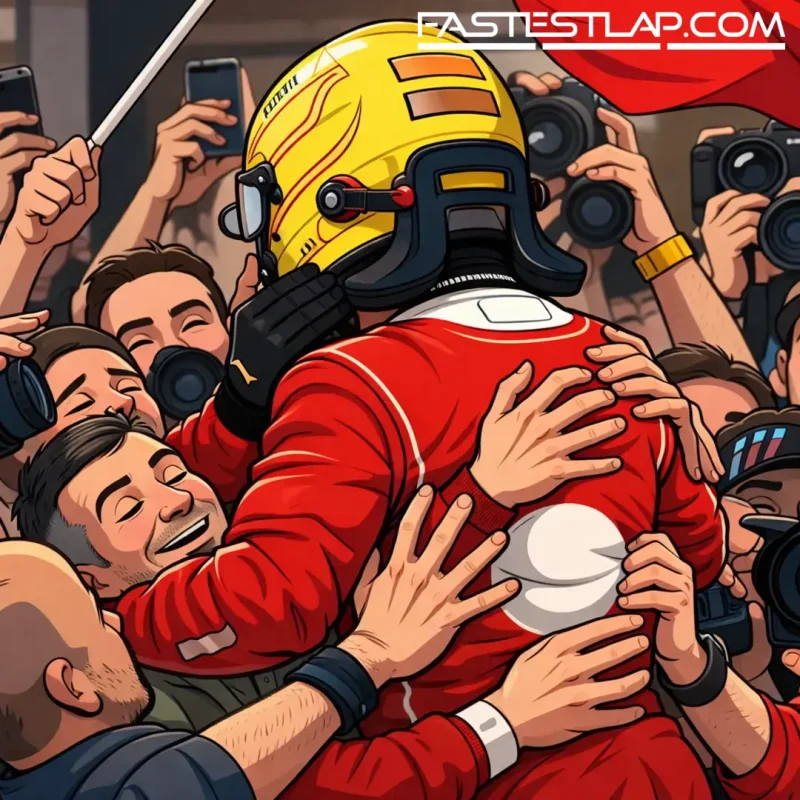
After two straight second places, Hamilton finally ticked the box everyone in Maranello had been waiting for: his first grand prix victory in red, and the 106th of his career. He left Spain not just with a trophy, but with a different kind of currency inside Ferrari — the sort that changes how people talk in meetings, how quickly a factory reacts to a request, and how much the team starts to believe the ceiling has moved.
Rob Smedley, who spent nearly a decade inside Ferrari’s machinery between 2004 and 2013, says that belief has landed with a thud in all the old familiar places: the engineers, the mechanics, the people who pride themselves on not getting carried away.
“I’m on lots of chat groups with all of my old colleagues, and they’re all over the moon with Lewis,” Smedley said on the *High Performance Racing* podcast. “They just love him.”
That’s the part worth sitting with. Ferrari can be the most intoxicating environment in F1 when it’s winning, and the most suffocating when it isn’t. Hamilton didn’t go there for comfort; he went because the upside is unique. When Ferrari buys into a driver, it’s not merely a professional partnership — it becomes a mission. Barcelona looked like the first proper ignition of that.
Smedley’s read is that Hamilton’s influence is only going to grow if the results keep coming. The wider paddock has always understood Hamilton’s professionalism, but Smedley leaned into something Ferrari people tend to value more than reputation: the grind, day after day, even when the payoff isn’t immediate.
“He puts so much effort in,” Smedley said. “People always misunderstand Lewis because of the shell that he’s created around himself of his public persona… but this is a guy that — funnily enough, Max [Verstappen], Lewis, Michael [Schumacher], Sebastian [Vettel], all of those guys who are greats — they work harder and put more of themselves into it to get to the positions that they’re in.”
It’s a familiar theme among those who’ve worked on the inside: the very best aren’t the most talented in a clean-room sense; they’re the ones who treat the job like a compulsion. And Ferrari, for all the romanticism that surrounds it, is a team that responds to obsession. Not because it’s glamorous, but because it’s contagious.
Smedley went a step further, floating the comparison Ferrari people can’t avoid once a champion starts winning there: Michael Schumacher. It’s not the easiest name to invoke in Maranello — and it’s not something the team itself tends to do out loud — but it’s always there in the background as both inspiration and burden.
“We talked about this,” Smedley said. “This could be a Michael story.”
That’s not a prediction, and it’s certainly not a promise. It’s an observation about the way narratives form at Ferrari once the door cracks open. Schumacher’s era wasn’t built on a single breakthrough; it was built on accumulation — of trust, of authority, of operational sharpness, of a team slowly bending itself around a driver’s demands because the evidence kept stacking up.
Hamilton, understandably, has urged caution about Ferrari’s trajectory. He knows better than most how quickly the sport can flip from euphoria to frustration. But momentum is a real thing in Formula 1, especially when it starts to affect the internal mood. One win doesn’t guarantee anything. What it does do is remove the last easy excuse for scepticism: *maybe it won’t quite happen for him here.*
Now it has.
The more immediate reality is that the title fight remains an uphill chase. Hamilton heads to the Austrian Grand Prix second in the standings, 41 points behind championship leader Kimi Antonelli. That’s not insurmountable, but it’s also not a gap you erase with vibes and nostalgia. Ferrari need repeatability, not a highlight reel.
Still, Barcelona mattered because it changed the tone. It’s one thing to join Ferrari as a seven-time world champion with a global brand and a lifetime of experience. It’s another to validate the whole project in the way Ferrari’s workforce feels most acutely — on a Sunday afternoon, when the garage erupts and the pit wall suddenly looks ten years younger.
Smedley’s point, essentially, is that Ferrari’s affection is there for the taking — but it comes with a condition.
“Lewis, if he can get on top of the car and he can lift the team, and he can start winning races, and he can guide them towards world championships,” he said, “they will absolutely love him.”
At Ferrari, love is never quiet. And once it starts, it tends to get loud fast.