
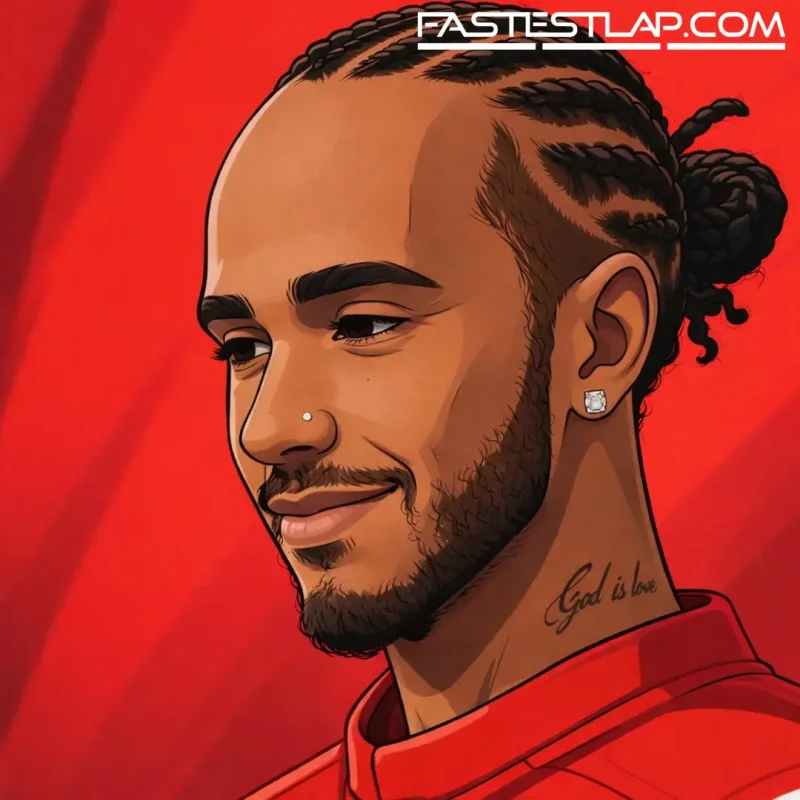
Lewis Hamilton has spent most of his career leaning on feel and feedback more than fashionable tools, so perhaps it shouldn’t be a shock that he’s now drawing a line through Ferrari’s simulator programme. But doing it publicly — and framing it as “too risky” — is the sort of statement that lands with a thud inside a modern F1 team, particularly in 2026 when the cars’ powertrain management has become one of the most sensitive performance levers of the lot.
Hamilton’s complaint in Miami was blunt: the sim wasn’t helping, and what he was learning from it wasn’t matching what he was driving on track. The car “felt different”, and after a run of weekends where his preparation wasn’t translating into lap time, he decided to opt out of simulator work ahead of Canada.
Then came the complication for everyone trying to make sense of it: Montreal was easily his most convincing weekend in red. Hamilton finished second — his best result since joining Ferrari — and did it emphatically enough to finish 30 seconds up the road from Charles Leclerc at the flag. One data point, yes, but the kind that can harden into belief very quickly when a driver is searching for something stable to trust.
Hamilton, unsurprisingly, didn’t sound like a man planning a swift return to the rig.
“Whether or not I use it to prepare for another race? Probably not,” he said. “There are just too many risks. If you look at the two best races I’ve had, I didn’t use a simulator and that’s honestly how it was. Pretty much all the championships before, except for probably 2008, I didn’t use the sim, so it’s not a necessity.
“It’s a tool that can be powerful, but, for me, I’m old school. I’m probably better without it.”
Inside Ferrari, the reaction — at least as described by former Ferrari race engineer Rob Smedley — was less outrage than a weary acceptance that this is part of the Hamilton package in year one. Smedley, speaking on the High Performance Racing podcast, said he’d spoken to people at the team who “shrugged their shoulders” when asked about it.
That image is telling. A shrug isn’t agreement; it’s an acknowledgment that picking a fight over it probably isn’t worth the energy when the bigger issue is getting Hamilton consistently comfortable in the car. The politics of it are delicate, too: if the seven-time champion feels the sim is pulling him towards set-up directions he doesn’t like, Ferrari can either force the process and risk losing the driver, or let him work his own way and accept a degree of operational untidiness.
Smedley, though, wasn’t buying the certainty Hamilton is projecting — and neither would any engineer with a spreadsheet and a healthy fear of coincidence.
Hamilton, Smedley explained, “refused to go and do his work on the simulator pre-Canada” because he had a notion it was “dragging him in directions that he didn’t like”. The problem, as Smedley put it, is that “of course, he has a sample size of one. All of a sudden, it’s statistically true that if you don’t go on the simulator, you’re on the podium.”
It’s the classic racing trap: the moment you change something and results improve, the change becomes the reason — even when the weekend’s outcome is always the sum of a dozen shifting parts, from tyre behaviour to track evolution to traffic in qualifying.
Otmar Szafnauer made essentially the same point, with the sort of dry realism that tends to irritate drivers and calm engineers.
“It’s not a controlled experiment,” the former Alpine team principal said. “Had I gone on the simulator, would I have won the race? Not saying you would, but it’s not a controlled experiment.”
In other words: maybe Hamilton finished second because he binned the simulator. Or maybe he’d have been faster still if he’d used it properly. You can’t run the weekend twice, and you can’t separate cause from comfort as neatly as the human brain wants to.
What gives the debate more bite in 2026 is the technical backdrop. With these cars, energy deployment and power unit management are no longer background tasks. They’re central to lap time, tyre life, and racecraft, and they’re deeply sensitive to tiny differences in how you approach phases of the lap. Szafnauer said a conversation with an Alpine engineer underlined how much more delicate the system now is compared to previous eras.
Smedley was even more direct: “It’s massive. Everyone you talk to up and down the pit lane. It’s very sensitive, it’s very, very critical in terms of management. So the simulator is very helpful, but you also need all of it. You can rehearse a certain situation as much as you want, but it’s the edge cases that catch you out. So you need to have a really good understanding.”
That’s the crux. The sim isn’t just for finding a set-up direction; it’s for rehearsing scenarios you can’t reliably replicate in free practice — awkward deployment windows, changing grip levels, the sort of “why did it do that?” moments that decide races. If Hamilton steps away from it entirely, Ferrari will need another way to cover that preparation, whether it’s more detailed engineering briefings, different correlation work, or simply accepting that Hamilton’s racecraft and adaptability will compensate.
For Hamilton personally, the decision reads like a bet on instinct over infrastructure — and it’s a bet he’s comfortable making because it’s how he’s always operated at his best. But it also puts pressure on Ferrari’s processes: they can’t afford a split programme where one side of the garage is living in the simulator and the other is effectively running on veteran intuition, not with a tight championship fight and a team-mate who will happily use every tool available.
As it stands, Hamilton is fourth in the Drivers’ Championship on 72 points, three behind Leclerc, and 59 adrift of leader Kimi Antonelli. That’s not a deficit you close by winning an argument about philosophy; you close it by stringing together weekends where preparation, set-up, and execution all point in the same direction.
Canada suggested Hamilton has found a route to that alignment. The next few races will decide whether it’s a repeatable method — or just the sort of one-weekend clarity that Formula 1 has a habit of handing out right before it changes the question again.









