Lewis Hamilton didn’t sound like a driver searching for comfort after a difficult Sunday in Miami. He sounded like someone trying to steer Ferrari’s development conversation in a very specific direction.
The seven-time world champion left the Miami Autodrome convinced the Scuderia has missed something on the front wing – not in the broad, “we need more downforce” sense, but in the more uncomfortable way that suggests rivals have stumbled onto a particularly valuable interpretation of what the current regulations allow. In Hamilton’s view, McLaren, Mercedes and Red Bull are all arriving at similar answers, and Ferrari’s is simply different.
It’s a pointed claim coming after a weekend that was supposed to reset Ferrari’s momentum. The team unloaded in Florida with a sizeable upgrade list – 11 new parts in total – including a revised front wing endplate and, at the back, the updated ‘Macarena’ rear wing. On paper, that’s the sort of package that should move the needle, and there were fleeting hints it might: Charles Leclerc topped the only practice session.
But that turned out to be Ferrari’s lone moment at the sharp end. When it mattered, the SF-26 couldn’t hold the front-runners, and the team’s recent run of podiums ended abruptly. Leclerc’s race unravelled late – he was already outside the top three before a last-lap spin dropped him to sixth, then a post-race penalty pushed him down to eighth. Hamilton followed him home on the road in seventh.
The more painful context for Ferrari is what happened around them. McLaren looked the more complete challenger to Mercedes, with Lando Norris and Oscar Piastri flanking race winner Kimi Antonelli on the podium. Red Bull also took a clear step forward: Max Verstappen produced his best qualifying of the season with second on the grid, underlining that the team’s Miami update did what it was supposed to do.
Both McLaren and Red Bull arrived with their own development pushes – seven new parts each. Red Bull’s list included a front wing revision that changed all three elements and the endplate, aimed at increasing load and improving flow stability. McLaren’s Miami package also leaned heavily on the front wing, with endplate changes as part of a “next-level” concept.
Hamilton, watching those gains stack up against Ferrari’s more modest progress, didn’t hide what he thinks Ferrari should be doing next.
“Mercedes did bring improvements, just not the same as others,” he said. “They had like two and we had, I don’t know, eight or something. Their package is coming next race.
“The team [Ferrari] worked incredibly hard to run those components, and it has taken a step, but the others have also taken a step.
“I heard McLaren brought a step, but that it was worth much more than they anticipated. That’s not how we’ve experienced ours. So definitely they’re doing something different.
“Mercedes, McLaren and Red Bull are doing something different with the front wing to us. So we need to look into that to see whether or not there’s something we can improve on.”
What makes that interesting isn’t the usual post-upgrade frustration; it’s the implication that Ferrari’s aerodynamic philosophy may be leaving lap time on the table in an area that’s become disproportionately influential. In 2026, with teams fighting for performance in increasingly fine margins, front wing behaviour dictates far more than initial turn-in. It sets up the car’s platform, it shapes the flow that the rest of the floor and bodywork live or die by, and it can decide whether a driver has the confidence to lean on the entry phase or spends the whole lap waiting for the front axle to “arrive”.
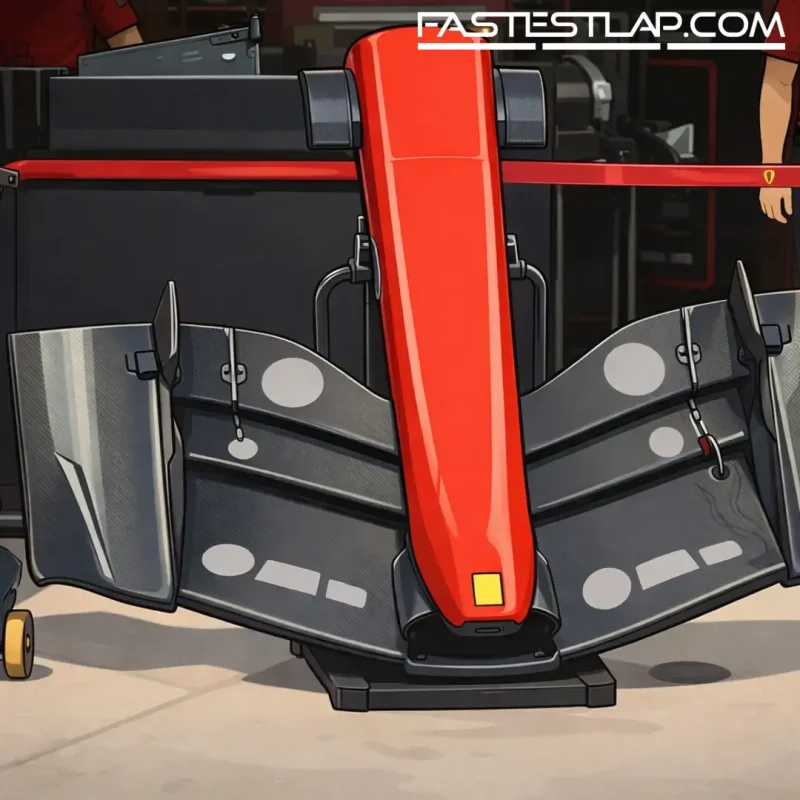
Hamilton also hinted at something else: that the visual differences are obvious enough to be worth an immediate deep-dive.
“Just look at everyone else’s wing and look at ours, you’ll see it looks different,” he said when asked to explain what he was seeing.
“I don’t know if that’s necessarily the whole thing, but I wonder what that’s doing, because others seem to have it and they improved.”
There’s a certain Hamilton logic at play here. He’s never been shy about calling out where he thinks performance is coming from, and he’s typically direct when he believes a team is circling the right answer rather than committing to it. The subtext is simple: Ferrari can bolt on as many new parts as it likes, but if the front-end concept is lagging behind the best ideas in the pitlane, it’s going to keep losing the same fight every weekend.
It also folds neatly into what’s been bubbling around the paddock since earlier in the year, when Mercedes’ front wing drew attention at the Chinese Grand Prix. On that occasion, Kimi Antonelli’s wing appeared to show a multi-stage transition between the car’s straight-line and cornering modes. Mercedes later explained it was down to a hydraulic pressure issue, not an intentional design feature – but it did highlight how much scrutiny front wing behaviour is attracting, and how quickly rivals will pounce on anything that looks like a breakthrough.
For Ferrari, Miami is now less about one messy race result and more about what the data says the upgrade actually delivered. The team did take a step, Hamilton insisted, just not a step that changes its weekends. And in a season where McLaren can bring a front wing package and immediately look like Mercedes’ nearest threat, “a step” isn’t the currency that matters.
The uncomfortable question is whether Ferrari can afford to iterate gradually here, or whether it needs a sharper pivot – the kind that only happens when a senior driver makes it clear the benchmark has moved and the team must follow. Hamilton has, in effect, drawn a circle around the front wing and told Ferrari’s engineers: start there, and start yesterday.